Note
The Russell Shuffle
A quiet corner of small-cap bank investing: uplist an OTC bank to Nasdaq, land in the Russell 2000, and a mechanical buyer appears. Research and education, not a recommendation.
There is a very straightforward corner of bank investing that most people outside the industry would never know exists.
A note before we start. I am not doing this. This is not a recommendation. Do your own due diligence, and assume the professional bank investors who do this full time already know every name below and may already be positioned.
But it goes a little something like this.
Find undervalued OTC, or over-the-counter, bank stocks that appear large enough for Russell 2000 inclusion. Then check whether they could qualify for Nasdaq, especially its market, public-float, shareholder, governance and liquidity requirements.
The liquidity test is the first easy screen. For a company previously quoted over the counter, Nasdaq generally requires at least 2,000 shares of average daily volume over the 30 trading days before listing, with volume on more than half of those days. There is a qualifying underwritten-offering alternative.
If a bank fails that screen, a split is not automatically required. It needs more qualifying volume. That could come organically, from a forward split followed by a fresh 30-session window, or through another permitted route.
Then comes the calendar. Uplist before the Russell ranking date, remain eligible when the preliminary lists are built, and make the final cut.
If that happens, funds that replicate the affected Russell indexes need exposure. That creates a mechanical buyer. It does not guarantee a higher price, and it certainly does not mean every fund waits until the effective date.
The three completed bank examples in this sample uplisted in 2025 or 2026 and entered the Russell 2000 in June 2026. From the first Nasdaq close to the first preliminary Russell list, their returns were 62.8%, 30.3% and 12.5%. Median: 30.3%.
Small sample. Useful precedent. Not a law of finance.
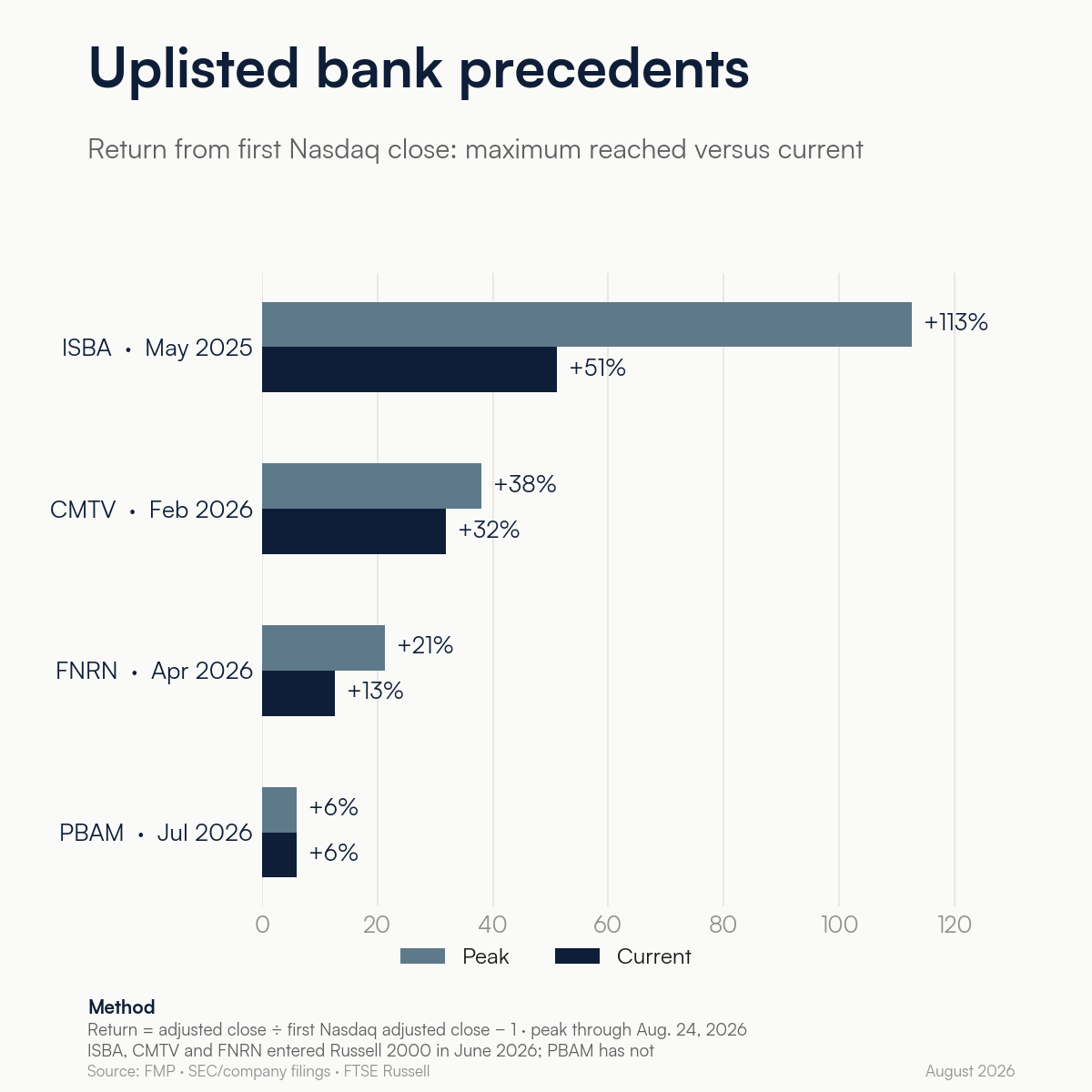
ISBA, CMTV and FNRN all outperformed KRE from their first Nasdaq close through August 24, 2026. Most of the appreciation happened before effective inclusion. The data shows what prices did. It cannot prove forced buying caused the move.
PBAM is already uplisted but had not entered the Russell 2000 as of August 24. The names below are selected possibilities, not confirmed uplist candidates. I found no public evidence that management at any of them intends to uplist.
Sharp eyes will catch FFBB. Its bank subsidiary remains under a January 2025 FDIC and California consent order covering Bank Secrecy Act and anti-money-laundering controls. The company says it is working through remediation, and reported another $321,000 of related consulting costs in the fourth quarter of 2025.
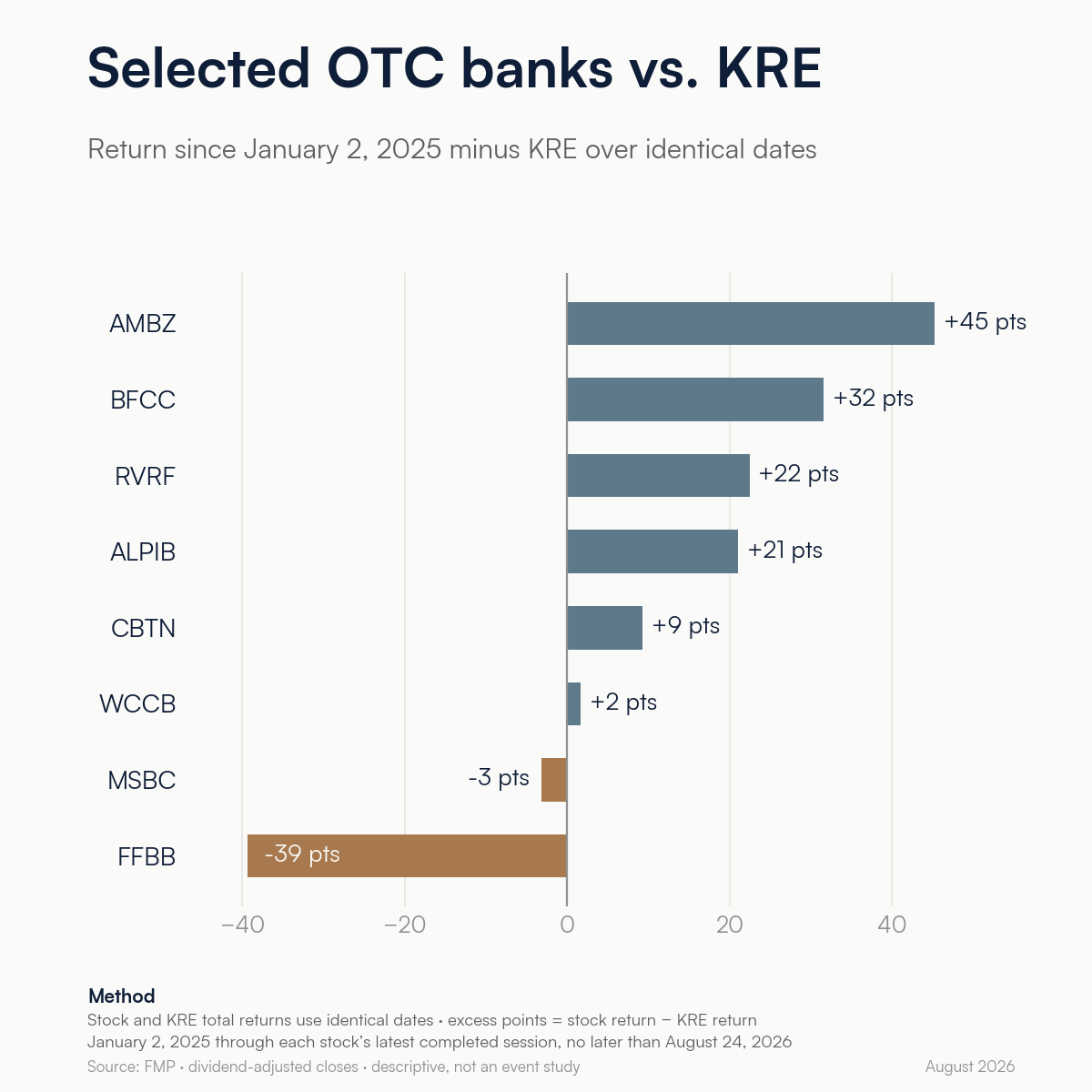
And liquidity matters twice. It matters for Nasdaq eligibility, then it matters to you.
At only 10% to 20% of trailing dollar volume, building a $500,000 position would take roughly 8 to 16 trading days in ALPIB. The same math says 986 to 1,972 days in RVRF. Yes, years.
Only ALPIB, AMBZ and WCCB currently pass our simple OTC volume screen.
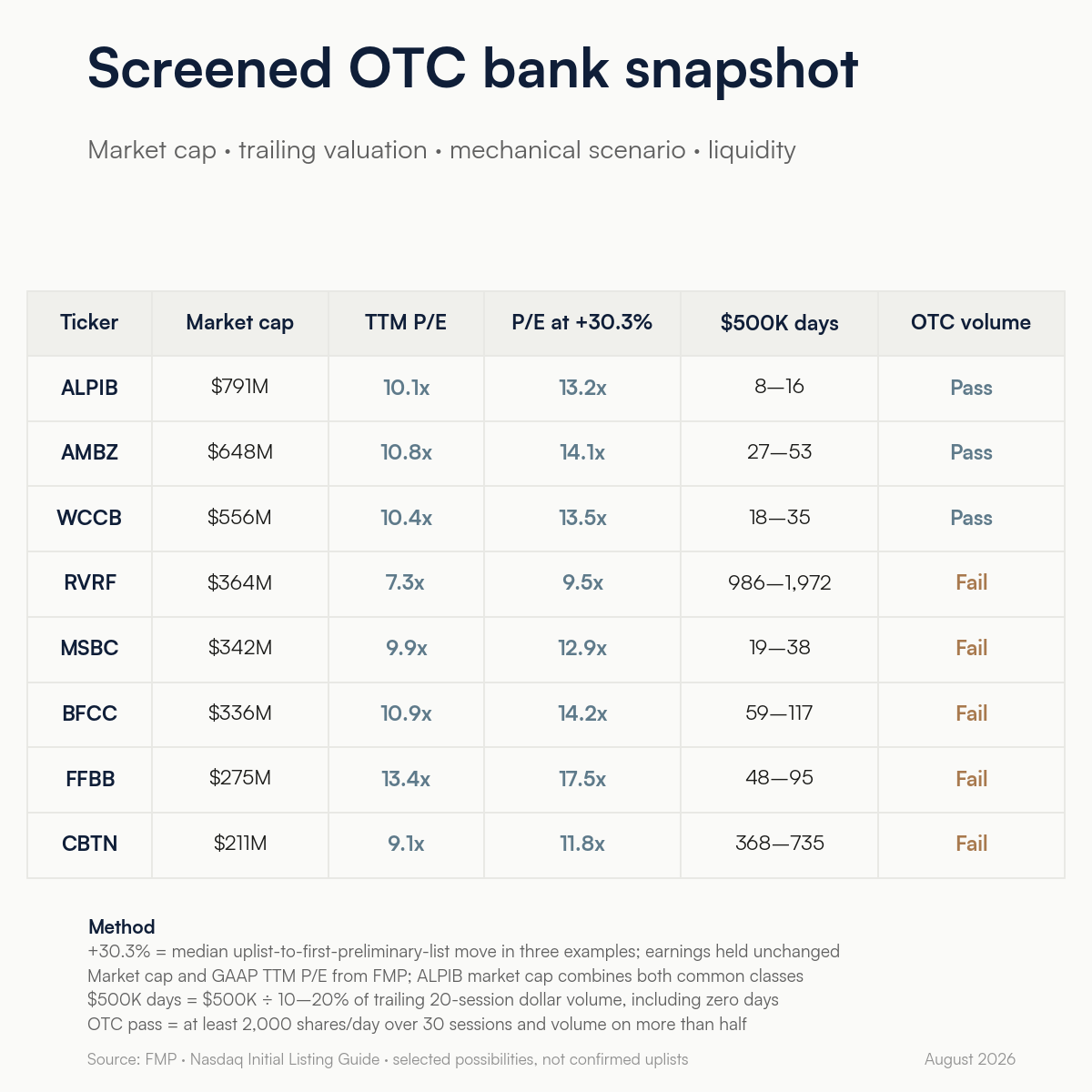
And if we start swagging, a CFA term, the 30.3% historical median onto today's prices while holding earnings flat, the resulting P/E ratios run from 9.5x to 17.5x. Some still look reasonable. Some become outright expensive.
So be careful. There are several ways for this to fail: no uplist, a missed ranking date, a volume failure, a Russell eligibility failure, a valuation that already discounts the move, or simply no incremental buyer left by the time you arrive.
Now you at least know about the Russell Shuffle in small-cap banks.
Sources and method
Nasdaq eligibility language comes from the Nasdaq Initial Listing Guide. Russell event status and dates use FTSE Russell notices. Adjusted prices, market capitalizations, GAAP trailing P/E ratios and session volume use Financial Modeling Prep data through August 24, 2026. The 30.3% figure is the median of three observations, measured from each bank's first Nasdaq close to the first preliminary Russell list. It is descriptive, not a forecast.
FFBB's order is the January 7, 2025 FDIC and California consent order. Remediation cost is from FFB Bancorp's fourth-quarter 2025 results.
Research and education only. No position is being taken here. Do your own due diligence.