The Price Is Right, The Timing Isn't
Two optically cheap names. One a payments company with a lending book and fancy airport lounges. Another likely the cheapest large cap ever.
A short letter this time covering two names, because they don’t all need to be long.
American Express and Charter.
Both of them passes.
American Express (AXP)
Amex? Yes. The reasons are pretty cut and dry.
It’s literally a wonderful company, trading around 19x 2026 EPS for a 34% ROE and with expectations of low to mid teens growth. I actually put this in the “great company” but fair price bucket, which Munger famously talks about buying.
It looks even cheaper when you consider the fact that Visa and Mastercard trade in the 30s range, but that friends is where the tourist fins investor gets it wrong. Amex trades cheaply because of its credit book. And the primary reason for my “pass” on AXP at this point is that they are too good at credit.
2% write-offs and 1.2% delinquencies as of MRQ is unheard of good.
And by my tally, we are either 16 years (GFC) or 6 years (COVID) into one of the literal greatest consumer credit environments known to man. Sure credit is great, but there’s literally no chance for write-offs or delinquencies to go negative. Plus, I’ll remind you young investors that in 2009 AXP charged off 10%, right at industry levels despite their upper K borrower profile.
You don’t even really need a credit blowup for AXP to underperform the financials sector (XLF or Payments). All you would really need is a reversion to the pre-2019 norm which would hit earnings on the losses and CECL reserve build front. And most recently, Q2 2026 flipped to a reserve release, so EPS now is actually collecting a bit of a tailwind.
Bulls not passing would tell me that 70% of revenue is fees, and they’re right. Bulls would also tell me the mini 2022-2024 credit cycle led by higher rates did see AXP outperform names like COF or SYF. Both true.
Still, I have to pass on AXP from a risk/reward standpoint. This isn’t a short, it’s a candid pass that I will track over time.
Remember, the great returns in cyclicals come from buying peak stress.
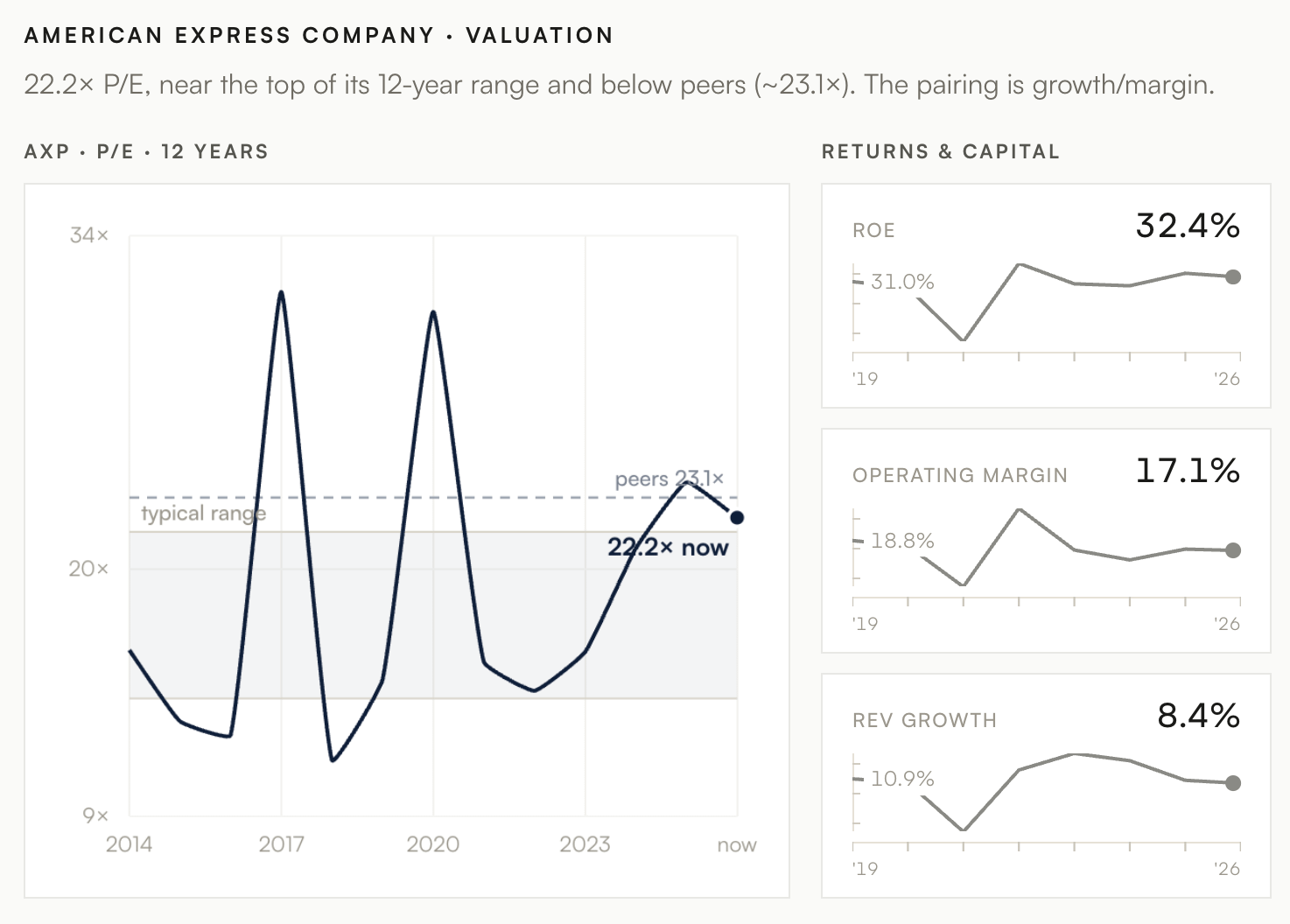
If you’re looking to learn more about Amex, you can find it at the Terminal.
Charter Communications (CHTR)
I’ve owned this in the past and like almost all shareholders, I’ve participated in my share of tax losses and bag holding.
Despite their buy back driven beat just the other day, this is one of, if not the cheapest stocks out there. 3.5x earnings and a 22% FCF yield. Almost as cheap as Hynix! But as Lee Corso says, not so fast! Equity is only 17% of the EV and if you ran FCF on EV yields would be closer to 4%, well below Comcast’s 12%.
To start with, a big reason I’m passing is because I’m not very good at Communication Services going back to 2024. I regularly do backs and as you can see I do much better in other spaces.
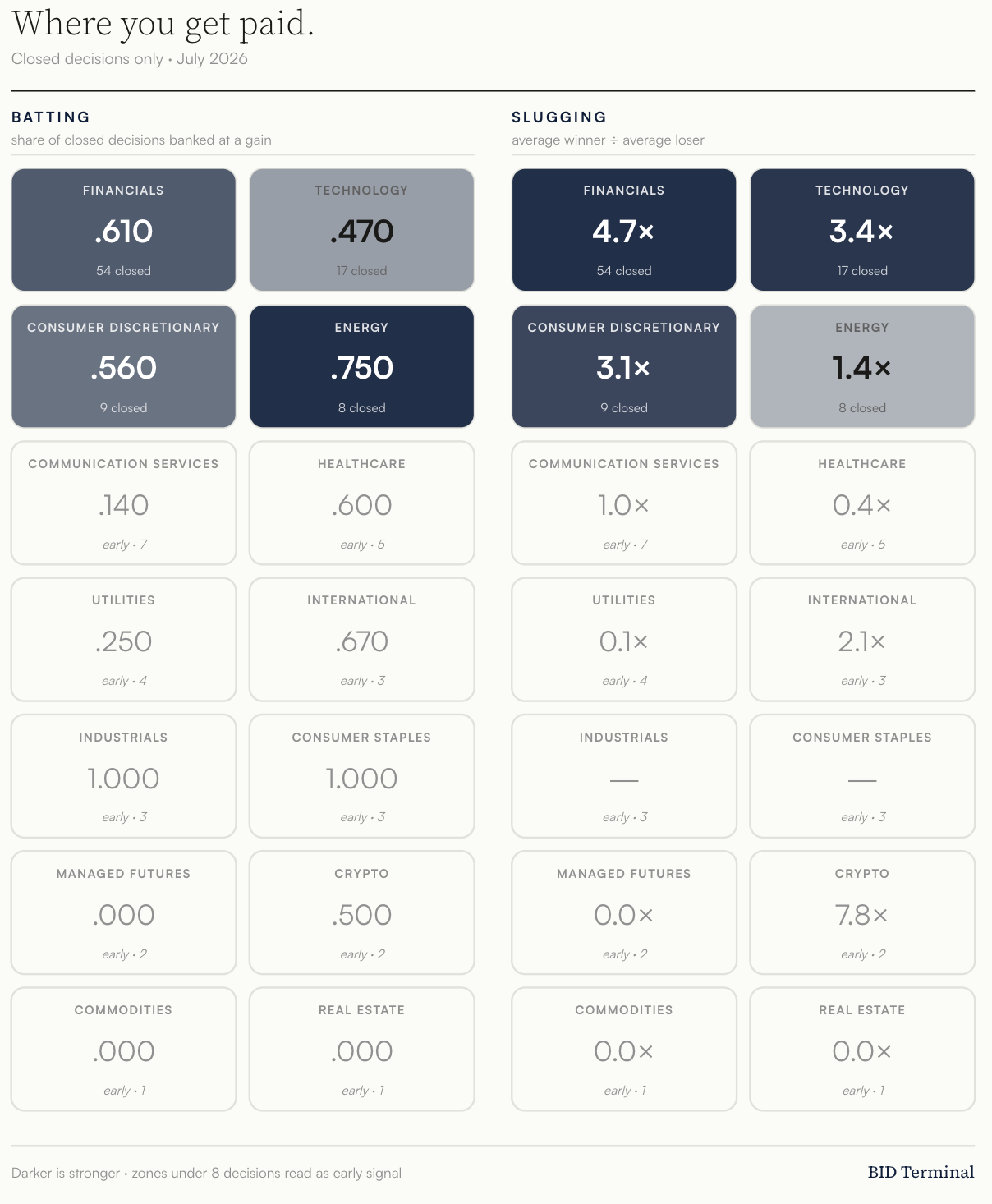
If you’re looking to run your own Circles of Competence, you can find it at the Terminal.
Why else am I passing on CHTR?
There’s no denying the risk/reward is very good. Convex in your favor. We’re talking a potential triple or more against a 50% to 75% drawdown from here.
The problem is what the bet rests on. Residential internet, just under 43% of revenue and by far their best margin business, turned negative last quarter at -3.2%. To own this you need that line to stabilize, or knowledge of future stabilization that I don’t have.
And note that word: revenue, not subscribers. The price war shows up twice and lost customers are just the most visible wound. Cheaper bills for the customers who stay are the quiet one. Charter has been forced to defend subscribers with promo pricing and mobile bundles, so revenue can keep falling even after the customer count stops. Pricing recovers last, because as long as T-Mobile sells $50 internet, Charter can't raise a bill. Management, for what it's worth, just guided broadband ARPU to improve sequentially in Q3 as retention offers roll off, so this test goes live in October. They have a literal physical moat, but that thing is under attack!
The bull case says CHTR has only two attackers though, one running out of ammo and one being met head on. T-Mobile and Verizon sell internet over spare room on their phone networks, and the spare room is fading. AT&T, and Verizon via Frontier, bury new lines street by street, and that attack isn’t fading at all. AT&T is accelerating to 5 million new passings a year through 2030. The honest fiber claim is smaller: Charter’s own network upgrade finishes in 2027, which makes the fight survivable rather than over.
What bothers me about the bull case on its own terms is that the free cash flow ramp comes from Charter not building. Capex falls fastest when you stop defending the network, and that feeds the churn that kills the EBITDA the whole structure leans on. Bulls will say the capex decline is the upgrade completing, not defense stopping. Maybe. But the upgrade ends in 2027 and the competitors don’t.
If internet revenue decline narrowed inside 2% for two straight quarters, I’d re-evaluate. If you own CHTR already, you’re deep in DCA purgatory with all the cognitive dissonance that comes with it. Trust me, I’ve been in both spots far too many times to count. Today I am not. So I’d rather wait for the thesis to prove out fundamentally first.
For me to buy I’d be: knife catching, without a fundamental thesis in tact, outside my circle of competence. Pass it is.
Know thyself,
BID
The full AXP research, with the durability test and the verdict, lives in the Terminal: AXP research. 107+ companies and counting.