I'm Popular Now: How a Boring Bank Beat the Market
On 9/9 of last year I wrote up Popular (BPOP) and set a fair value band somewhere in the $115 to $125 range, with a bull case up towards $130-$135.
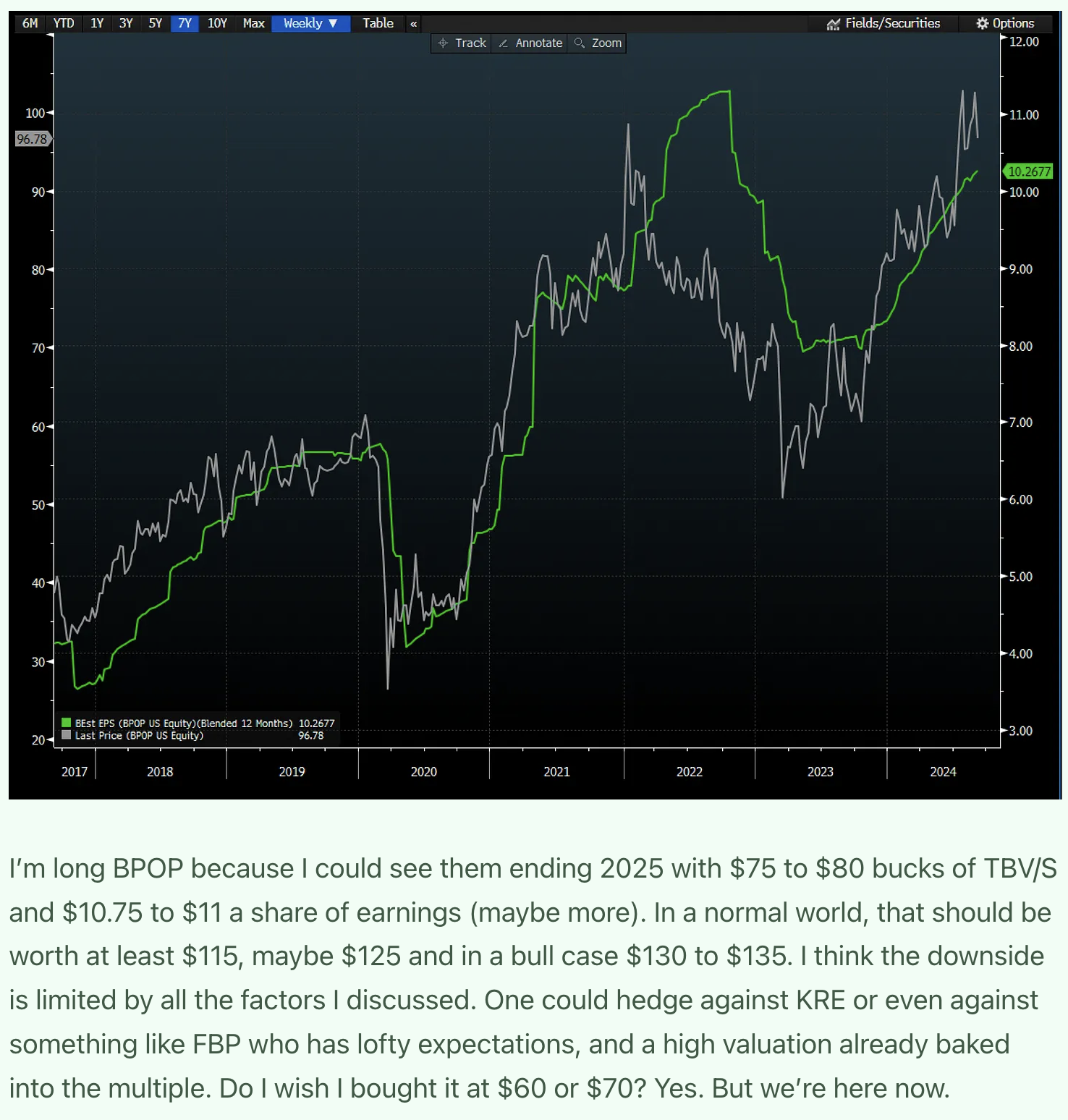
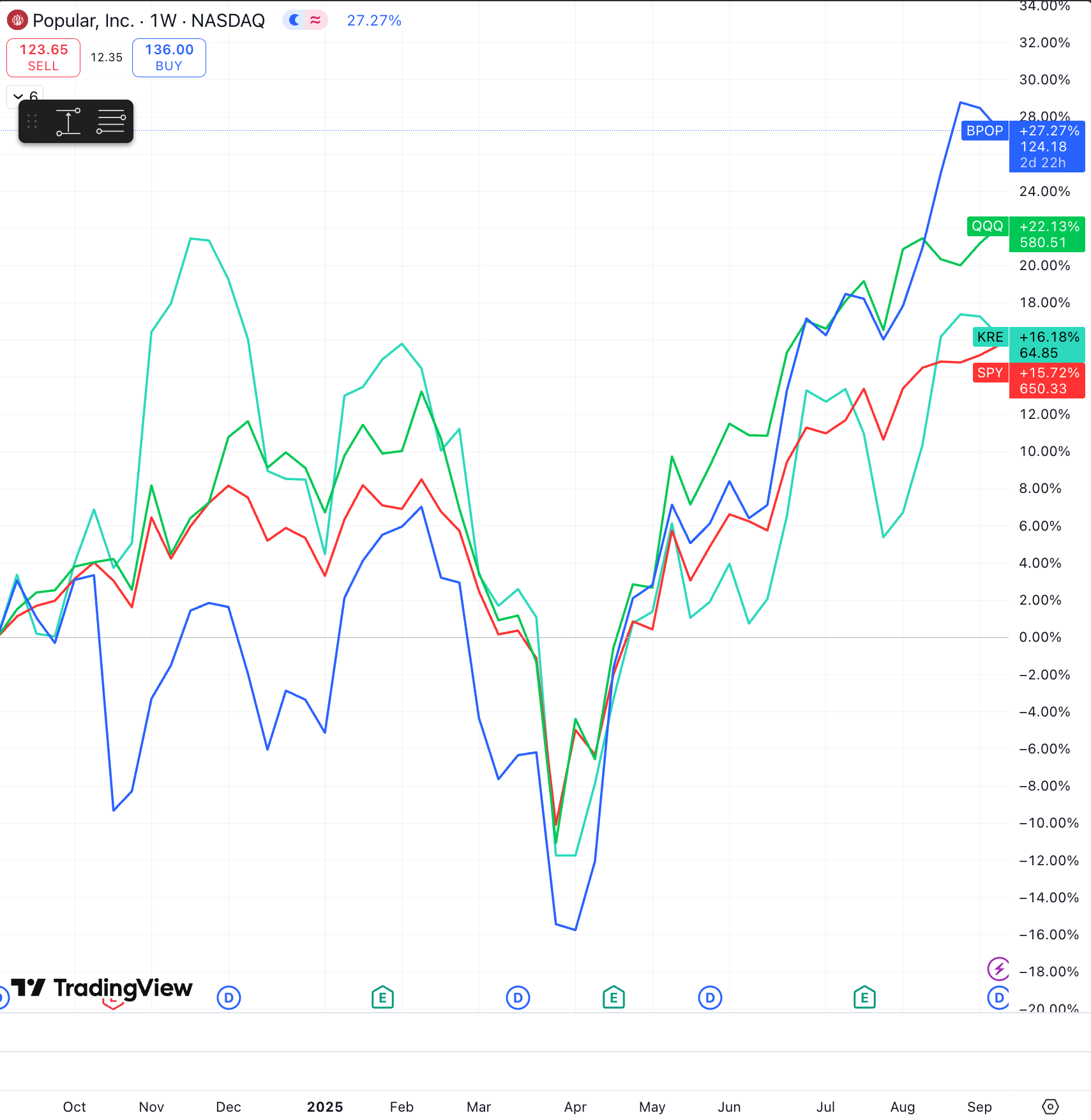
It’s funny to look back because you also get a lens into your psyche at the time of trades and investments. Back then I was kicking myself for seeing it, and not buying in when it was trading at $60 or $70. Fast forward to today and we got to $125 a few months earlier than expected. And it was done quietly, cleanly, and without drama I might add despite the siren calls of the bank doomers constantly jawboning about unrealized losses and CRE modificiations. But what you may not know is that this one actually beat the SPY, QQQ, and also the regional bank ETF KRE. BPOP was up 27% while QQQ did about 22%, KRE was up about 16%, and SPY 16% also. Even Wells Fargo’s latest research now echoes the framework I laid out back then, and they even gave a nod to Bad Bunny like I did.
For bank investors, the core idea was simple. Buy sleepy almost mechanical EPS growth at a beaten down multiple that no one was paying attention to. And I mean no one. The thing was barely noticed back then. Part of the mispricing came from positioning too, people basically just ignored Puerto Rico names.
But for me, the earnings trajectory was the tell. It’s a reminder that sometimes the cleanest setups are hiding in plain sight, simplicity is often the edge. 2024 EPS near $9 put you at roughly 11x. Street numbers for 2025 pointed to the low $11 range, which implied low 20% EPS growth at around 9x forward. Something did not add up because that is a multiple the market usually reserves for stalled franchises, not for a company stepping up earnings at that clip.
And now? Well now things look just as interesting.
Fresh estimates from Wells now carry $11.50 for 2025 and $13.20 for 2026, just shy of 15% for the year and not quite as appealing as last year, but still pretty good.
The balance sheet was built to be boring in the best way. Loans to deposits lived in the 50’s while the industry ran closer to the 70’s and in some cases well into the 80’s and 90’s. Their credit profile featuring elevated NCO’s and NPA’s from the hurrican felt scary but largely the credit buckets behaved. And the big deal for me was the fact that even if nothing changed, the securities ladder would roll about a billion dollars a month from 1% yields into 4% plus, which mechanically widens margin without stretching for risk. Add an all-in cost of funds that falls faster than peers in a rate-cut cycle and a CET1 stack above 16%, and you get flexibility to lift dividends and shrink the share count while you compound. Credit to management too, remember they hit their 12% ROTCE target two quarters early. When banks consistently deliver faster than promised it builds credibility. Oh, and that fixed asset repricing was then and still still is the heartbeat of the story. That’s not going away.
Back then BPOP traded around 160% of TBV while delivering a forward ROTCE path in the 15% range. At the time, peers with similar or lower ROTCE were getting up to 200% of TBV. And the AOCI drag masked fundamental book value, which made the true price to tangible capital even cheaper than it looked. It is worth noting that this hidden book value was not in long MBS, the type made famous by the SIVB failure, but rather shorter bullets with low yields, but predictable cash flows.
And then you had the capital return story. A fresh $500 million repurchase authorization paired with a higher dividend set the stage for heavy recycling of earnings to owners. With excess CET1 and modest organic growth needs, the flywheel then was and still is simple. Fewer shares, higher EPS, higher TBV per share, more room to buy again.
Being objective, if I had to say the thesis back then it was EPS growth cheap. And EPS growth that wasn’t built off some pie in the sky targets, just slow methodical repricing of securities couple with capital returns. The AOCI unwinds did the heavy lifting.
But what does this look like now. Because BPOP at $125 is a different beast than BPOP at $90.
Tailwind number one for BPOP investors now is that the growth in EPS still does not require a lot of brain drain. About $900 million per quarter of 1% bonds roll off and get re-invested into 4% plus yields. This creates a clockwork like march upwards in net interest income quarter after quarter. This gives it a bit of a multi-year EPS ramp that consensus still loves to hate on. Couple too with this that every underwater bond maturing takes AOCI and translates it into TBV accretion. So you also have a TBV growth story that happens not through anything crazy, but instead just the passage of time. A steeper yield curve, which is now consensus, does keep this story in check.
Tailwind number two is valuation. Even though it’s had a nice run up, it still sits at around 10x full year ‘25 earnings and just under 9x full year ‘26 earnings. The market is probably still discounting the projected high teens ROTCE next year a bit too much. And part of that is because it’s not sexy and because Puerto Rico always kind of seems like a bit of a crapshoot. But what this practically means is that a bank earning a near top quartile ROTCE is valued at 160% of TBV when others are valued more like 200% or higher.
Which in the spirit of brevity gets us to the last tailwind for Popular, the policy tailwind. I’m not going to pretend to be a Puerto Rico expert, but if you read my original piece you’ll see that I largely thought the worst had passed and that there were some potential “onshoring” manufacturing angles that would be bullish for Puerto Rico and BPOP. Fast forward to today and Trump just shook up the fiscal oversight board big time. Five of seven members were fired which in theory should mean faster federal-local coordination and in theory unlocks the release of more than $40 billion in obligated but unspent funds. This cash if released would then have a stimulative effect on small businesses, consumers, and the banks. If I had to pick a bad thing I’d say that the PREPA bankruptcy is still an overhang. This has been a mess since 2017 when they defaulted on $9 billion in debt. It’s left hedge funds and bondholders currently fighting over restructuring terms with only the lawyers really winning. Resolution here would be crucial to help the island fix the electrical grid and get capital flowing back into Puerto Rico.
If stimulus disbursement gets delayed that would hurt. Management has modeled about a $700M seasonal outflow in 3Q, which is a far cry from the $1.9B hit that tanked shares in 3Q24. So the risk is there, but the scale is materially smaller than last year. Same story with credit, provisions are projected to be up from $225 million to about $270 million in ‘26 and then $322 million in ‘27. While this reflects normalization on their consumer, if this spikes faster than expected then the algos and pods will dump it. I suppose a rates down parallel also hurts future NIM. The case being that if long rates come down and the cash they have coming back from bonds is re-invested at 2% instead of 4% then it hurts. But this hurts the entire sector except for the liability sensitive names.
Consensus still is treating Popular like a sleepy, boring little island bank that deserves a discount. My read is that with the mechanical EPS step up, some AOCI driven TBV growth, and with a little bit of policy tailwinds at its back, that it can be a winner. If you’ve been along for the ride, maybe pare some back. This is no longer screamingly cheap like it was a year ago. So I’m still holding BPOP and will stay along for the ride because of how straightforward the balance sheet story is coupled with the potential for upside should the policy tailwinds take place.
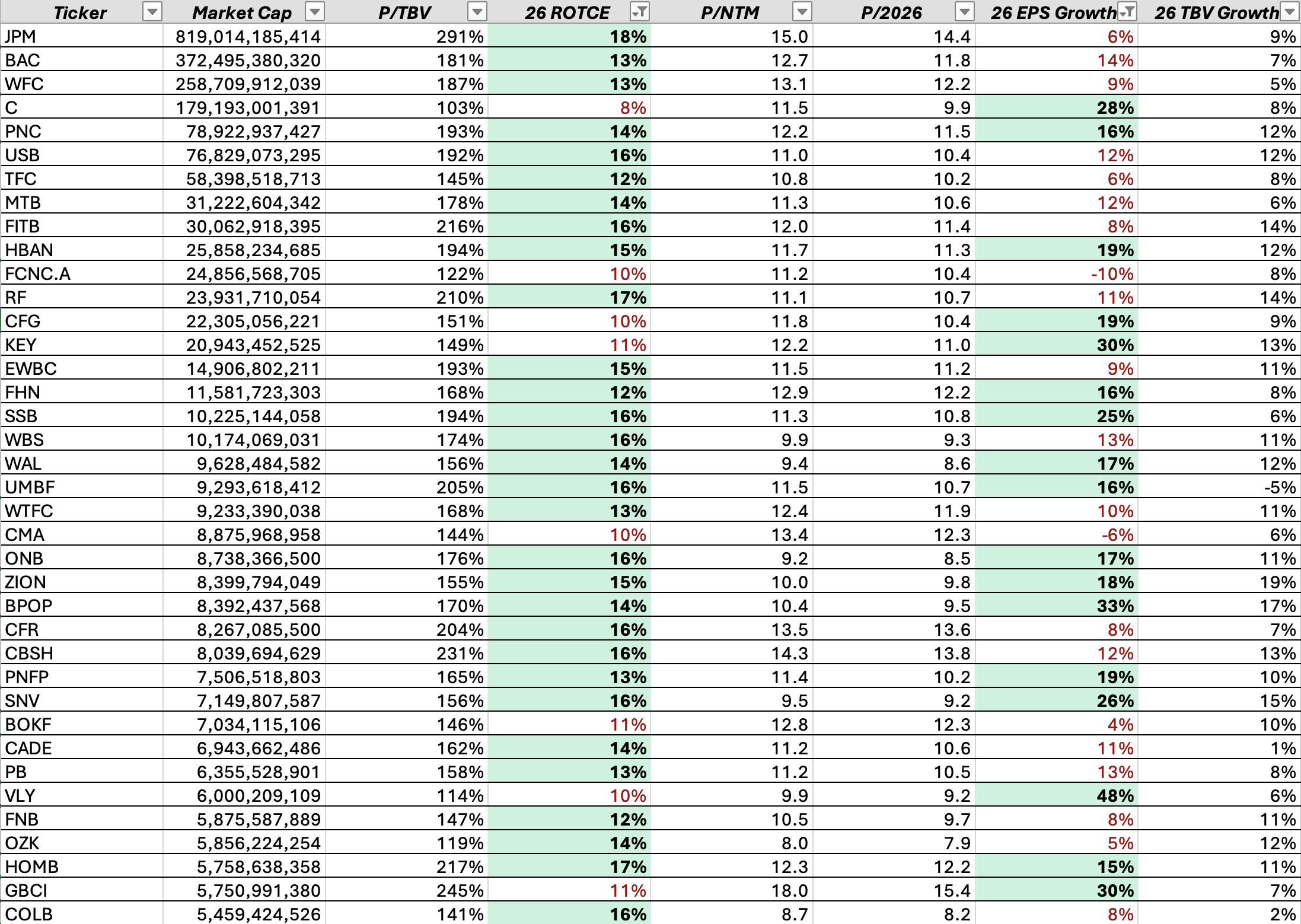
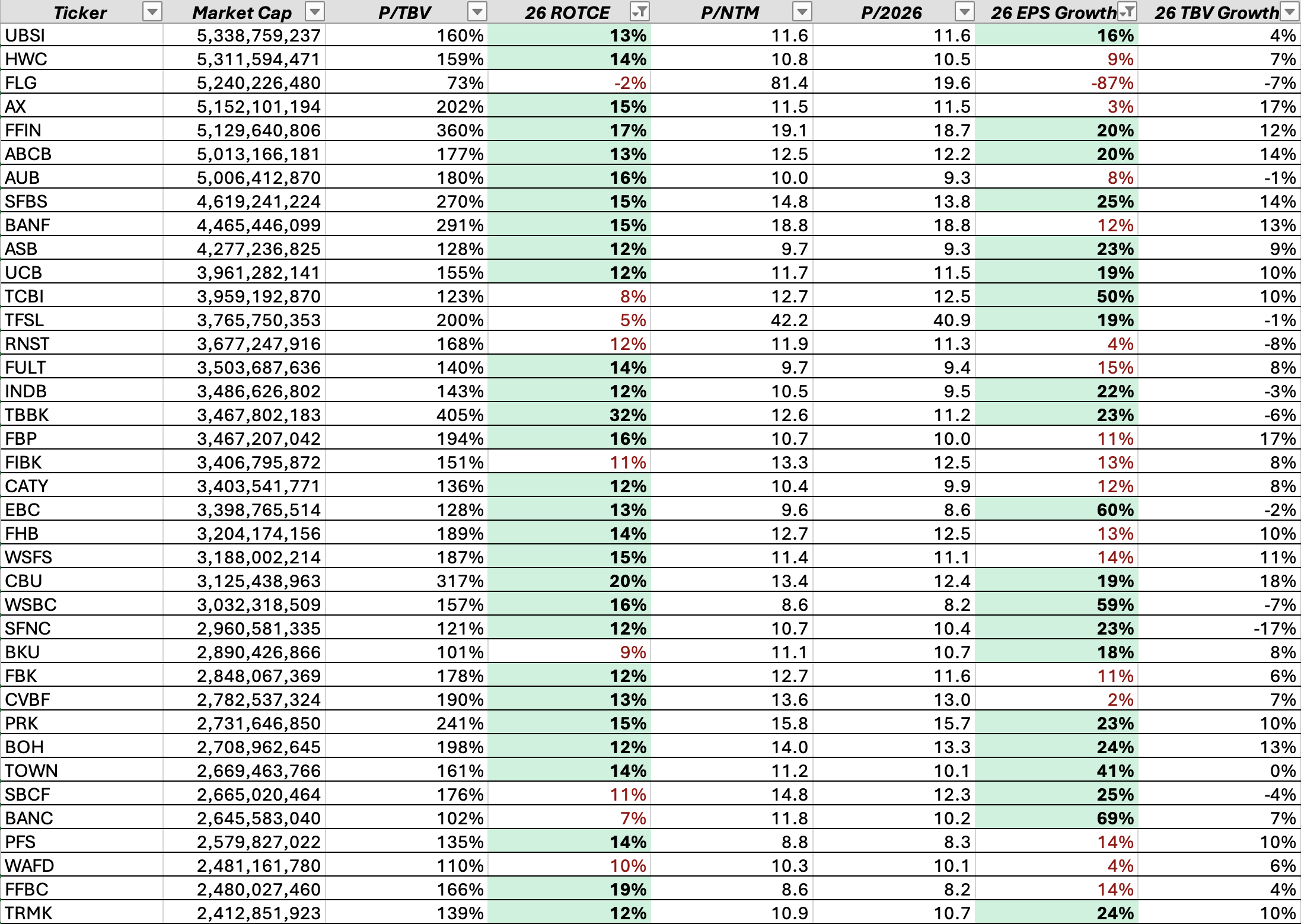
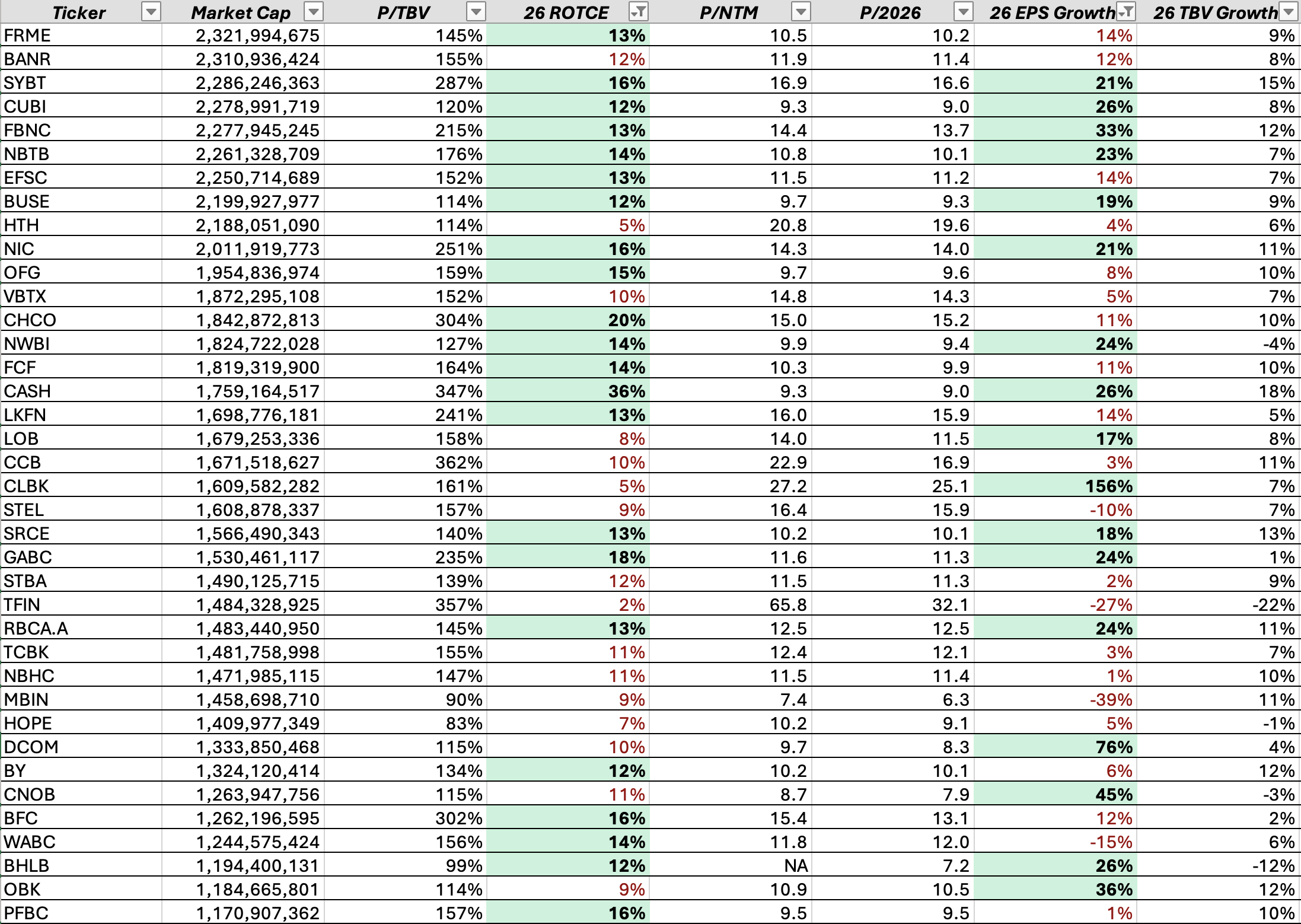
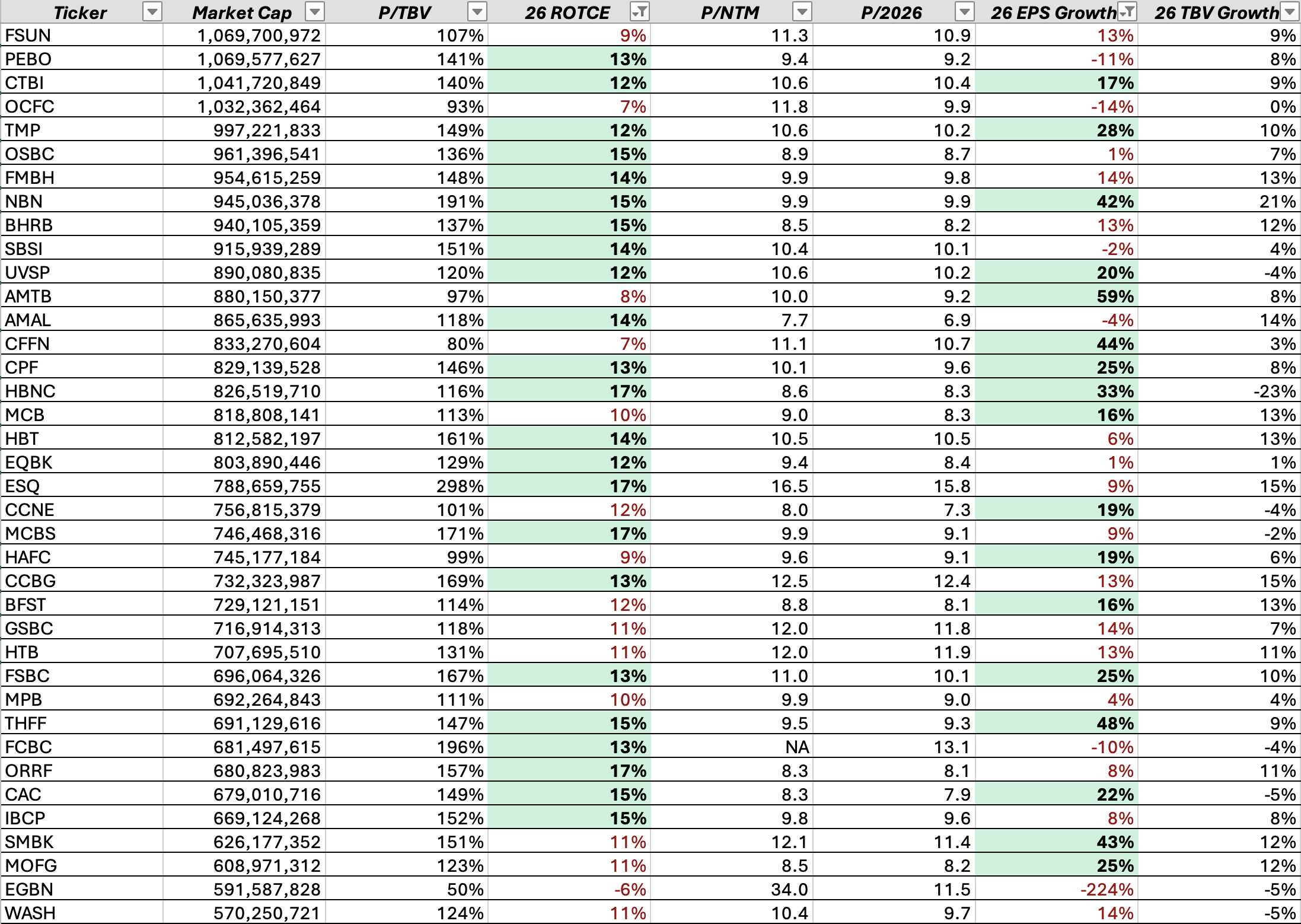
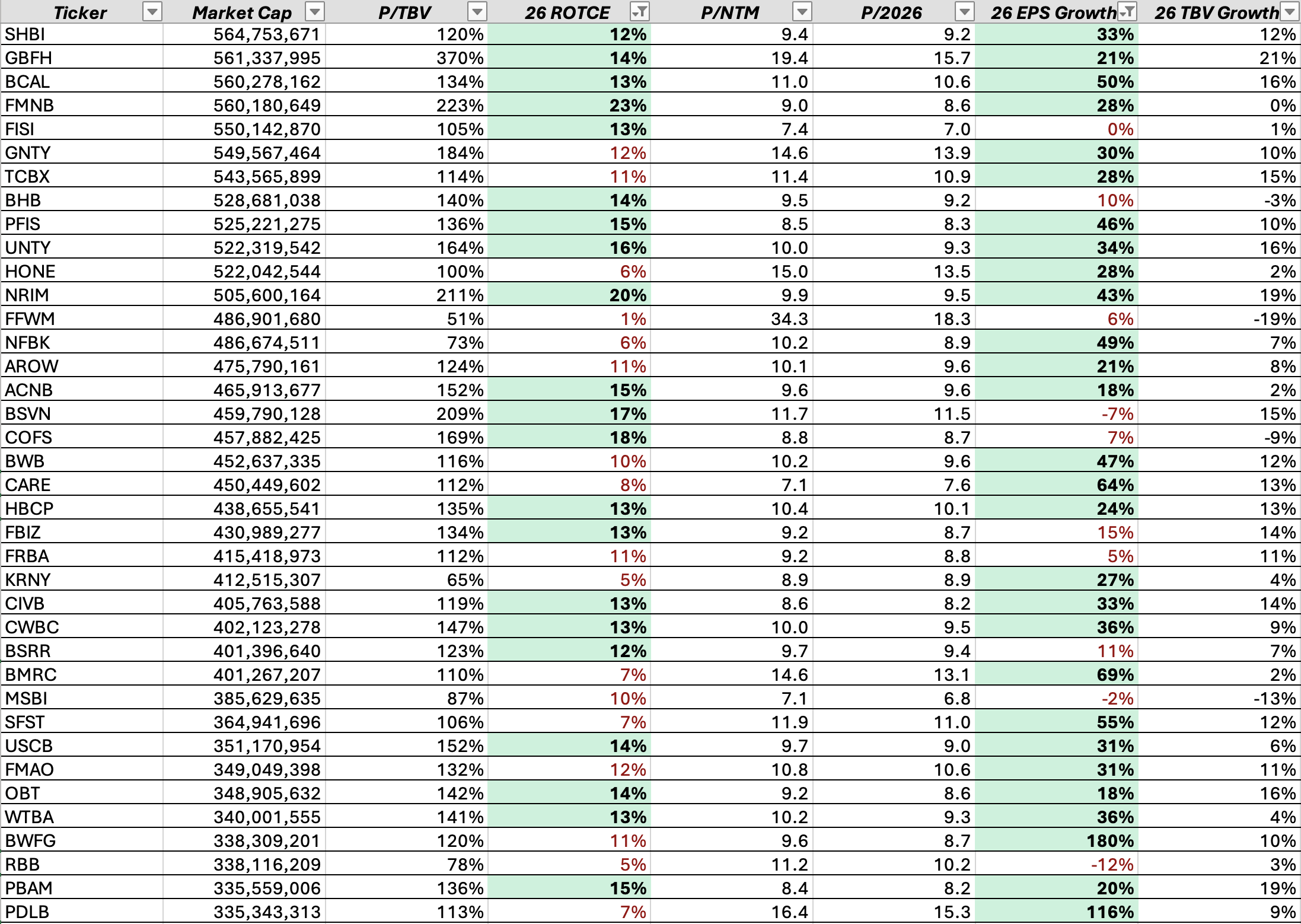
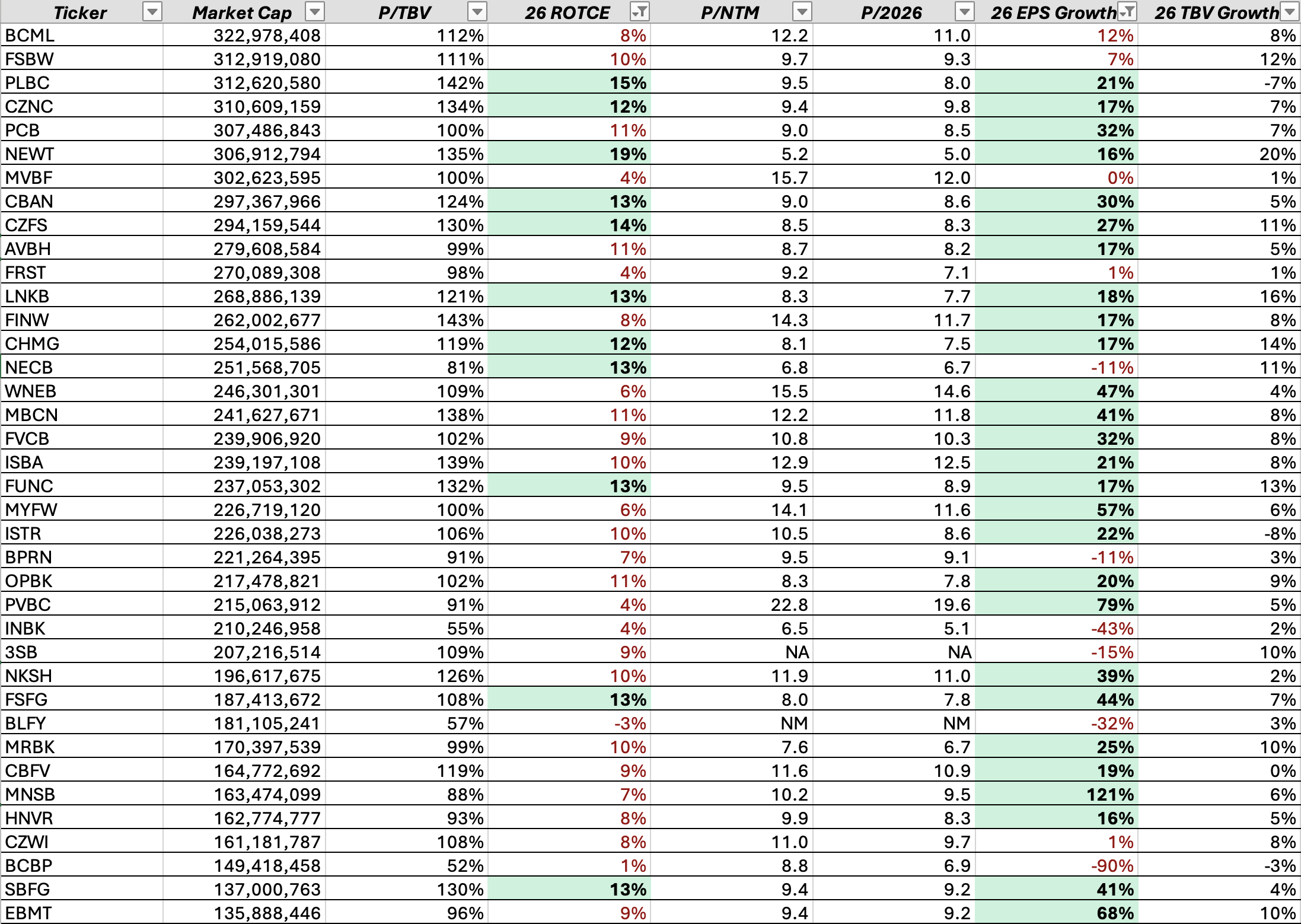
Screens are below. As always, DM on names.
The best is ahead,
Victaurs
Disclaimer:
This content is for informational and educational purposes only and does not constitute investment advice, an offer to sell, or a solicitation of an offer to buy any securities. The views expressed are solely those of the author and are based on publicly available information believed to be reliable at the time of writing, but no representation or warranty is made as to its accuracy, completeness, or timeliness. Any opinions or projections expressed herein are subject to change without notice. The author may have a financial interest in the securities mentioned. You should not rely on this content as the basis for any investment decision. All investments involve risk, including the risk of total loss. Please consult your own financial, legal, and tax advisors before making any investment decisions.
Below find the screens for above average 2026 ROTCE path via estimates (green/bold) and also abover average 2026 EPS growth via estimates (green/bold). You will want to make sure as you go through EPS growth that you do two things. One, take them with a giant grain of salt. Two, if they appear to be huge, and some are, it’s because they likely did some form of a loss trade or nuked 2025 earnings and not because they’ve all of a sudden turned into a tech company.
The full BPOP research, with the durability test and the verdict, lives in the Terminal: BPOP research. 107+ companies and counting.