Riding the Mortgage Market Tailwinds
Have a new one for you all in the consumer finance space. A name many of you may know, but most probably don’t. To sum it up succinctly, here’s the smooth brain thesis.
Smooth Brain Thesis:
A mortgage play that isn’t overpriced (like others) and benefits if rates don’t go down as much as “The Dot Plot” says or if the Mortgage Basis stays somewhat wide. They like making money and in Jerome’s no recession soft landing they should make more money. Tailwinds + operating performance + EPS growth. Current price mid 90s, 2025 target 125 to 128.
The information provided is NOT financial advice. I am not a financial adviser, accountant or the like. This information is purely from my own due diligence and an expression of my thoughts, my opinions based on my personal experiences, and the way I transact. This information is provided for general informational purposes only and should not be considered as personal advice. Your money, your outlay, your risk. This presentation does not provide investing advice in any way shape or form. You will be solely responsible for any decisions you make. If you need to seek any advice, speak to your advisers, accountants or other professionals who you may be relying on for your wealth creation journey. Please do your own due diligence.

A Mortgage Play Biased Towards Servicing:
Mr. Cooper (COOP) is the artist formerly known as Nationstar Mortgage. Founded in 1994 in Colorado, the Company moved to Texas in the early 2000s. Led by Jay Bray, a former Wall Streeter from asset backed securitizations and secondary marketing operations (read as: true professional) COOP is a beast in the servicing space. They were a relatively smaller player pre-GFC but seized on opportunity (I love this) during the mortgage meltdown that many in the Finance industry weren’t even around for now. They acquired a big portfolio of troubled loans (estimated around $40-$50 billion) from Fannie Mae when the world was blowing up and established themselves as a major player.
To paraphrase Bain in Batman, Mr. Cooper was born in the dark.
But back to the business, Mr. Cooper’s revenue is split into two main engines:
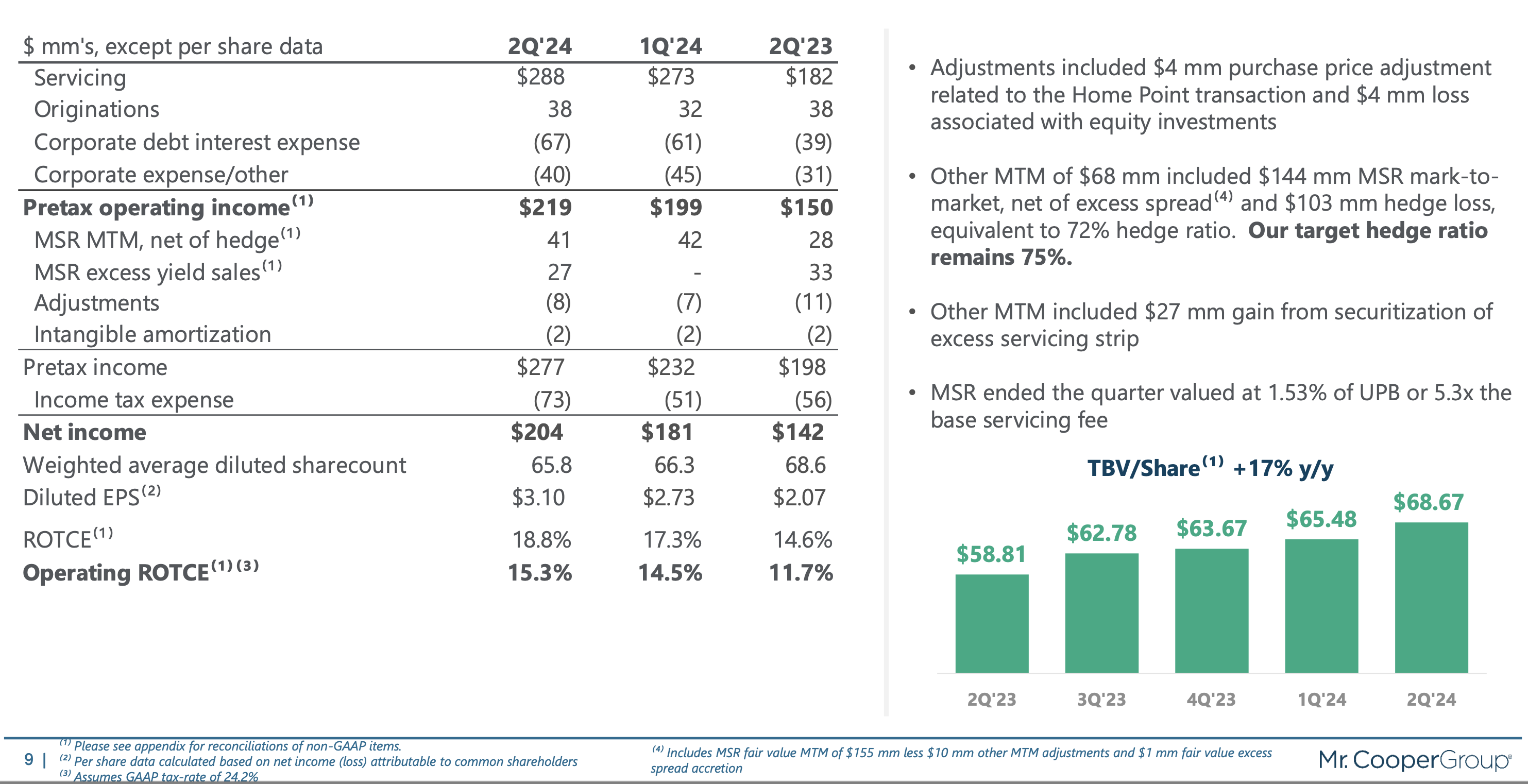
Mortgage Servicing (80-85% of income): This is their bread and butter. They're essentially mortgage caretakers, collecting monthly payments, managing escrow accounts, and putting out fires when they arise. It's a steady, reliable income stream that brought in a $288 million in pretax operating income in Q2 2024.
Mortgage Origination (15-20% of income): This is where some growth happens. Historically a servicer, they’ve realized the importance of the origination engine too. It's more volatile and interest rate driven but potentially lucrative, contributing $38 million in pretax operating income in Q2 2024. This should grow as a piece of the pie in a lower mortgage rate world.
There's also a small supporting cast of other services, including their Xome business, which handles real estate transactions and auctions. A pretty slick site actually: XOME
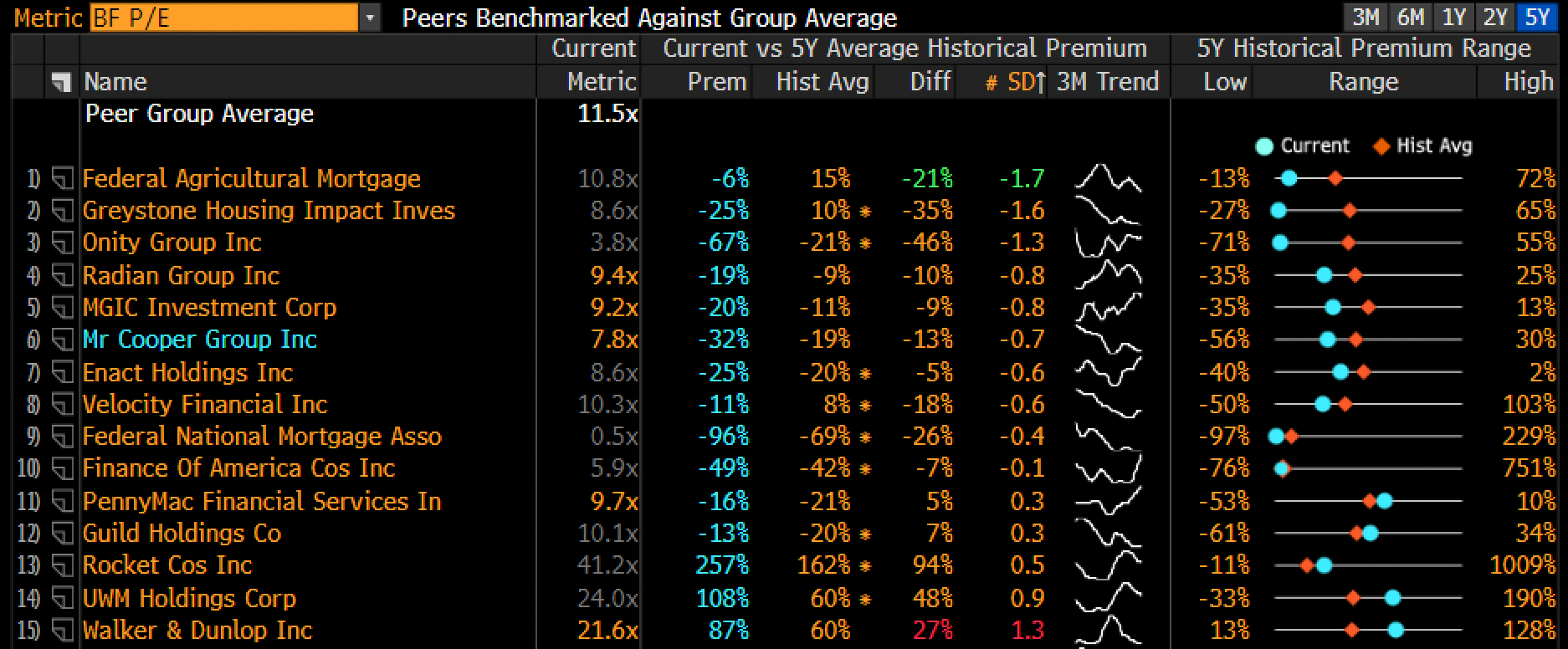
And put this in the “for what it’s worth” bucket, but it also has not run up as much as it’s origination comrades RKT and UWMC. Those have absolutely flown as rates have come down on the Treasury front. So, it operates in a space that doesn’t get quite as expensive as other more “pure play” refinancers. This is part of the allure for me on COOP.
The Financial Forecast:
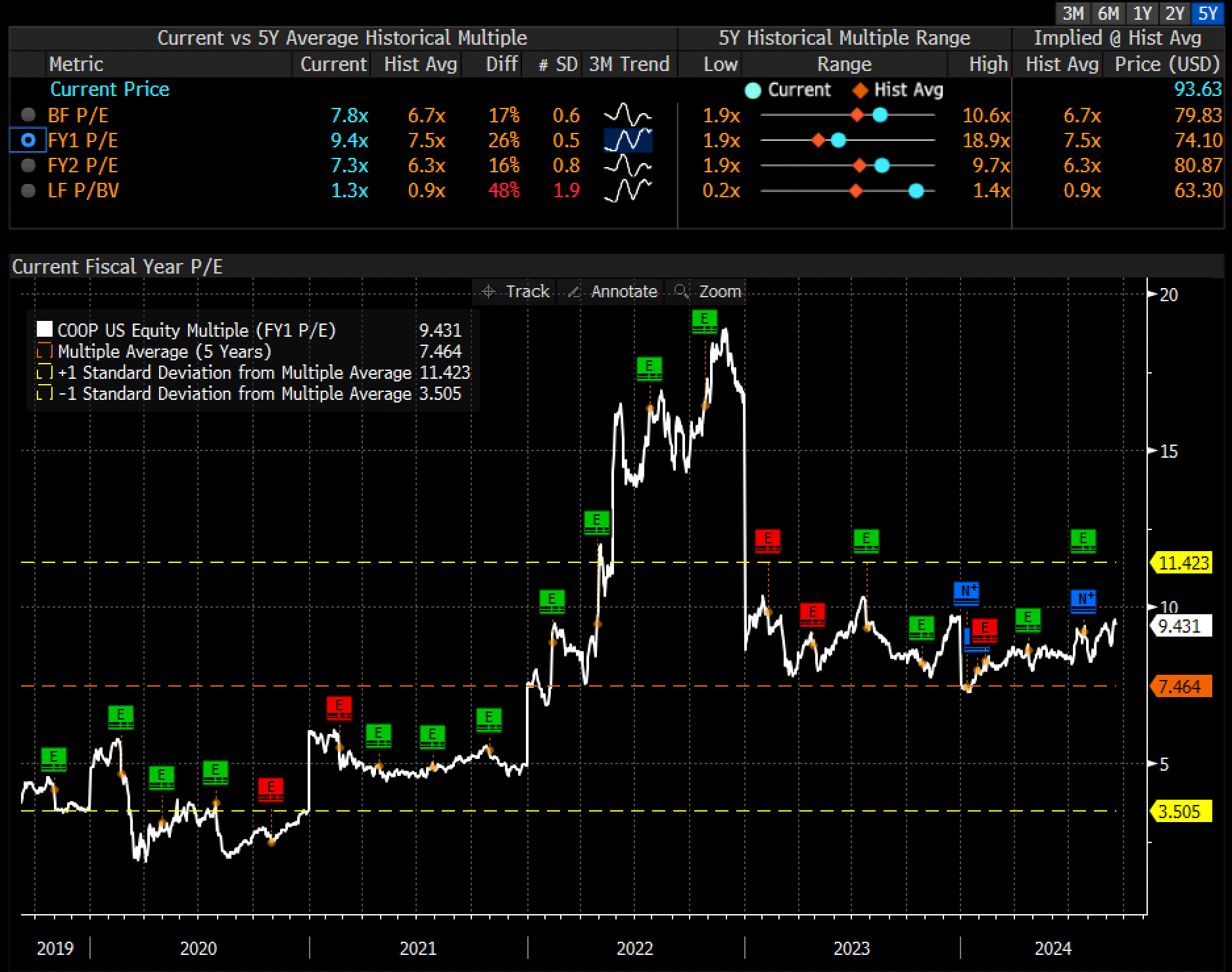
As I write this COOP is trading around $93.5 bucks a share, is trading around 12x trailing 12 months EPS and 130% or so of book value. On a forward-looking basis they’re trading around 8.25x next 12-month EPS and 7.34x 2025 EPS. Fair to trailing but cheap to forwards given growth baked into the estimate cake.
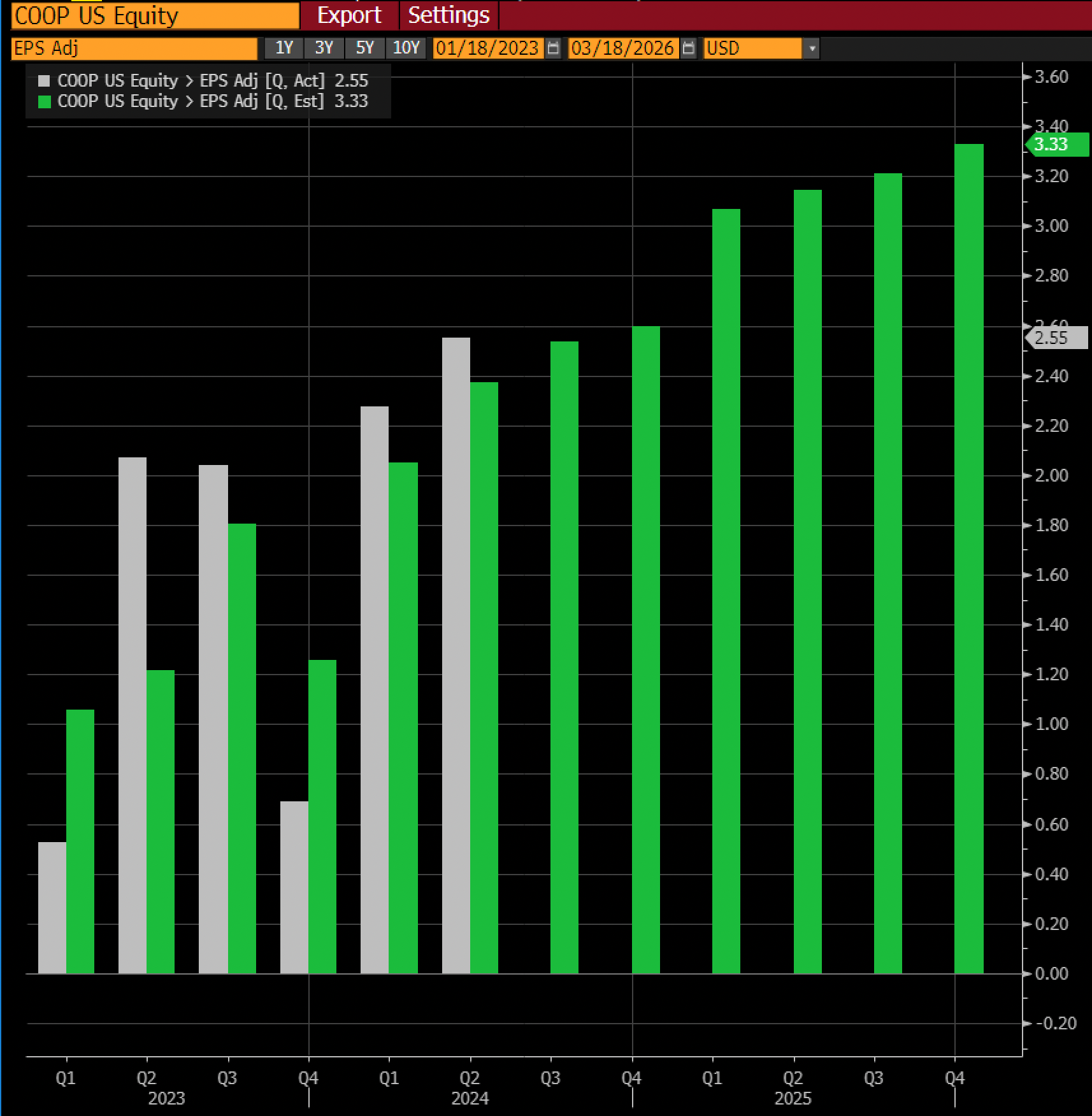
This year, Mr. Cooper or COOP has delivered on growth this year. They did $3.24 in Q1 and $3.91 in Q2 (largely as a result of the big Flagstar MSR acquisition) and are estimated to do $2.53 in Q3 and $2.60 in Q4.
Summarizing the go forward EPS outlook:
2024: Expected earnings of $9.93 per share
2025: Projected to hit $12.75 per share
2026: Aiming for $14.72 per share
And these estimates are not pie in the sky based on an overly rosy view of the world. They don’t require a big interest rate move, nor do they require new acquisitions. So, we’re looking at 28% EPS growth in 2025 and 15% EPS growth in 2026.
My main risks disclaimer looks something like this: Mr. Cooper's outlook is promising, but it's important to acknowledge the risks inherent in their business model. These include potential impacts from interest rate volatility, market fluctuations, and competitive pressures. The integration of the Flagstar acquisition, with its $50 million in expected costs, poses its own challenges. Regulatory changes in the mortgage industry, economic downturns, and housing market slowdowns could also affect performance. Operational risks tied to technology investments, credit quality issues in their servicing portfolio, counterparty risks in subservicing, and cybersecurity threats are additional concerns. Finally, as the company grows, maintaining operational leverage could prove challenging. These factors underscore the complex landscape Mr. Cooper must navigate to achieve its ambitious goals.
Hedging to Smooth Things Out:
A common know on servicers is the impact of prepayments and lower interest rates. These two are bad for servicers mainly because they lose interest income when borrowers prepay and the value of the MSR portfolio goes down as rates go down. An MSR is effectively a little strip of money on a big pool of funds, so if the pool of funds gets smaller, the strip of money gets smaller and the value of the whole pool declines.
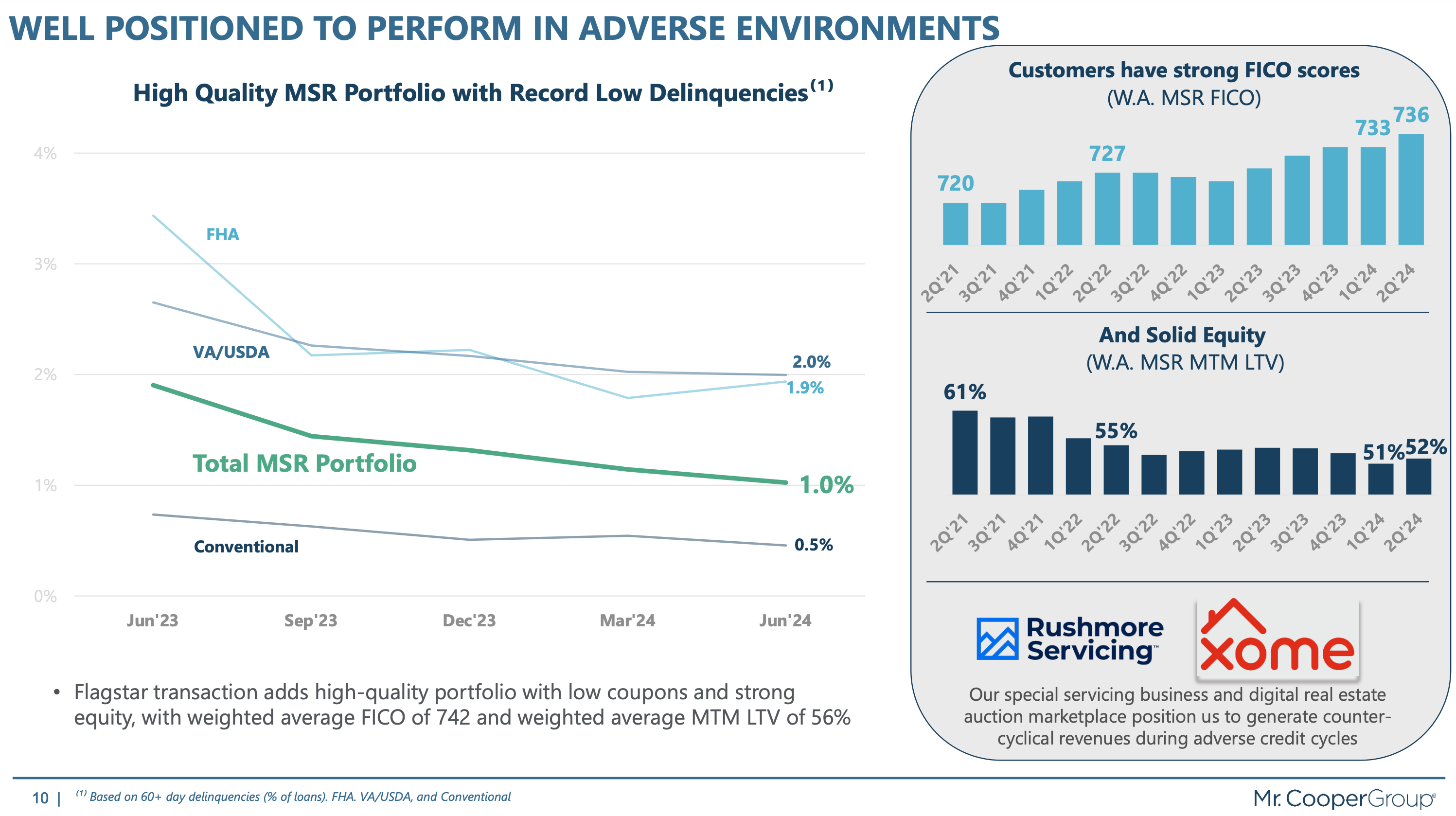
But COOP has some interesting stats on its MSR portfolio:
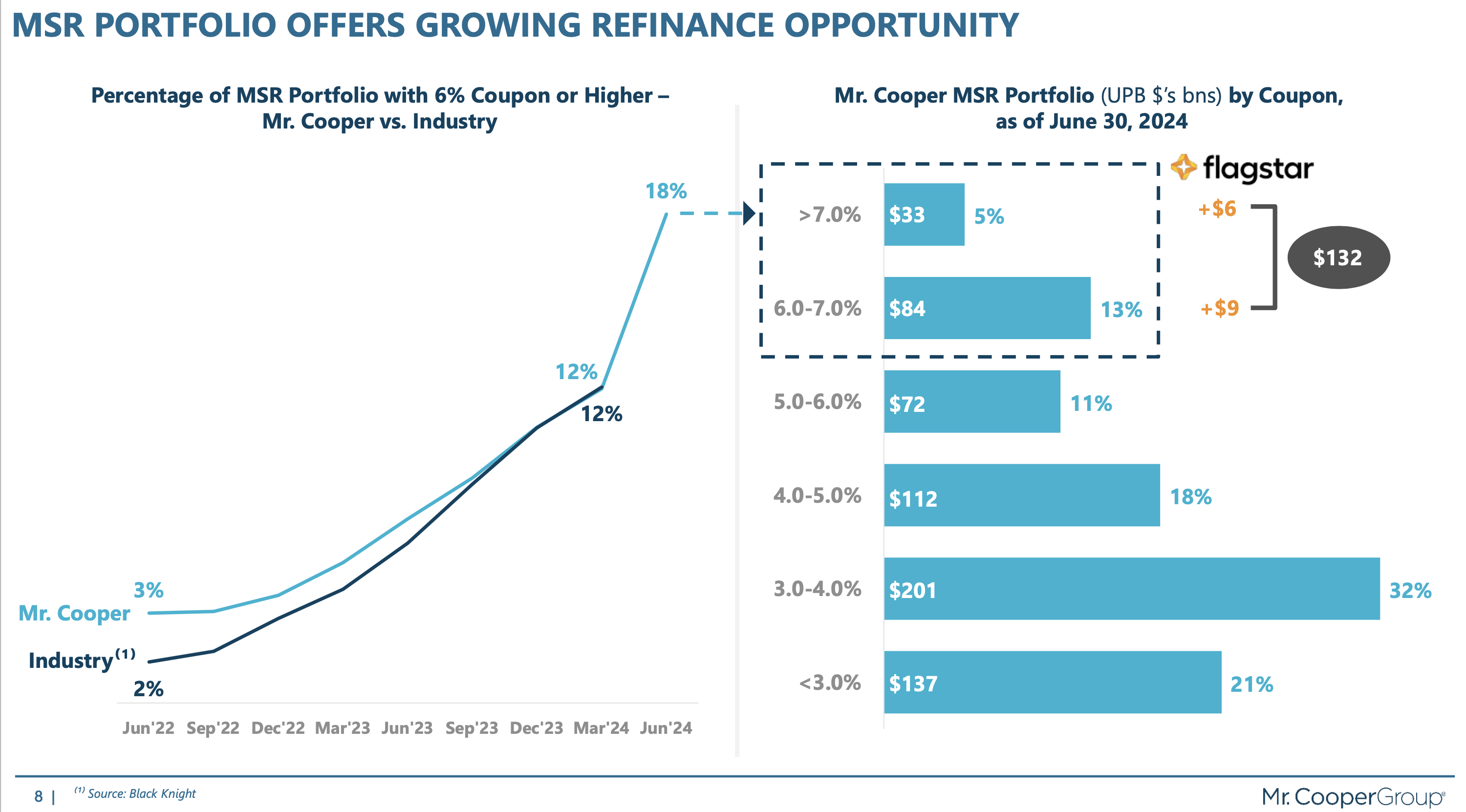
21% of the portfolio has coupons below 3.0%
32% has coupons between 3.0-4.0%
18% has coupons between 4.0-5.0%
In total, 71% of their portfolio has coupons below 5.0%, providing a stable income even if rates drop
They maintain a 75% hedge ratio on their MSR portfolio, protecting against interest rate volatility
This hedging has been consistent for about eight quarters, with results within plus or minus 7.5% of their 75% target
18% of their portfolio now has coupons of 6% or higher, up from just 3% in 2022, positioning them for refinancing opportunities if rates fall
This balanced approach allows Mr. Cooper to potentially profit regardless of which way interest rates move. COOP also has a fairly balanced portfolio of servicing and sub-servicing assets which helps them operate more efficiently.
The Flagstar Acquisition:
In a move reminiscent of Jamie Dimon's philosophy (and their GFC move) – "Don't waste money and don't do anything stupid, let everybody else waste money and do stupid things and then we'll buy them" – Mr. Cooper acquired Flagstar's mortgage operations. This bold step:
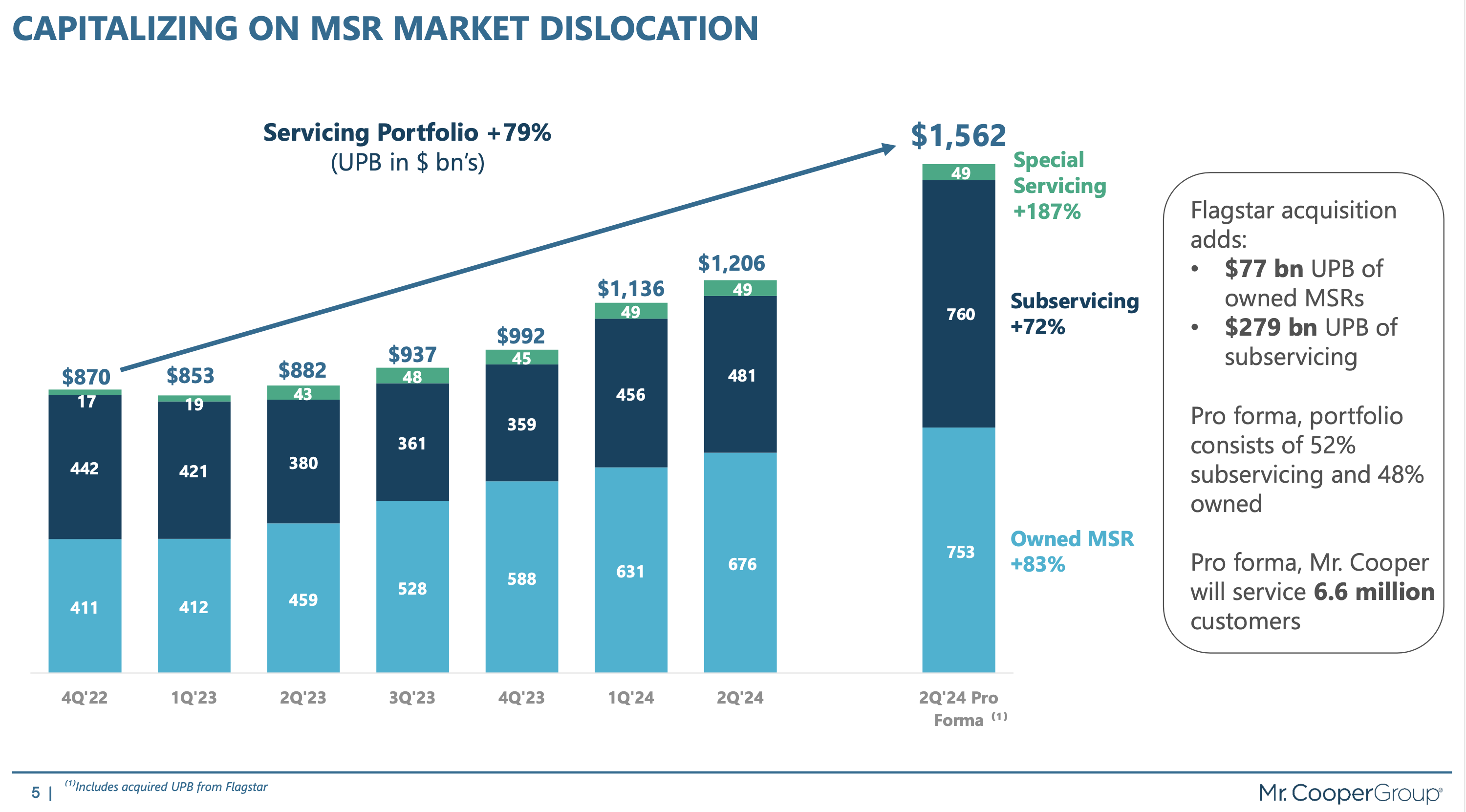
Adds a hefty $356 billion to their servicing portfolio
Catapults their total portfolio to an impressive $1.56 trillion
Expands their customer base to 6.6 million
Achieves a near-perfect balance of 52% subservicing and 48% owned MSRs
Deepens relationships with existing clients and develops new partnerships
Is expected to be accretive to earnings
Helps move Mr. Cooper towards the midpoint of their 14-18% ROTCE target range for 2025
COOP is now one of the biggest players in the space and their ability to acquire such a large MSR book puts them into rare company.
Servicing into Originations:
Here's where Mr. Cooper really shines. With a 73% refinance recapture rate in Q2 2024, they're experts at turning servicing customers into origination opportunities. Their direct-to-consumer channel, expanding capacity (adding about 100 loan officers in Q2 2024), and data advantage position them to capture a larger slice of a growing pie.
In essence, Mr. Cooper has built a mortgage machine that's both robust and adaptable. They've balanced the steady income of servicing with the growth potential of originations, all while using cutting-edge technology to run their operations with increasing efficiency.
The Upside Scenario:
Historical context for mortgage originations:
2019: $2.0-$2.5 trillion range
2020: Exceeded $3 trillion, possibly reaching close to $4 trillion
2021: $3-$3.5 trillion range
2022: Below $2.5 trillion
2023: Around $2 trillion or below
If the mortgage market expands, Mr. Cooper is poised to capture a disproportionate share of the growth. In a scenario where the market is 25% larger:
Their origination volume could increase to $26,008 million
Market share could grow to 0.99%
Gain on Sale margin might improve to 2.80%
Earnings per share could reach $14.32, a 15% increase from the base case
In a scenario where the market is 50% larger:
Their origination volume could skyrocket to $42,724 million
Market share could expand to 1.36%
Gain on Sale margin might reach 2.98%
Earnings per share could soar to $18.42, a staggering 47% increase from the base case
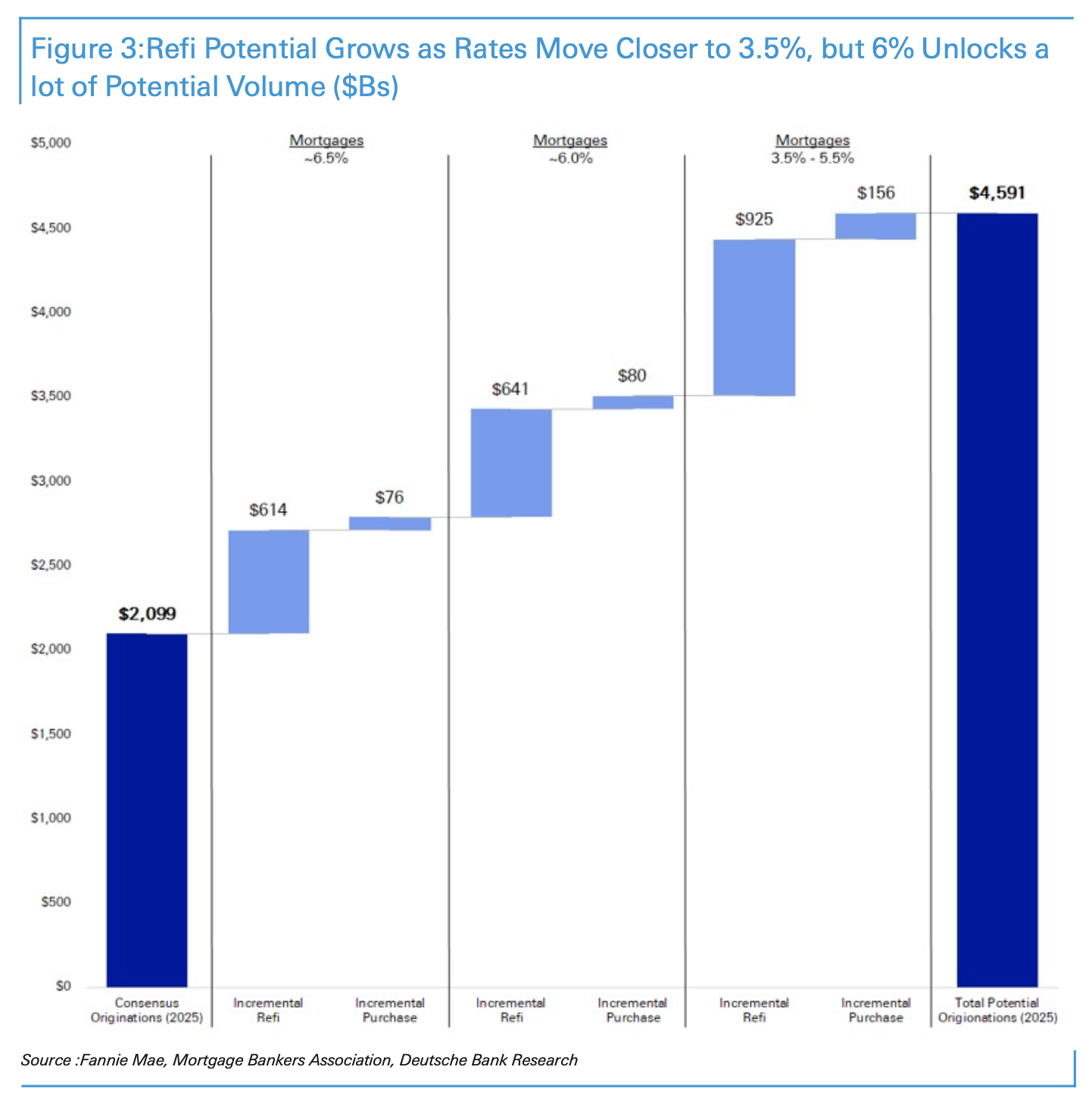
I will be honest I don’t see the 50% larger scenario, and if it did happen, I may want to own RKT a purer play originator instead (I digress), but with even $14 a share in earnings sooner and with a pinch of multiple expansion you can get to a low to mid $100s pretty easily. Below is COOPs historical forward P/E multiple, and while not cheap it definitely could see some investor “reflexivity” if the mortgage market outperforms going forward. That plus limited downside is a good set up for me.
A Share Cannibal:
Mr. Cooper has been actively engaged in share repurchases. Here are the key points about their share repurchase program:
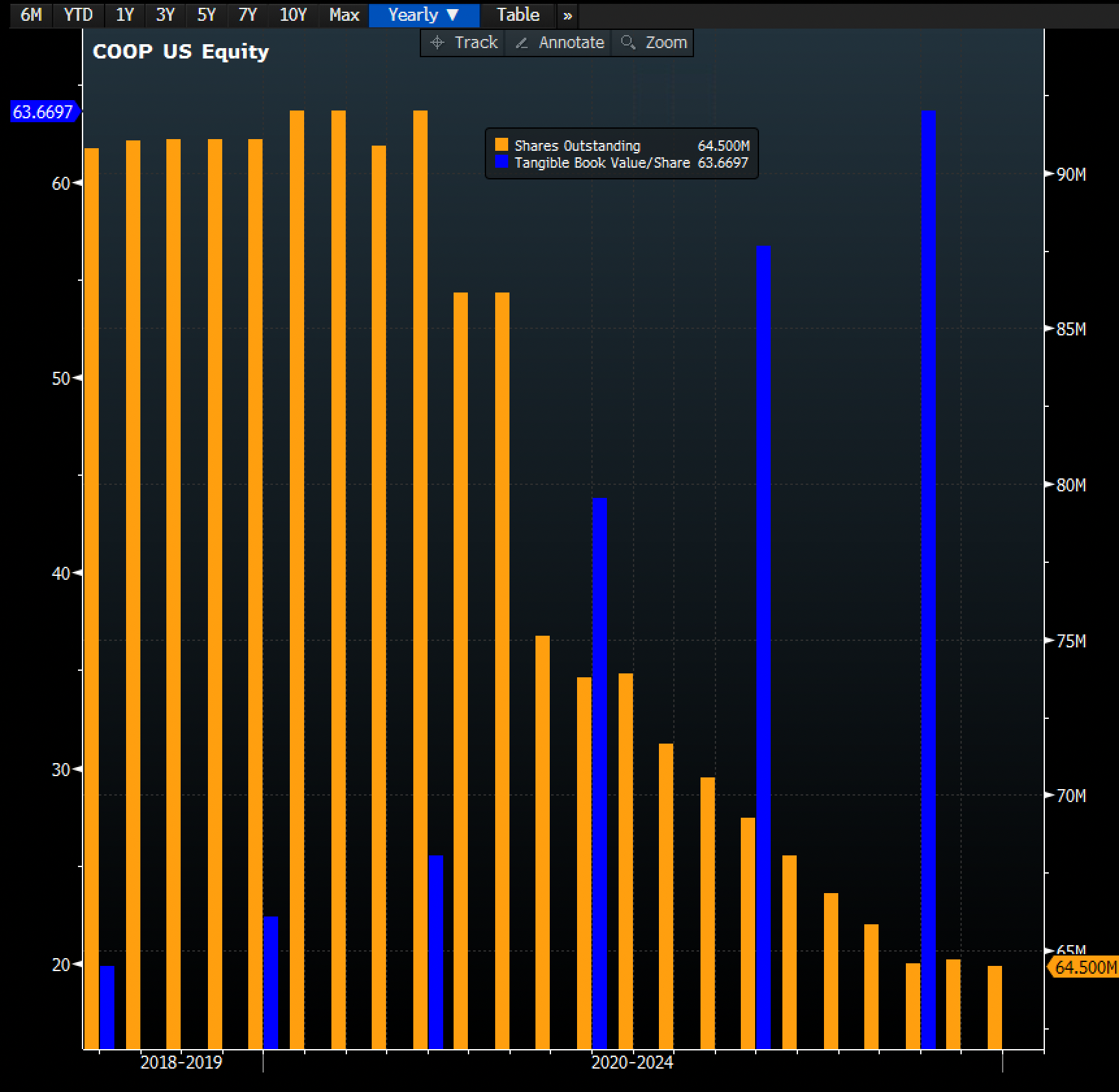
Recent Activity: In the most recent quarter (presumably Q2 2024), Mr. Cooper repurchased 0.3 million shares for $24 million.
Cumulative Impact: Since the inception of their share repurchase program, Mr. Cooper has repurchased a total of 32.3 million shares. This represents approximately 35% of the original outstanding shares.
Ongoing Authorization: The Board of Directors has authorized an additional $200 million for the stock repurchase program. This brings the total authorization to approximately $270 million.
Consistency: The company has been consistently repurchasing shares, reducing the share count by 4% over the last year alone.
Financial Position: Despite these repurchases, the company maintains a strong capital position with ratios above stated target ranges and ample liquidity.
This share repurchases demonstrate Mr. Cooper's commitment to returning value to shareholders and their confidence in the company's financial health and future prospects. The significant reduction in share count (35% since inception) can potentially lead to higher earnings per share, all else being equal, which could be beneficial for long-term shareholders. They’ve also grown TBV per share in the process which is the mark of any good capital allocator. They also care about TBV per share, and mention it regularly, and track it, which is more than we can say for many public companies.
Haters Gonna Hate:
It’s a fact of life, haters gonna hate. Here’s what the haters would say.
Interest Rate Volatility: This is the most significant risk for Mr. Cooper. Dramatic changes in interest rates could impact both their servicing income and origination volumes. While they have hedging strategies in place, a major shift in rates could still significantly affect their profitability.
Integration Risks from the Flagstar Acquisition: With $356 billion being added to their servicing portfolio, successful integration is crucial. Any hiccups in this process could lead to operational issues, customer dissatisfaction, and failure to realize expected synergies.
Economic Downturn or Housing Market Slowdown: A broader economic recession or a significant slowdown in the housing market could severely impact both Mr. Cooper's origination business and the quality of their servicing portfolio. This could lead to decreased revenues and increased credit risks. COOP does have a clean book though.
The Mortgage Basis
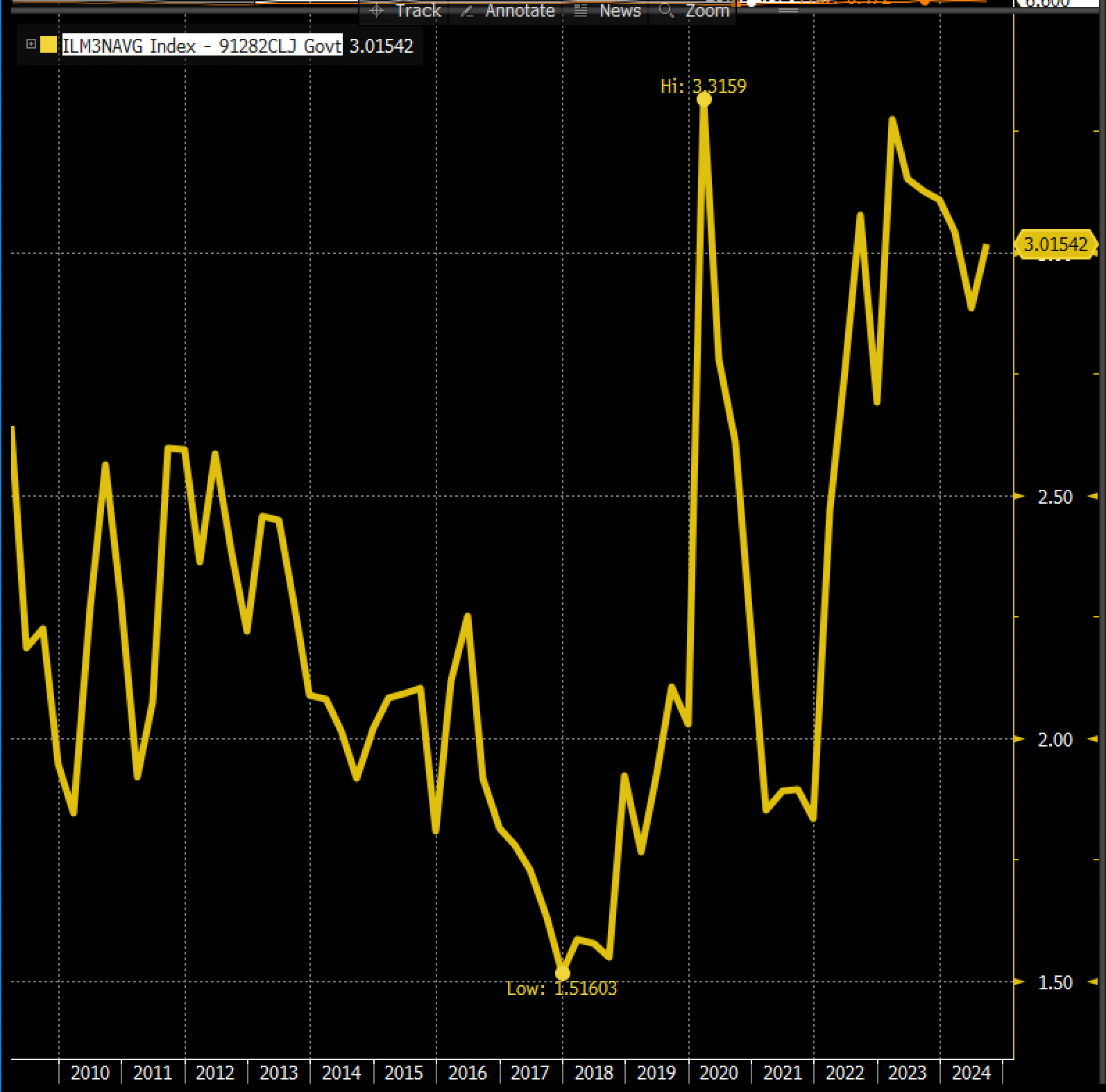
One other thing impacting COOPs MSR portfolio is the mortgage basis. And the difference between the 30-year mortgage and 7-year treasuries is really wide. Post GFC, the average is low 200s basis points. It’s north of 300 basis points. Should this tighten, it would lower mortgage rates further and quicker and would be a tailwind to RKT and UWMC (the pure play originators/refinancers) over COOP who is more servicing.
I show this because I believe it’s inevitable that it tightens. To what degree? I don’t know exactly, but this tacks on to the point that COOP is a great set up for a more gradual drift down in mortgage rates and activity, rather than an abrupt crash in mortgage rates.
The counter to this point is COOP will outperform in a world where the government starts spending like drunken sailors (again) pushing longer rates up.
But it’s Gone Up a Lot?
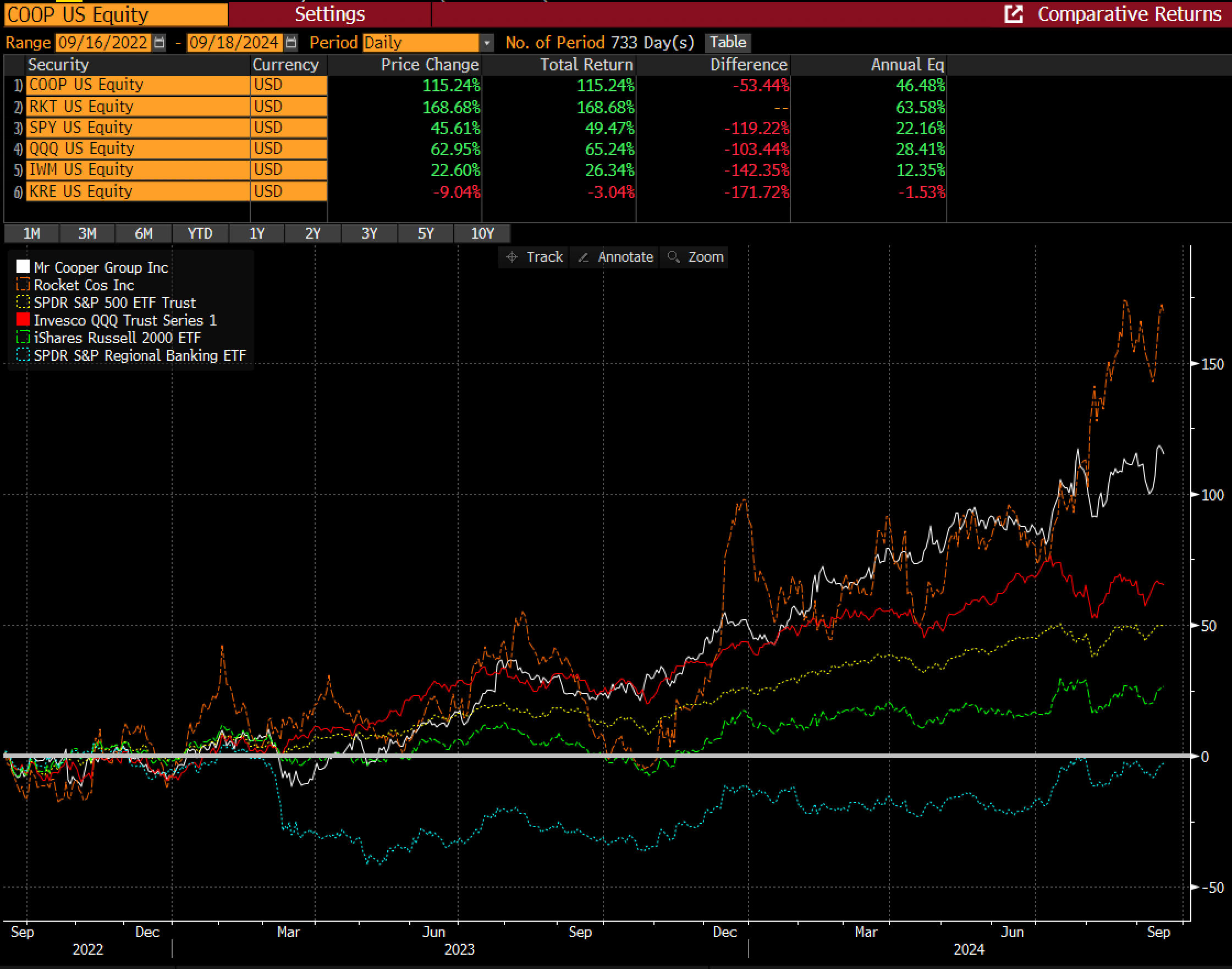
I don’t like it when people say this as a means to say it can’t go up in the future, but yes it has gone up a lot. By my tally it is up about 115% over the past two years. Trouncing KRE and banks who have barely broken even on a total return basis and also trouncing SPY, QQQ, and IWM.
Newton’s law of inertia dictates that objects in motion tend to stay in motion. And I think COOP (and probably RKT too) stay in motion. Newton's Laws
Secular Inertia:
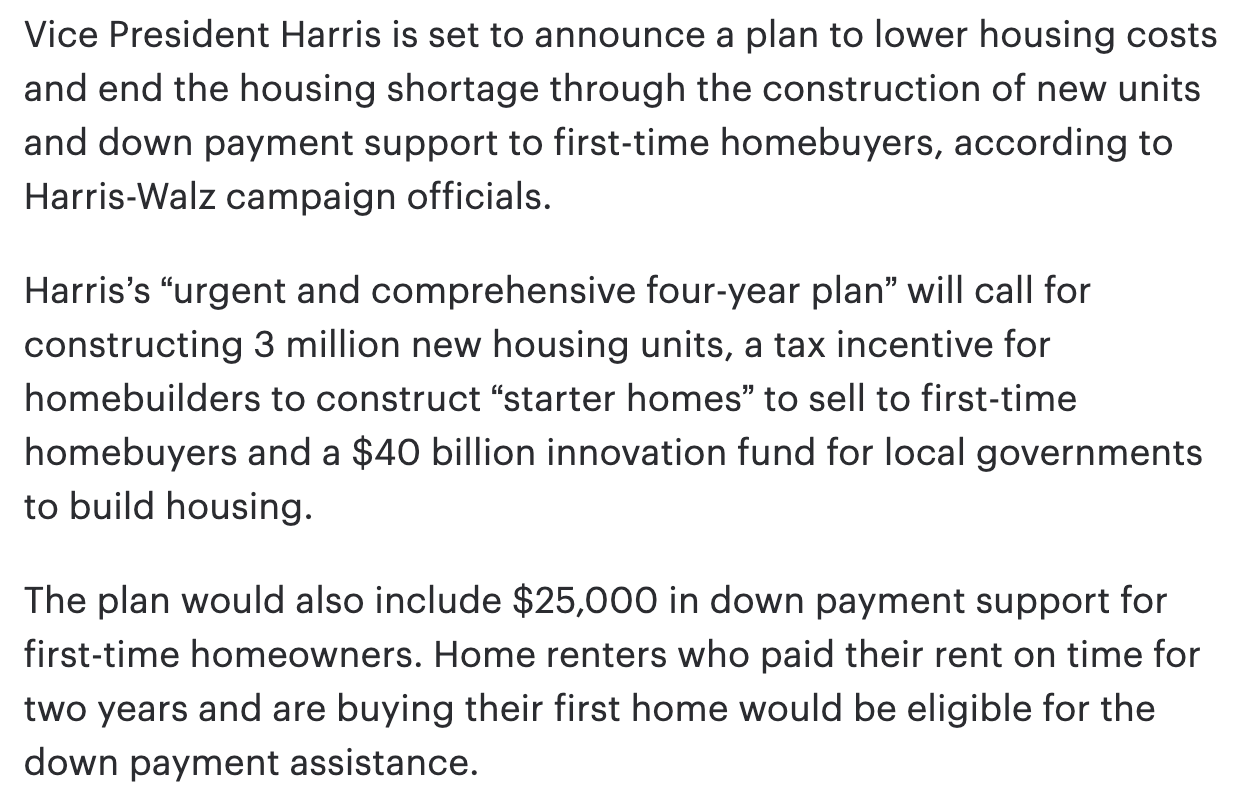
I’ll leave it at this proposal by Kamala Harris. No matter who is in the government, housing is sure to be targeted. All mortgage players win in a world where the mantra is now, “if you build it, they will come”. Home builders, originators, servicers, you name it.
Government aware housing is unaffordable for many, check.
Government wanting to give borrowers free money, check.
Government willing to give more money should trouble arise, check.
Government addicted to running a deficit to buy influence, check.
Sad but all these things are bullish for housing and by extension COOP.

Wrapping It Up:
2.5% position but do see this becoming a larger piece of my portfolio. I like it in in the high 80s to low 90s and consider me a bid there. As always, I will be continually monitoring. If anything changes, I will be sure to mention it. I’m also in the builders and some other hybrid names. If you want to chat on any of these names, be sure to send me a note. Here’s hoping COOP can ride the mortgage market tailwinds for us all.
The best is ahead,
Victaurs
The research behind essays like this one lives in the Terminal: open Research. 107+ companies and counting.