They Were the Villain of Dumb Money. I Hated Them Too. Until I Saw the Numbers.
A 7 min read on a name I hated ... and then didn't hate.
Cut to Robinhood HQ. Panic in the air. The market’s on fire. GameStop is ripping like it’s 1999 and everyone’s long call options with max leverage. Retail is winning. Hedge funds are bleeding.
And the folks at Robinhood? They’re not high-fiving.
They’re sweating bullets.
Vlad Tenev looks like a guy who just realized he might be running a billion-dollar margin call. He gets a call from their clearing partner. Collateral requirements have exploded overnight. They don’t have the cash. Not enough to clear the trades. Not enough to keep the machine running.
The firm’s on the hook. The message is clear: pause the madness or go bust.
So what do they do?
They shut it down.
Not “halt trading” like the NYSE. Not “implement a risk throttle.” No. They literally remove the buy button for GameStop, AMC, Blackberry, Nokia. Any stock with meme blood in it.
You could sell. But you couldn’t buy.
Retail is furious. Reddit melts down. Twitter explodes. The vibe? Betrayal. Feels like the game was fair… until the players started winning. Then the house changed the rules.
Back in Robinhood HQ, Vlad’s staring at his phone like it might spontaneously combust. He’s on the phone with Citadel. The clearing house. Lawyers. PR. Congress is calling. The app store reviews are tanking.
In the movie, it’s chaos. In real life, it was worse.
That one decision to remove the buy button turned Robinhood from the darling of retail into the poster child for rigged markets. They said they were democratizing finance. That day, it looked a hell of a lot like they were protecting the Kenny G and Steve Cohen.
And it stuck.
The movie captured the absolute chaos of the GameStop saga, and yeah, Robinhood came off looking like the villain they deserved to be. A trading app that shut down buying when things got hot? Selling client order flow under the illusion of "free" trades? It was the house rigging the game and handing retail the dice.
I hated them. Maybe I still do. It tatined my view of them for a long time.
But here’s the thing: sometimes something you hate might actually make you money. You gotta take the bias off. You gotta see things clearly.
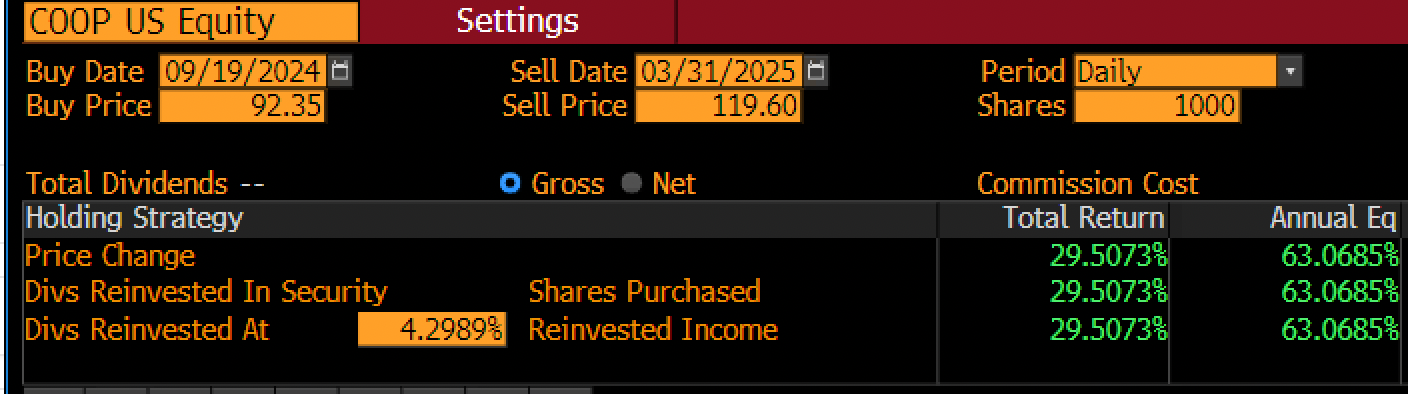
Oh … and before I forget. Yes a big congrats to COOP shareholders on the RKT acquistion. I wrote about this back in the fall and if you followed along, congrats.
TL;DR
I hated Robinhood after the GameStop mess. The buy button fiasco felt rigged and broke trust. But over the past year, they’ve executed like crazy: eight $100M+ revenue streams, doubled AUC to $193B, scaled IRAs and Gold, launched new products, expanded globally, and actually did what they said they would.
Yes, it’s still a risky time to own growth. But Robinhood looks like a call option on the next generation’s financial stack. Sticky users, rapid product velocity, and real revenue. You can pair it with a short (SoFi’s the obvious one).
They might not be Dumb Money anymore.
The Bloodless Verdict of HOOD Today
Robinhood isn’t just a meme-stock casino anymore. It’s evolving into a legit fintech platform with over eight separate revenue streams doing $100 million-plus each. Quietly, methodically, they’ve crossed an inflection point. And yeah, the numbers back it up even for a vibes guy like me.
2024 revenue came in at $2.9 billion, up 58% year-over-year. Adjusted EBITDA hit $1.4 billion, with margins just over 48%. And they even flipped to GAAP profitability, earning $1.56 per share. Net deposits? Up 49% to $51 billion. And assets under custody? Nearly doubled from $100 billion in 2023 to $193 billion by year-end. That’s one of the more impressive stats.
And they now manage more assets than SoFi (poor SOFI bros), Acorns, and Betterment combined. No, they’re not touching Schwab’s $8 trillion or Fidelity’s $12 trillion. But Schwab didn’t grow Assets Under Custody (AUC) by 90% last year. Robinhood did. Kind of a coming out party if you will.
They’re bringing in deposits at a clip of about $4 to $5 billion per month. February alone clocked $4.8 billion. Ally Bank, yeah, a real bank, only pulled in $2.5 billion that same month. That’s a set of numbers that a trad bank would literally kill for, and if not kill at least give up a few of their children.
Gold subscribers are sitting right around 3 million (actually, 3.1 million as of March). These users aren’t just dabblers, they’re entrenched in the ecosystem. They generate 7x the ARPU of free accounts and adopt IRAs at 5x the rate. Speaking of IRAs, Robinhood’s version has ballooned to $13 billion in AUC in just 18 months. Gold Card? One million people on the waitlist, 95% retention. Futures platform? Coming. Advisory? Already live. AI tools? Rolling out this year. They even launched in the U.K., and with the Bitstamp acquisition, they’re building out regulated crypto rails across Europe and Asia.
They said they’d build a platform for the next generation. And for once, a fintech actually delivered. So put my hate in check? Yea, when I read their recent updates I had to.
The Bear Case - For the Haters in the Building
One of the best things you can do in investing is beat the hell out of your thesis by painting a bear case first. If you are still bullish after that, then you have something.
So here it is:
Robinhood still leans hard on trading revenue. Options and crypto made up over 40% of transaction-based revenue last year. Net interest income? Another ~40%. So more than 80% of the business still dances to macro and retail sentiment. Crytpo and spread on customer cash is it for HOOD.
MAUs peaked at 22 million back in 2021. They ended Q4 2024 with ~13 million. That’s a 40% drop. Not great. Although 2021 was anything normal.
Trust issues? Still a thing. Over 1,000 BBB complaints in the past three years. Settled a $7.5 million fine in Massachusetts for gamification in 2024. Not good Bob.
IRA AUC is $13 billion, but that’s just 6.7% of total AUC. It’s early but their foray into retirement accounts just doesn’t move the needle yet.
The average AUC per funded account is still under $9,000. We’re talking small dollars here. For context, Schwab’s is over $250,000. Robinhood’s users are young and lower balance. I think this is bearish.
Fed cuts are a looming threat. If rates drop 150bps, Robinhood could lose north of $250 million in interest income that drops straight into bottom lines. That is not nothing.
Payment for Order Flow (PFOF) is still in the SEC’s sights. Add futures, crypto, and index options to the mix and the regulatory risk stack just keeps getting taller. Yes Trump “should” result in less regulation, but still that’s a lot of risk.
They’ve added products, but have they added depth? They pride on shipping products, but churn is real if customers don’t grow into the platform.
TradePMR added $85 million in expense for 2025. $45 million in operating costs, $40 million in SBC. Margin drops from 56% to 53% expected. They want to get into RIAs and it’s costing them right now.
February crypto volumes fell off a cliff, from $20.4B in Jan to $14.4B in Feb. That’s a 30% drop in a month. Revenue still has some whiplash DNA. And it will for a long time.
The Bull Case - On the Other Hand
As best I could, here’s what I see as the bull case:
They’re not just GAAP profitable. They’re scaling profitably. $1.56 in EPS. $1.4 billion in EBITDA. Margins at 48%, and projected to hit 53.9% next year. These are almost like “real company” numbers.
They’ve got eight $100M+ revenue lines: options, equities, crypto, margin, interest, Gold, Card, and retirement. I was pretty surprised to read this in their recent updates.
Gold subs at 3.1 million. ARPU is 7x higher. And they hold over $20 billion in AUC. That’s not small. That’s loyalty in the face of the heinous buy button Dumb Money actions they took. Customer forgetfulness? Maybe.
Gold Card launched with 100,000+ users and a 95% retention rate. Cashback goes straight into investments. That’s sticky and is a little bit of a flywheel that tells me they understand the end game. More assets to manage.
The IRA business has scaled from zero to $13 billion in just 18 months. They’re offering 3% match to Gold users. Nobody else is doing that. And certainly not the Boomer Schwab guys.
Bitstamp adds global crypto licenses, EU and Asia coverage, and even institutional relationships. Optionality is off the charts. I probably can’t even calculate the upside of this. It’s such a pipedream to take over global bitcoin trading from other major platforms, but hey they can try.
Robinhood Legend, desktop for active traders, is already at a $50M+ run rate. And it’s incremental, not cannibalizing mobile at least as far as the data goes. I am going to sign up for a HOOD account myself just to see if it’s terrible or not.
Futures are next. Management sees 9-digit annual revenue potential. Index options just launched and already pacing at a $15M run rate. Kind of have to laugh, but if you do crypto and options, why not do futures too? Might as well get the roulette players in addition to the slots and black jack crew.
Their U.K. launch came with 5% APY on cash. That’s aggressive. Customer uptake has been strong. Wallet, DeFi access, and cross-border builds are underway. The global ambition is notable for me.
Most importantly, they did what they said. 2023’s earnings calls laid out IRAs, Gold scale, Card, crypto wallet, Legend, and advisory. By Q1 2025? Done. That’s rare. And in the world where they destroyed trust, this actually builds it back.
Whose Lunch is HOOD Eating?
In brokerage, you’ve got Schwab, Fidelity, and E*TRADE. These are the old guard. Trusted by advisors, loaded with assets, but clunky when it comes to onboarding younger investors. They’ve been slow to modernize, slow to simplify, and slow to listen. And it shows.
Robinhood owns the under-40 crowd. They made it easy, fast, and borderline fun to trade. Their UX is cleaner, their incentives are clearer, and their mobile-first approach meets users where they already are. This isn’t just a design win. It’s a generational loyalty moat the incumbents never built.
In cash, you’ve got Bank of America, Chase, and Wells Fargo still paying basically nothing on deposits. We’re talking 0.01% in most checking accounts. It’s insulting. They’re coasting on inertia and decades of brand equity.
Robinhood flipped that script. They’re handing out 4.9 percent to Gold subscribers and 5 percent in the U.K. This isn’t a gimmick, it’s real money in your pocket while the big banks drag their feet. For a younger generation that actually checks rates and expects more, this kind of delta matters. It’s not just better. It’s embarrassing for the banks.
In cards, you’ve got Amex, Chase, and SoFi offering solid rewards. Cashback, points, lifestyle perks. It’s a mature game. But here’s the gap. None of them tie spending to actual long-term wealth. You swipe, you get points, maybe a flight upgrade. That’s it.
Robinhood flipped it. Gold Card takes your spending and turns it into equity ownership. Cashback flows straight into your brokerage account. It’s not just credit. It’s capital formation (in theory at least).
In retirement, Vanguard and Fidelity still dominate by AUM. Incredible brands, serious infrastructure, total trust with older generations. But the interfaces feel like 2009 and the incentives are nonexistent. No reason to contribute early. No reason to consolidate assets.
Robinhood’s IRA has a 3 percent match for Gold users. The UI is built for mobile. No forms, no hassle. And in less than two years, they’ve grown IRA assets to 13 billion dollars. That is impressive.
In crypto, Coinbase is the default. But they still charge retail fees. Every trade costs you. They’ve got strong brand equity and deep crypto roots, but they’re expensive and not really integrated with broader investing behavior.
Robinhood takes a different angle. No commissions on crypto. No friction between asset classes. And now, with Bitstamp, they’ve picked up licenses in the U.K., EU, and Asia. That’s global infrastructure with institutional potential. Coinbase should be watching, I’m sure they are.
In advisory, Betterment and Wealthfront charge traditional AUM fees. One percent here, half a percent there. It adds up. The model is clean, but it hasn’t changed in a decade. And for high-balance accounts, the fees get heavy fast.
Robinhood doesn’t play that game. They charge a flat five dollars. Or nothing at all if your account is over one hundred grand. That is a shot across the bow. It breaks the model. And it forces the question: why are you still paying a percentage?
Where I Stand … Can You Like a Company You Hated?
The answer is yes. You can do whatever you want in this life. Never forget that.
For me I am bullish the name. Initiating a new position.
Yeah, it’s a challenging time to own risk. The macro backdrop is messy, rate cuts might compress margins, and anything growth-flavored still trades with a target on its back. But that’s also why the setup here is interesting. If you believe in asymmetric payoffs, you don’t just buy what’s working today. You buy what could rerate when no one’s looking.
Robinhood is exactly that. A call option on the next generation of investors. They’re sticky. They’re loyal. And they’re getting wealthier.
This isn’t just a trading app anymore. It’s a multi-product financial stack built for people under 40. Gold Card, IRA match, futures, Cortex AI, advisory, even RIA custody. They’re shipping real product and entering real verticals. And they’re doing it fast. With a user base that clearly likes them. Shocking.
Now, to be clear, I’m not naive. Crypto is volatile. Fed policy is a headwind. And regulation is always one headline away from killing the vibe. They’ll have to retain users as they build wealth and financial needs get more complex.
But the core is there. Revenue diversification. High-margin subscription growth. International expansion with Bitstamp. They’ve gone from meme broker to platform in under two years. Clearly there are some adults in the room, or they’ve convinced me at least.
If you’re nervous about owning high beta, pair it. Hedge it. Short a basket. SoFi is the obvious one. You could add Coinbase. Interactive Brokers. Schwab. Maybe one of the bloated regionals for good measure. I haven’t finalized my mix yet, but I know this: I want to own HOOD.
They’ve earned it. Not with promises. With execution.
This might not be Dumb Money anymore.
It might be one of the smarter trades out there.
The best is ahead,
Victaurs
The full HOOD research, with the durability test and the verdict, lives in the Terminal: HOOD research. 107+ companies and counting.