Investment Banks Beneath the Surface: Capturing the Winners and Fading the Fakes
A market neutral way to play the investment banks
The vibes they are a changing. I can’t explain it but it feels like the media now has shifted from “everything’s over” to “high uncertainty”. Tariffs are still the talk of the town, but the frequency and magnitude of talks on it are dying down.
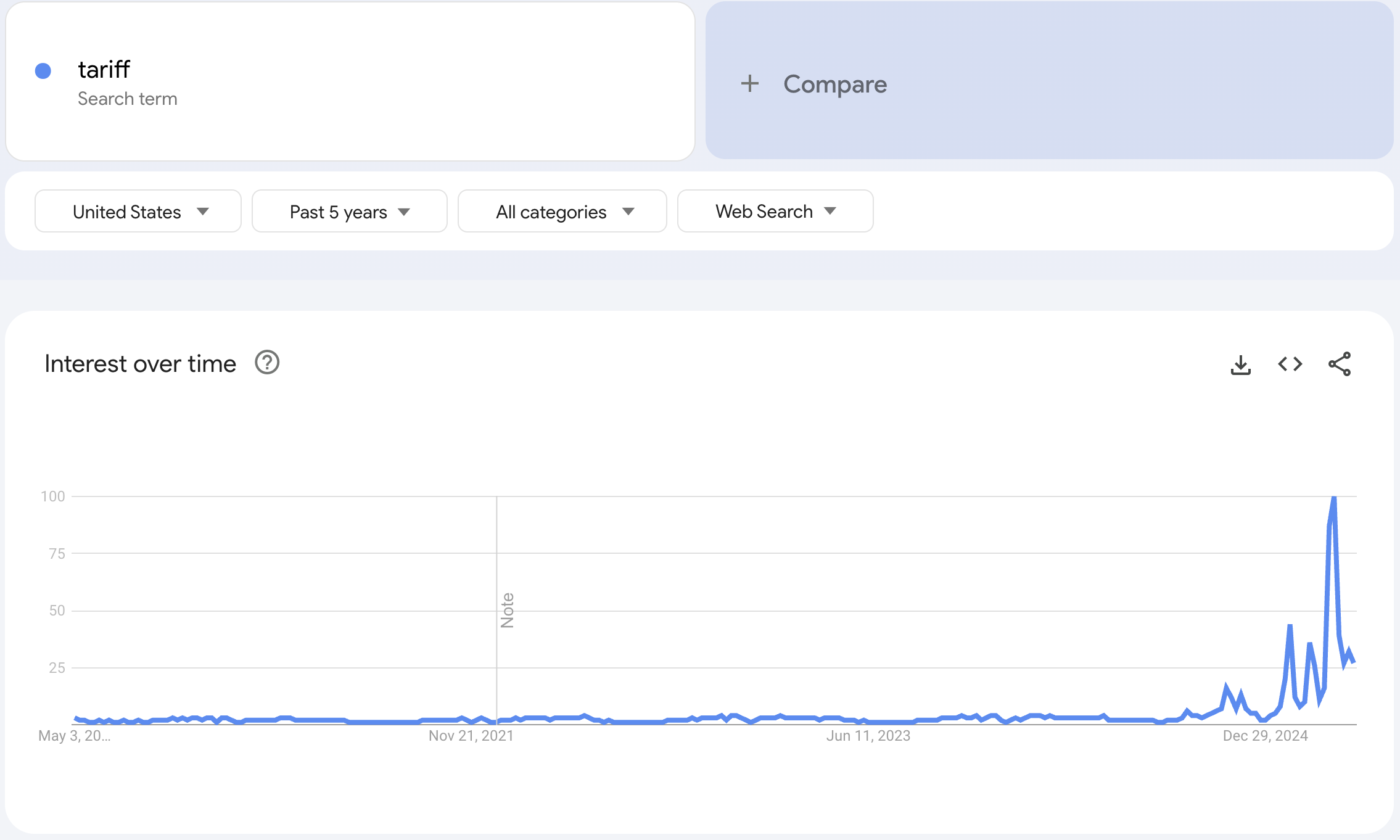
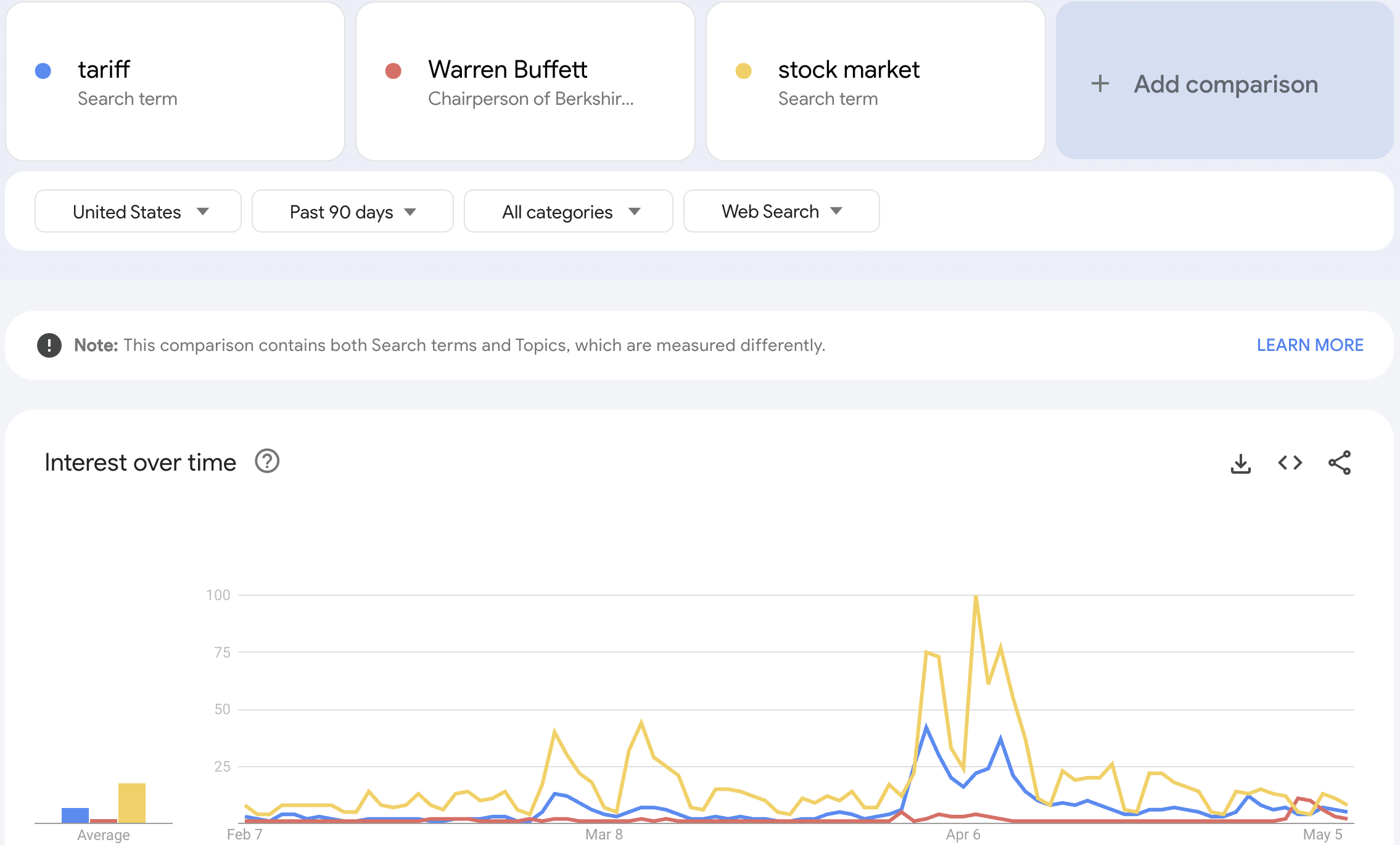
Surprising to no one, when tariffs were all over the news cycle searches on Google for “stock market” were flying. But notice what’s happened below? As those have chilled out, so too has the broader stock market volatility. As the news cycle fades, so does the volatility. For now at least.
I’m currently still positioned for uncertainty and volatility (diversified globally, high percentage of cash, etc.) and am outperforming YTD. Remember I am not your guru, or your furu. I do different things than most and even though I invest in financials as a core competency, I do other things (China, Energy, Pharma, LatAm, etc). I also reserve my right to change my mind all the time. All to say I am not going full cyclical reflation mode just yet. There’s still too much uncertainty, and with us laregly below the 200DMA and with the “sell the rips” crew largely in control it means you should be prudent.
But all to say, I think we’re closer to resolution than farther away. If you pinned me to it, I think my “base case” is a shallow/temporary recession that quickly resolves itself. I think certain sectors & industries get hit worse than others and rotations happen, but there isn’t a GFC type event looming. The vibes, are in fact changing.
The Investment Banks
As the image let’s on, they’re all a bit underwater right now. At least on a YTD basis.
And those of you that have been around for a while know that we made money shorting Evercore and Piper Sandler last winter and early this year. The numbers were soft, the backlogs were shrinking, and optimism was disconnected from the scoreboard. That trade worked. Peak to trough-ish drawdowns were 35% to 40% depending on the name. This is and was vibes at it’s purest.
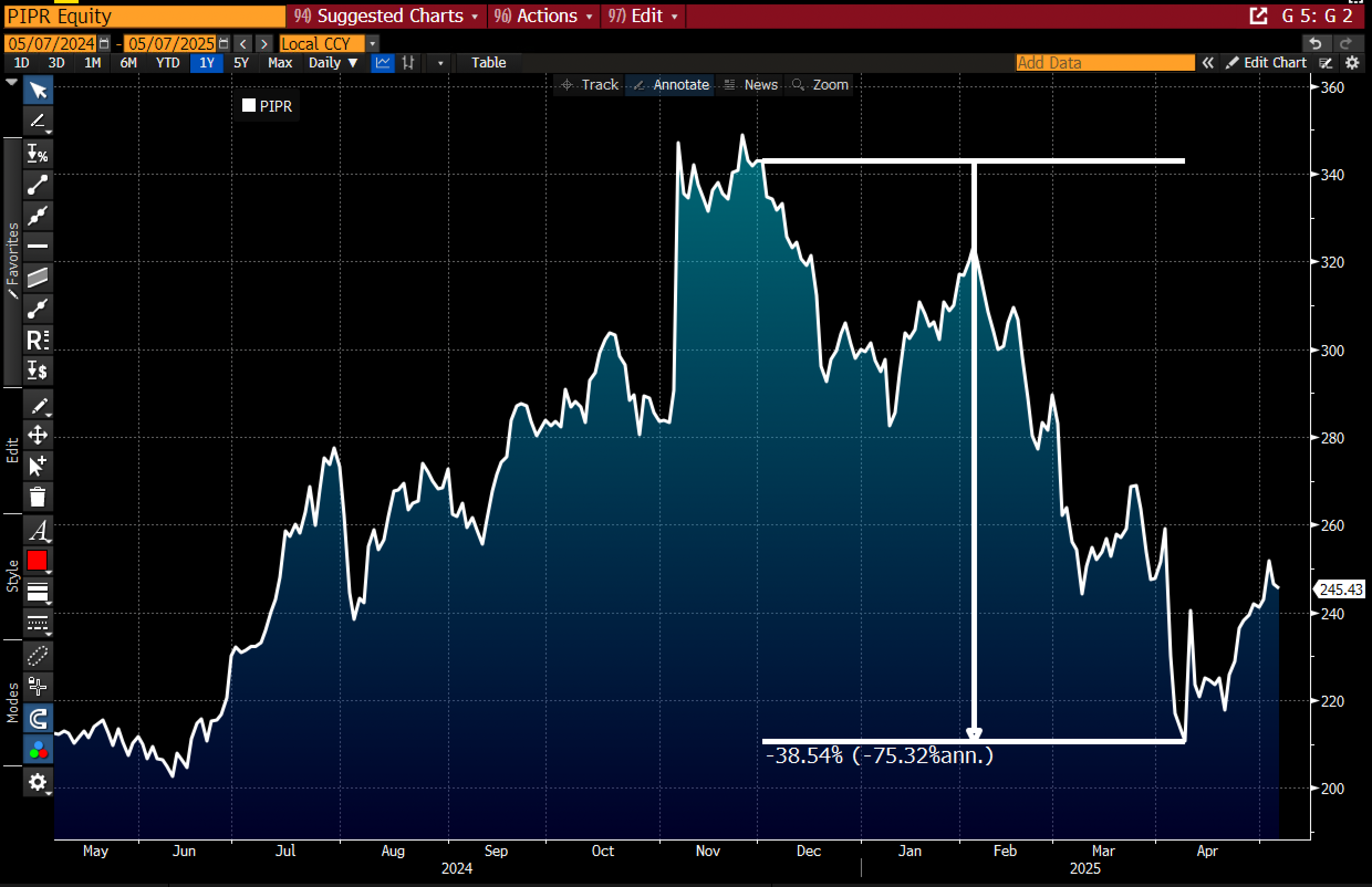
The set up was, huge runs upwards in multiples (industry vibes) and deteriorating actual deal flow pull through (Trump volatility pausing activity) both at the same time. So you didn’t even really need them to post bad results, you literally just needed the market to see that the boom boom times were on pause.
But … the game has changed. And when the data shifts, you shift with it. That’s not style drift. That’s just being intelligent.
Earnings overall for the sector has not been terrible at all. In fact there was some deal pull forward, which is to be expected. But there hasn’t been enough time for this to truly get bombed out as a sector. M&A has slowed, not stopped.
And so when I read through Goldman’s latest M&A activity report it showed something simple: the advisory world is splitting in two. Some firms are winning mandates again. Some are quietly fading. Backlogs are no longer filled. Deal momentum is uneven. And if you know where to look, the edge is starting to form.
I’m not going directional on the whole sector. I’m not trying to guess whether M&A volumes will be up 20 percent next quarter. What I am attempting to do is run a clean, balanced, market-neutral book that goes long the winners and short the ones still living off inertia. At least in theory …
My framework is built on three simple pillars:
Where earnings and valuation stand today
Who’s winning actual mandates and building backlog
What could make things all go wrong
Below are 4 names I’m leaning long and 4 I’m leaning short. Some “where does this go wrong” analysis and then a handful of factors to look out for. If you’re looking for pairs in the investment banking space, looking to learn who is performing behind the scenes, or just want to learn the space, then read on.
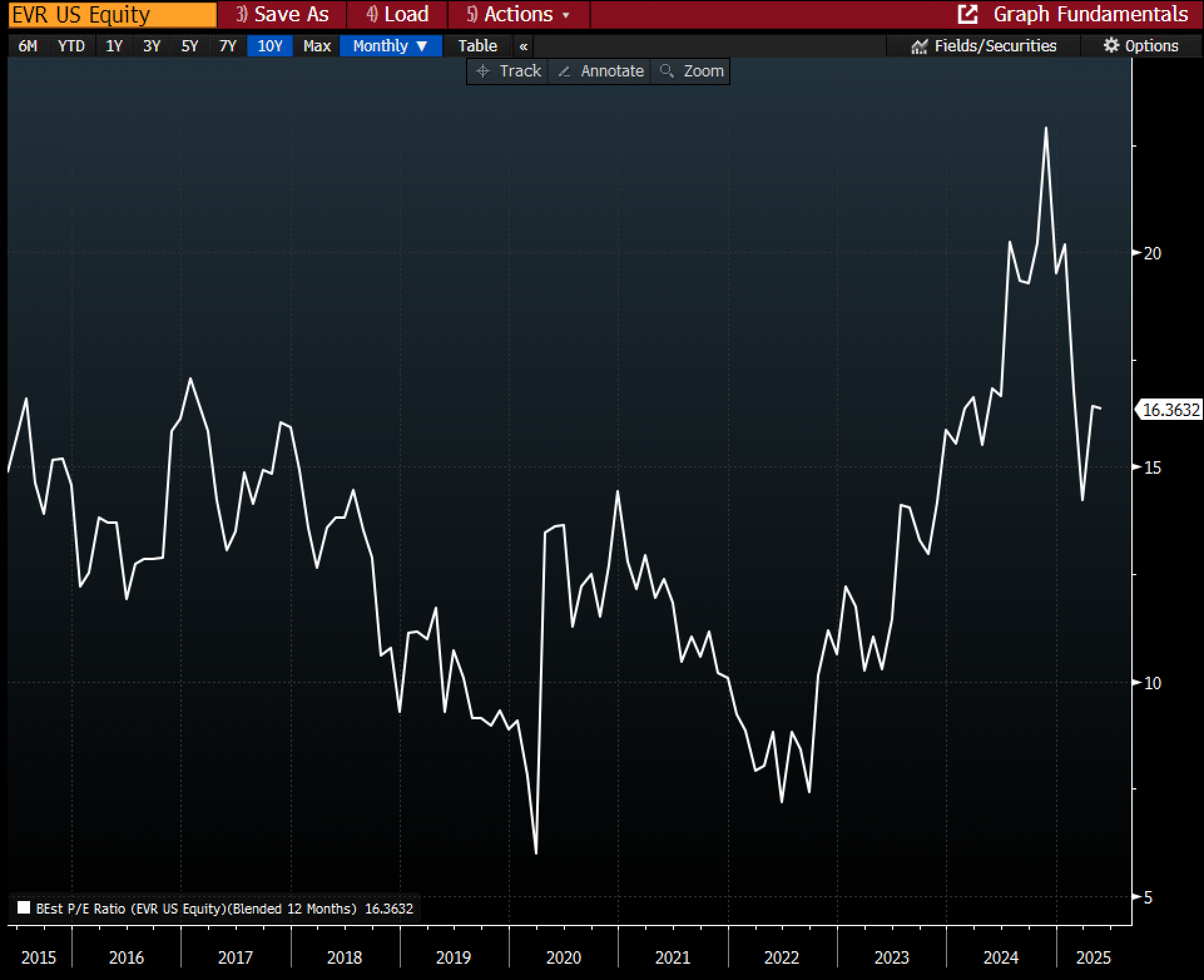
Evercore (EVR): $8.4B Market Cap / $205 Price / 16x forwards / $10.55 LTM EPS
Bias: Long
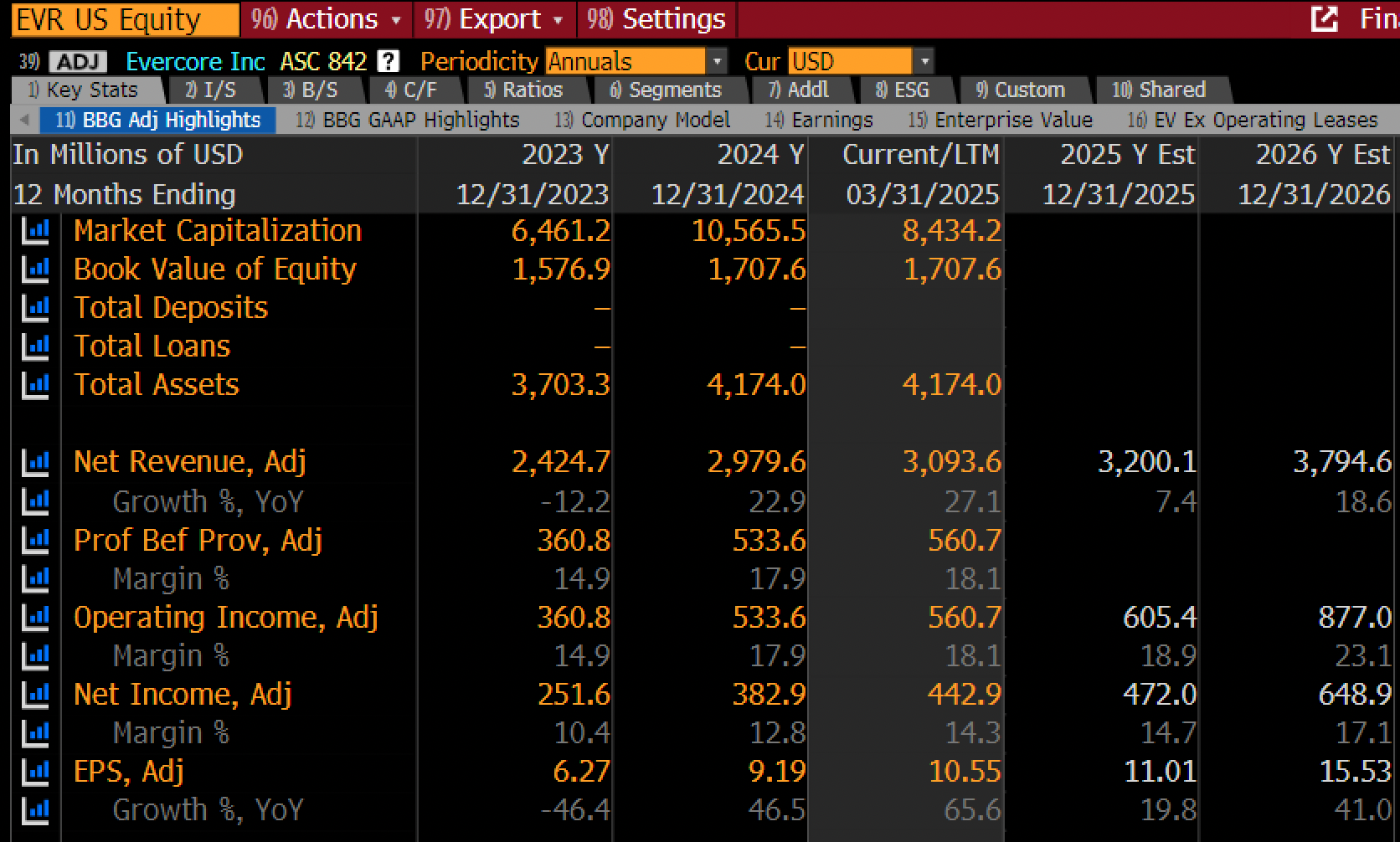
Evercore hasn’t just improved. They’ve detonated to the upside. In Q2 to date, they’ve announced $36.6 billion in new M&A volume across 18 deals which is a staggering massive increase compared to 3 year average. Completed deal volume year-to-date stands at $13 billion across 9 transactions. Their fee backlog now sits at $454 million, up 8 percent year-over-year, making it one of the fastest-growing books among the independent advisory set. They are actively winning mandates and capturing share.
Put bluntly, they are lapping the field. Among boutiques, Evercore is easily the standout. Their announced volume is nearly triple that of Jefferies and more than double PJT. Lazard and Houlihan aren’t even in the conversation. Even when stacked against bulge brackets, they hold their own. Only Morgan Stanley and JPMorgan carry larger backlogs, and those are multi-line, full-service banks. Evercore is doing it with a pure-play model and a leaner footprint. The 42 mandates they’ve underwritten this quarter signal something even bigger, real momentum. This is not a firm waiting for the M&A cycle to return. It’s already catching the early wave.
The stock trades at 16 times forward earnings, which is not cheap on paper but makes sense when you look under the hood. If even a third of that backlog converts, they’ll beat consensus by a full dollar per share. That’s not a stretch case. That’s just math. The deal mix is attractive too, healthcare, tech, and mid-cap sponsor flow, all sectors that tend to hum even when the broader market hesitates. They’re also one of the most AI-forward platforms, according to Morgan Stanley, which sets them up well for secular relevance regardless of macro cycles.
Evercore’s setup is tight. The balance sheet is clean. Tariff exposure is low. And while they’ve lagged in buybacks recently, they’ve got the flexibility to reload if the opportunity presents itself. I like them here.
PJT Partners (PJT): $6.1B Market Cap / $142.7 Price / 23x forwards / $5.38 LTM EPS
Bias: Long
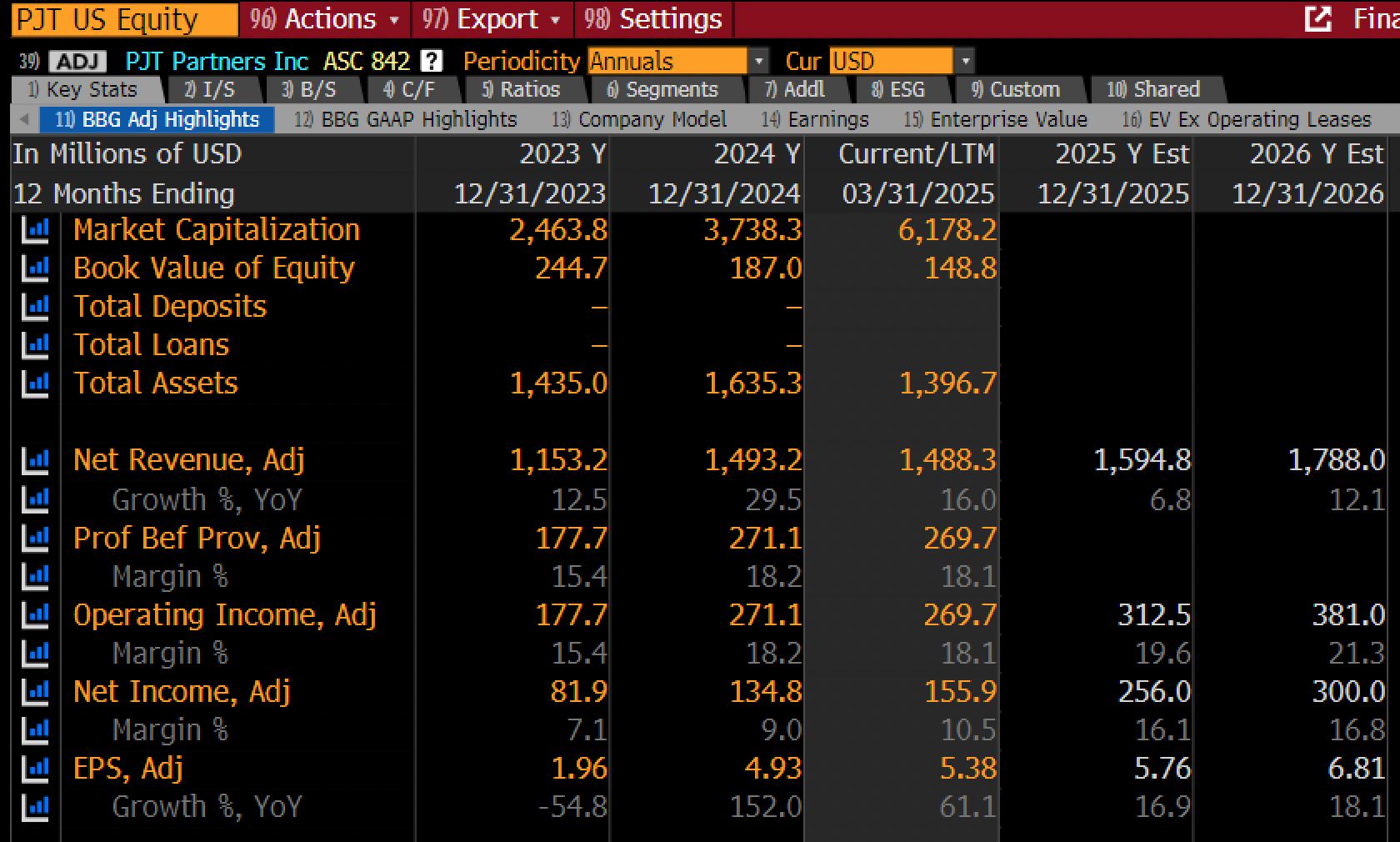
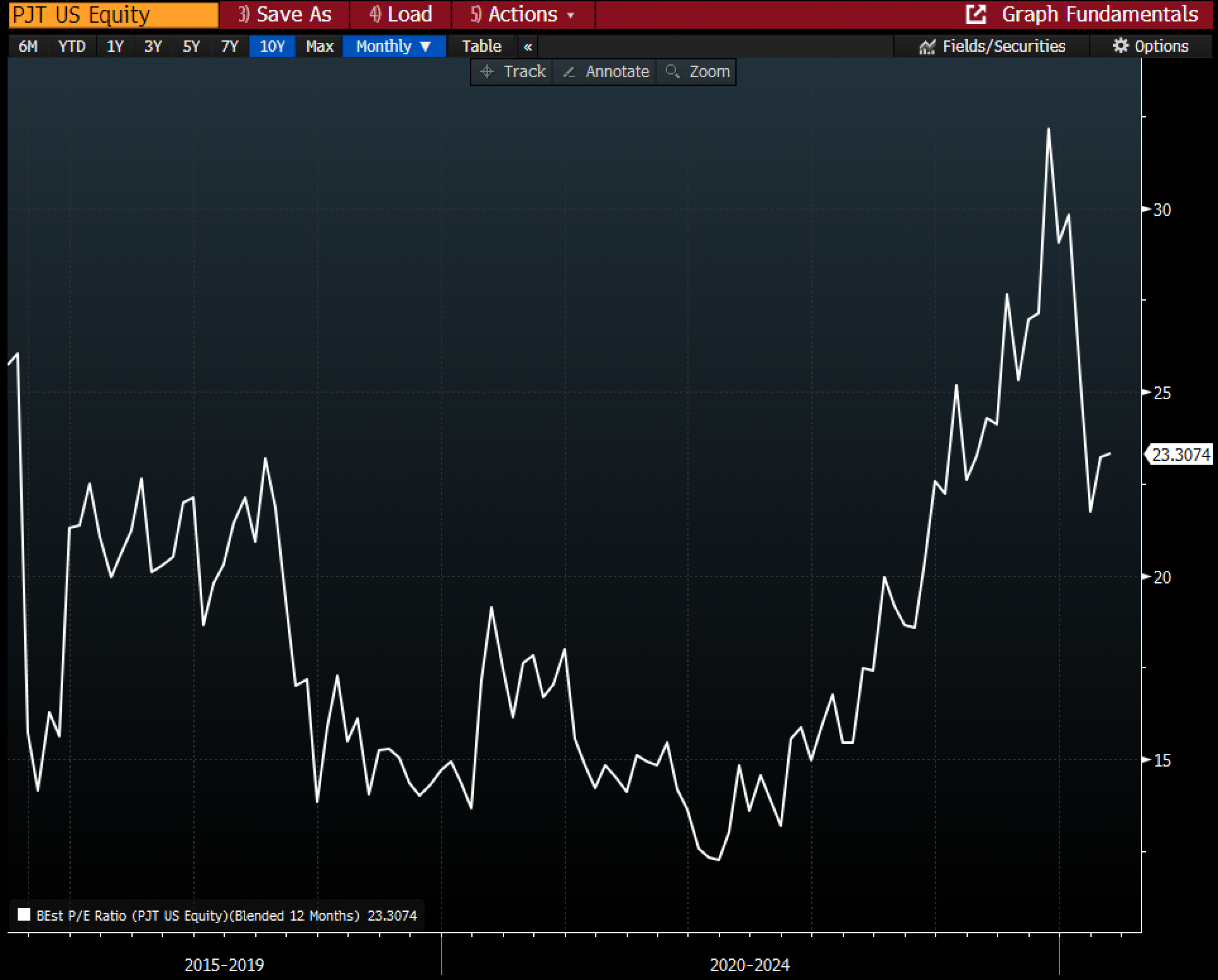
If Evercore is speed, PJT is torque. And you know how I feel about torque. In Q2 so far, PJT has announced $13.5 billion in deals across 13 mandates. Their backlog is now $345 million in fees, which maps to an estimated $31.6 billion in potential deal value. That’s up 177 percent year-over-year. And when you zoom out across the sector, PJT’s backlog growth is the most aggressive of any major advisor, independent or otherwise. That tells you they’re doing something different, and that they’re doing it well.
The nature of that backlog matters. PJT’s client base is deep-pocketed, opportunistic, and often event-driven. Sponsors. Restructurings. Special sits. This isn’t sleepy strategic advisory. It’s the kind of work that hits in lumpy but powerful waves. The stock trades at 23 times forward earnings, which means you’re paying up for potential, not predictability. But that premium makes sense when you consider how much earnings torque is packed inside even a few mandate conversions. One or two meaningful deals dropping into earnings can blow out estimates. That’s the asymmetry you want when positioning for early-stage momentum.
PJT isn’t a bulky name. It’s lean. It’s agile. It doesn’t carry the overhead that weighs down the bulge brackets. That matters in volatile environments where flexibility and client access mean everything. Tariff risk is minimal. Sector exposure is diversified enough to avoid binary outcomes. But this isn’t without risk. The mandate count isn’t massive. If one or two big clients delay, miss, or walk away, the quarter can slip fast. I like it long.
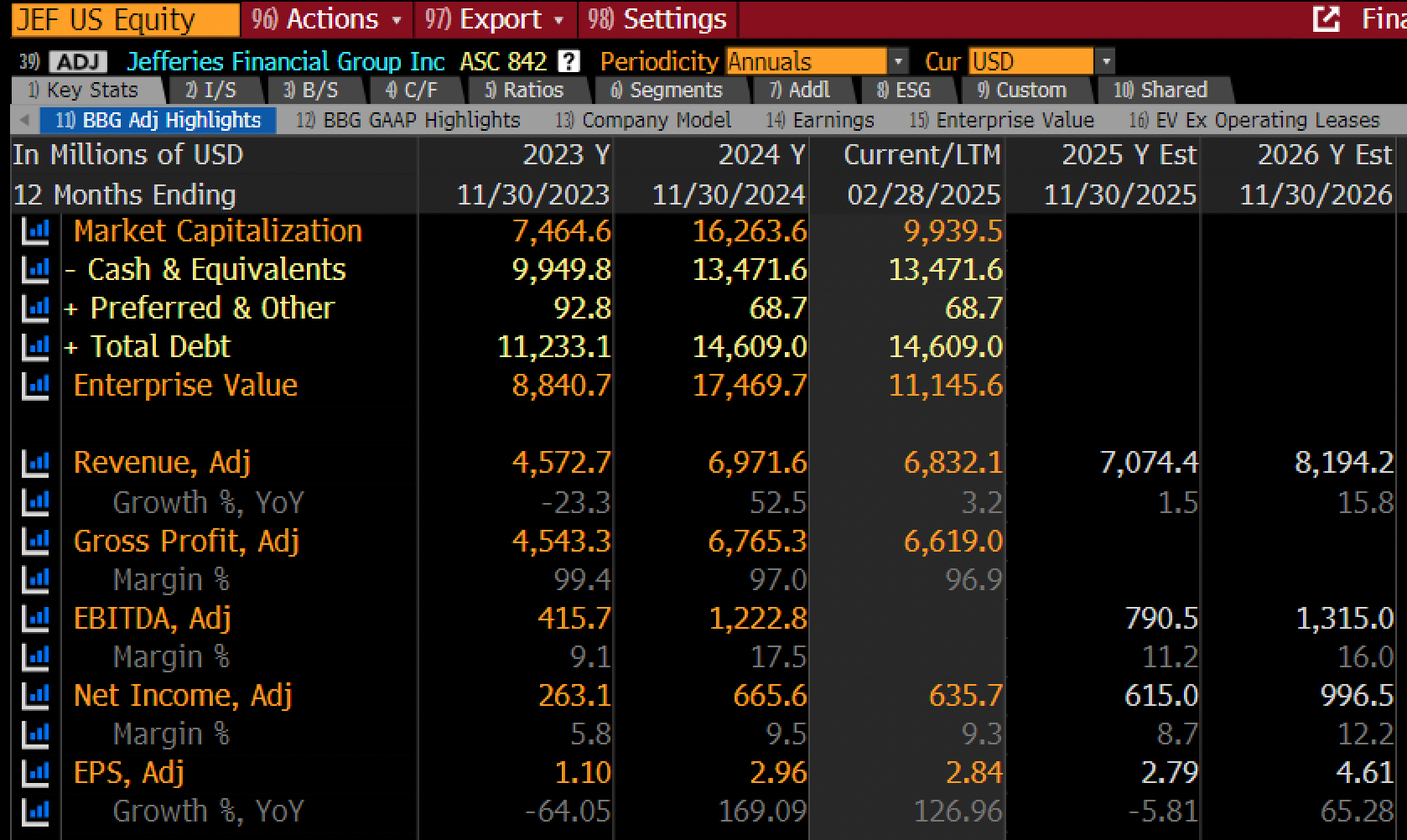
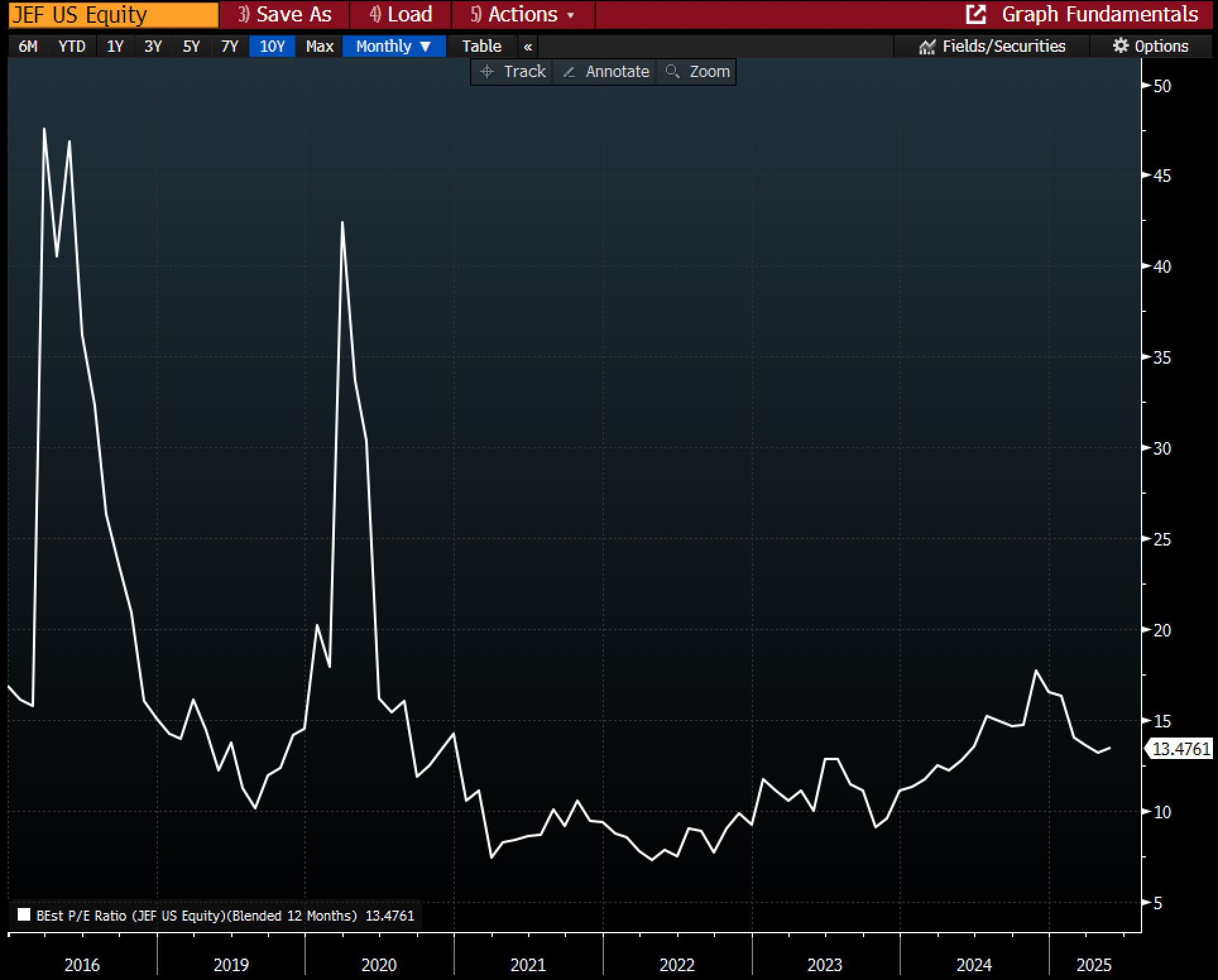
Jefferies (JEF): $9.9B Market Cap / $48.19 Price / 13.5x forwards / $2.84 LTM EPS
Bias: Long
Jefferies is moving in stealth. No headlines, just quiet execution. So far this quarter, they’ve announced $21.7 billion in deals across 13 transactions and locked in 41 new mandates. That’s not off-the-charts, but it’s sturdy. More importantly, they’ve already completed $33.5 billion in M&A year-to-date, which puts them among the top performers across the advisory space. Their fee backlog sits at $376 million, up 22 percent from the start of the year and holding near the highs of the group. That consistency is what makes JEF stand out right now.
They trade at just 14 times forward earnings. That’s a bargain for a shop that’s spent the past year quietly transforming itself. Headcount is leaner. Sector focus is tighter. They’re winning mandates in tech, energy, healthcare, and with sponsors. All the right places. And because they aren’t pure-play advisory, they have more flexibility than most. That diversification gives them room to maneuver if deal momentum stalls, but doesn’t stop them from fully participating if things ramp.
Tariff exposure is low. Their operating model has shed a lot of its legacy bloat. They aren’t betting on a big wave to justify valuation. I like Jeffries here in this market neutral type IB bet.
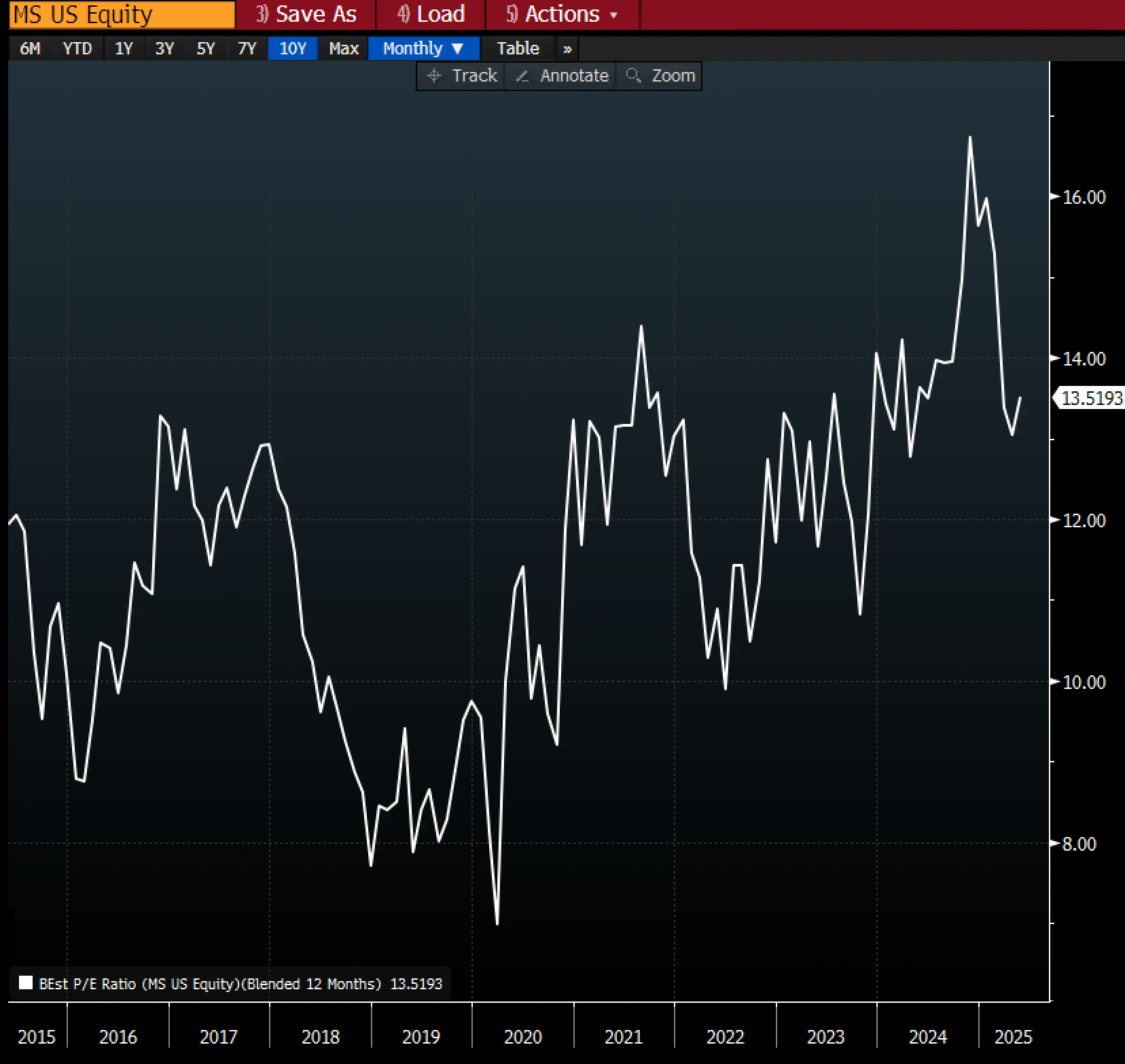
Morgan Stanley (MS): $190B Market Cap / $118.33 Price / 13x Forwards / $8.52 LTM EPS
Bias: Long
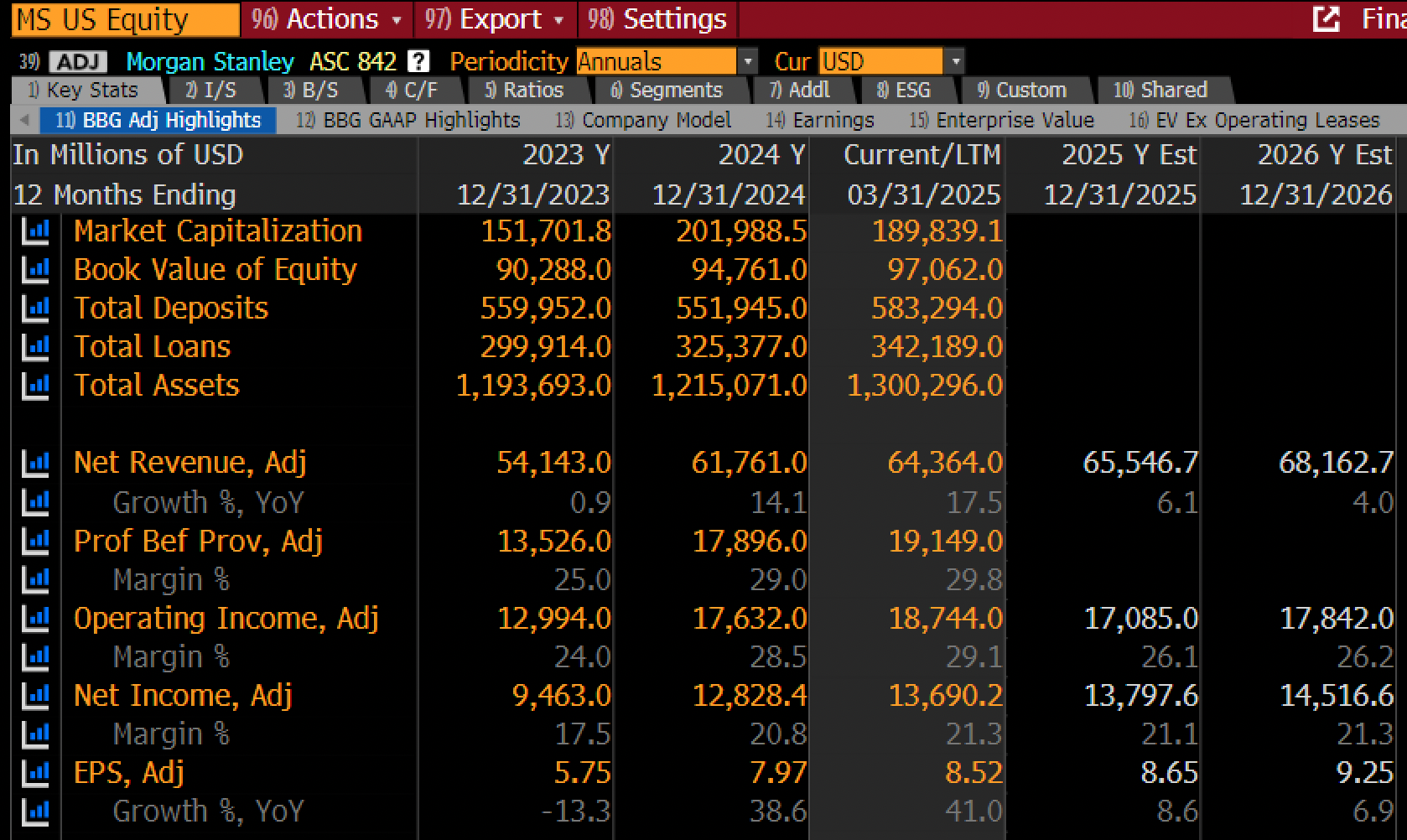
Morgan Stanley is the quiet giant in this space. Year-to-date, they’ve completed $66.8 billion in M&A deals, the most of any U.S. investment bank. Their announced volume sits at $48.3 billion across 17 deals, and their fee backlog has climbed to $1.38 billion, up 10 percent year-to-date and 36 percent higher than this time last year. That puts them at the very top of the backlog leaderboard, ahead of JPMorgan, Citi, and everyone else.
The stock trades at14 times forward earnings. That’s low for a platform that’s as embedded across wealth management, asset management, and advisory as Morgan Stanley. The advisory business is effectively free optionality at this point. You’re paying for the annuity-like stability of wealth and getting a shot at upside if M&A trends continue to unthaw. And that optionality could be meaningful. Even a modest improvement in backlog conversion adds hundreds of millions in incremental fee revenue and margin.
What makes MS especially compelling right now is positioning. They’re not chasing cyclicals. They’re not exposed to fragile sectors. They’re winning mandates in tech, and healthcare. They’ve kept compensation ratios in check. They return capital aggressively. And Morgan Stanley is also one of the few large banks leaning hard into AI across their investment banking and wealth platforms. That gives them a long-term strategic angle most of their peers can’t match. I like them long.
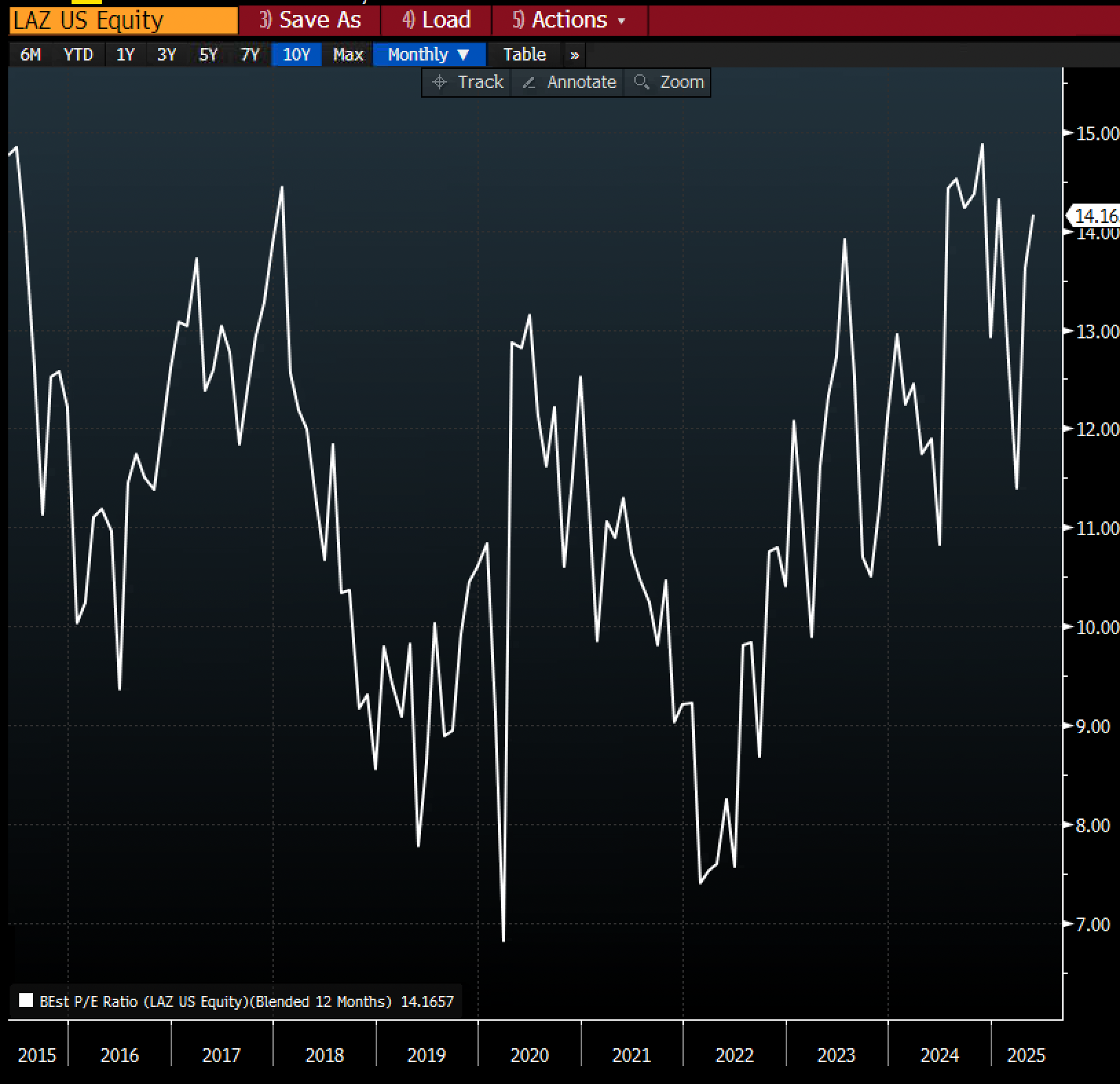
Lazard (LAZ): $4.6B Market Cap / $40.84 Price / 14x Forwards / $2.22 LTM EPS
Bias: Short
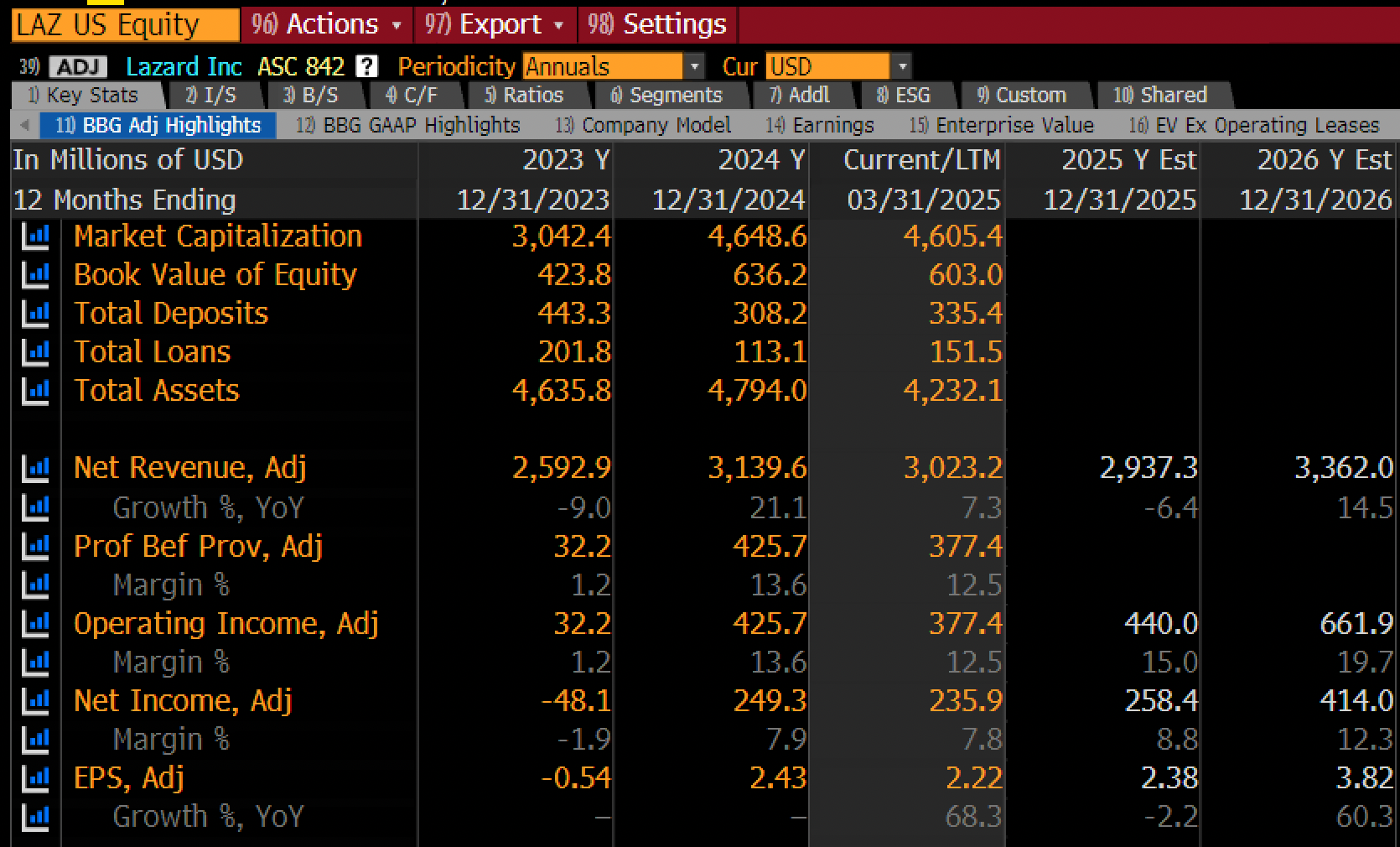
Lazard was once a titan in global advisory, a firm that punched above its weight and delivered real results. But the scoreboard doesn’t lie. This quarter, they’ve announced just $2.8 billion in new deals across 5 mandates, a shadow of their former self. Their completed M&A volume YTD is $66.5 billion, which might sound impressive until you realize nearly all of it came in Q1 and not from new business. The fee backlog tells the real story: it’s down to $412 million, a 21 percent decline year-over-year and one of the sharpest drops across the space. The pipeline is thinning, the mandate flow is drying up, and for a firm that lives and dies on advisory fees, that’s a problem.
The stock trades at 14 times forward earnings. On the surface, that might look reasonable. But under the hood, it’s completely disconnected from the fundamentals. Lazard has no capital markets arm, no trading desk, no recurring revenue stream to cushion the blow if M&A activity slows. Worse, their business is highly global and cross-border. That makes them one of the most tariff-exposed names in the group. In a world where geopolitics are unstable and trade is being weaponized again, that’s not a great place to be.
What makes the setup even more fragile is the comp structure. Lazard’s compensation model is sticky and slow to flex. When revenue falls, margin compression follows almost immediately. And with backlogs shrinking and new mandates scarce, that pressure is only going to build. I am fading LAZ here.
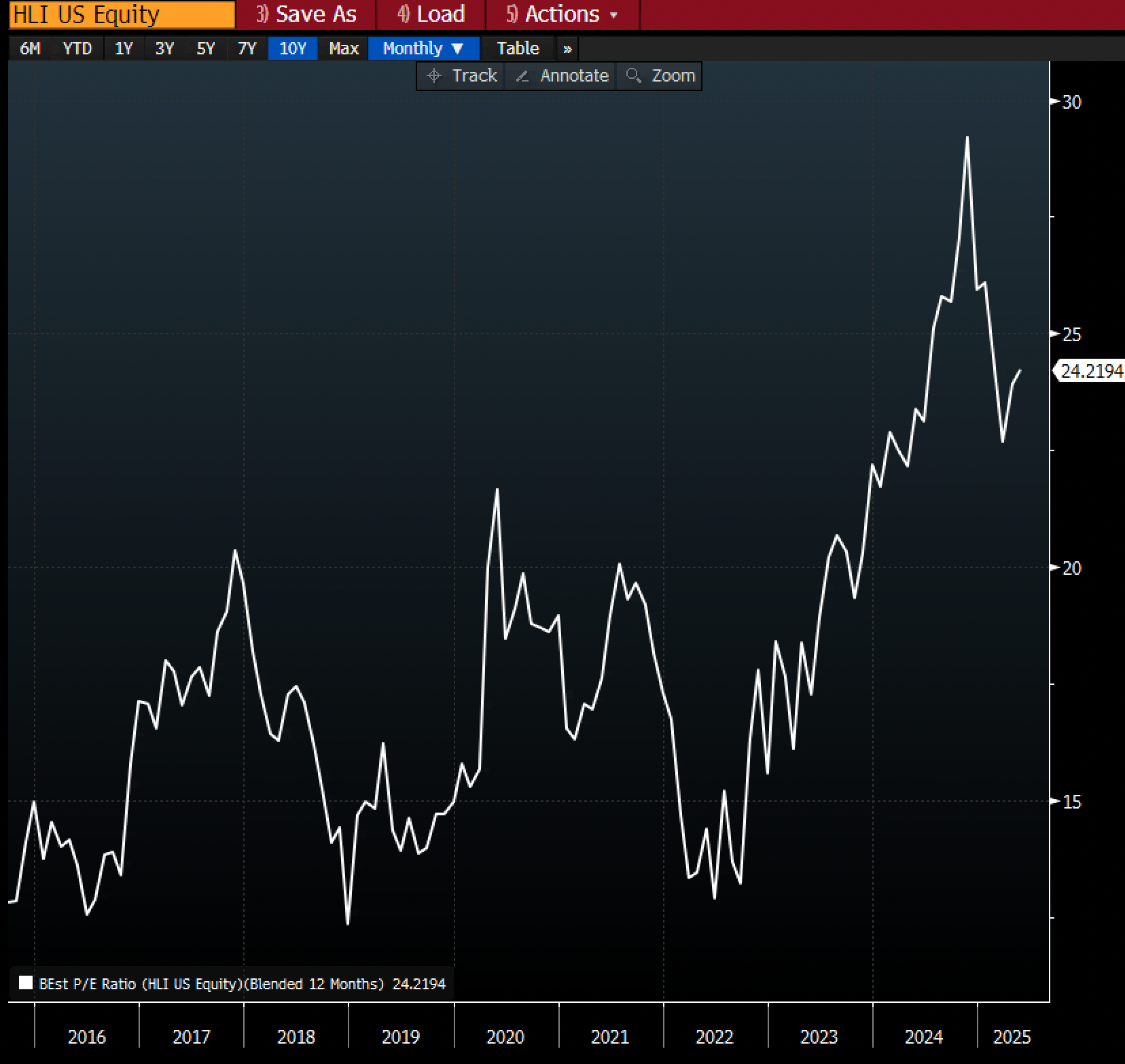
Houlihan Lokey (HLI): $11.5B Market Cap / $164.83 Price / 24x Forwards / $5.80 LTM EPS
Bias: Short
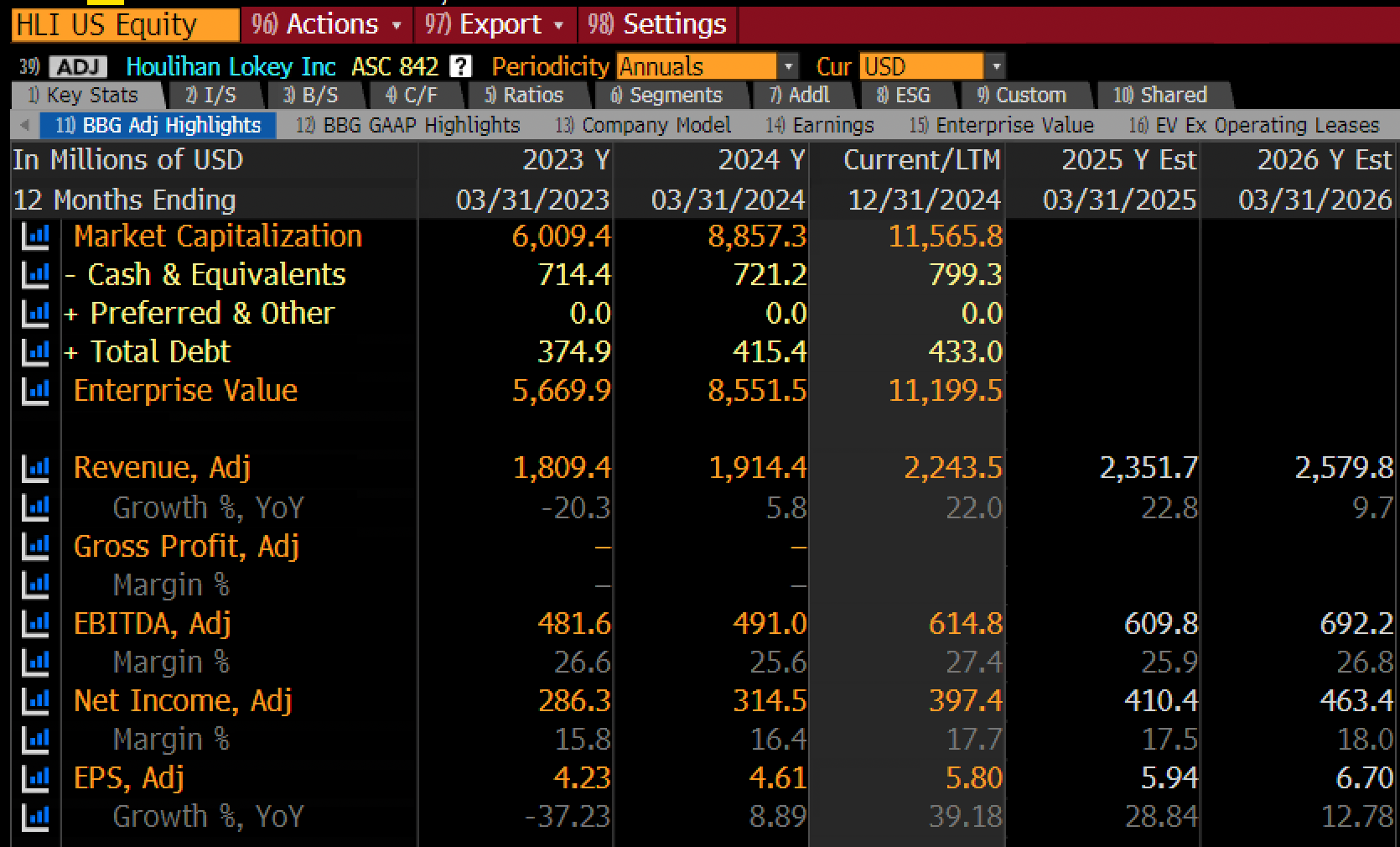
Houlihan Lokey is slowing, and the signs are getting harder to ignore. This quarter, they’ve announced just $3.7 billion in deal volume across 12 mandates. That’s a modest pipeline by their standards and a clear comedown from prior momentum. Their fee backlog sits at $113 million, down 12 percent year-over-year and slipping another 10 percent since the start of the year.
The market still prices HLI like a company with structural tailwinds. They trade at over 24 times forward earnings and nearly 30 times trailing. That’s a steep premium in a market where fee compression, volume softness, and macro overhangs are all real. It’s especially aggressive when you consider their core client base lives in mid-cap industrials, real estate, and other tariff-sensitive sectors. Those are the areas feeling the brunt of global trade friction and higher-for-longer rates. If you’re going to justify that multiple, you need evidence that they’re continuing to win business at scale. Right now, the data suggests otherwise.
Houlihan’s strength has always been its client loyalty and mid-market dominance. But that edge works both ways. When volume slows or sentiment turns, there’s no offsetting revenue stream. They don’t have a capital markets engine or trading arm to lean on. Their revenue is tied directly to the deal flow that’s now fading. Fade for me.
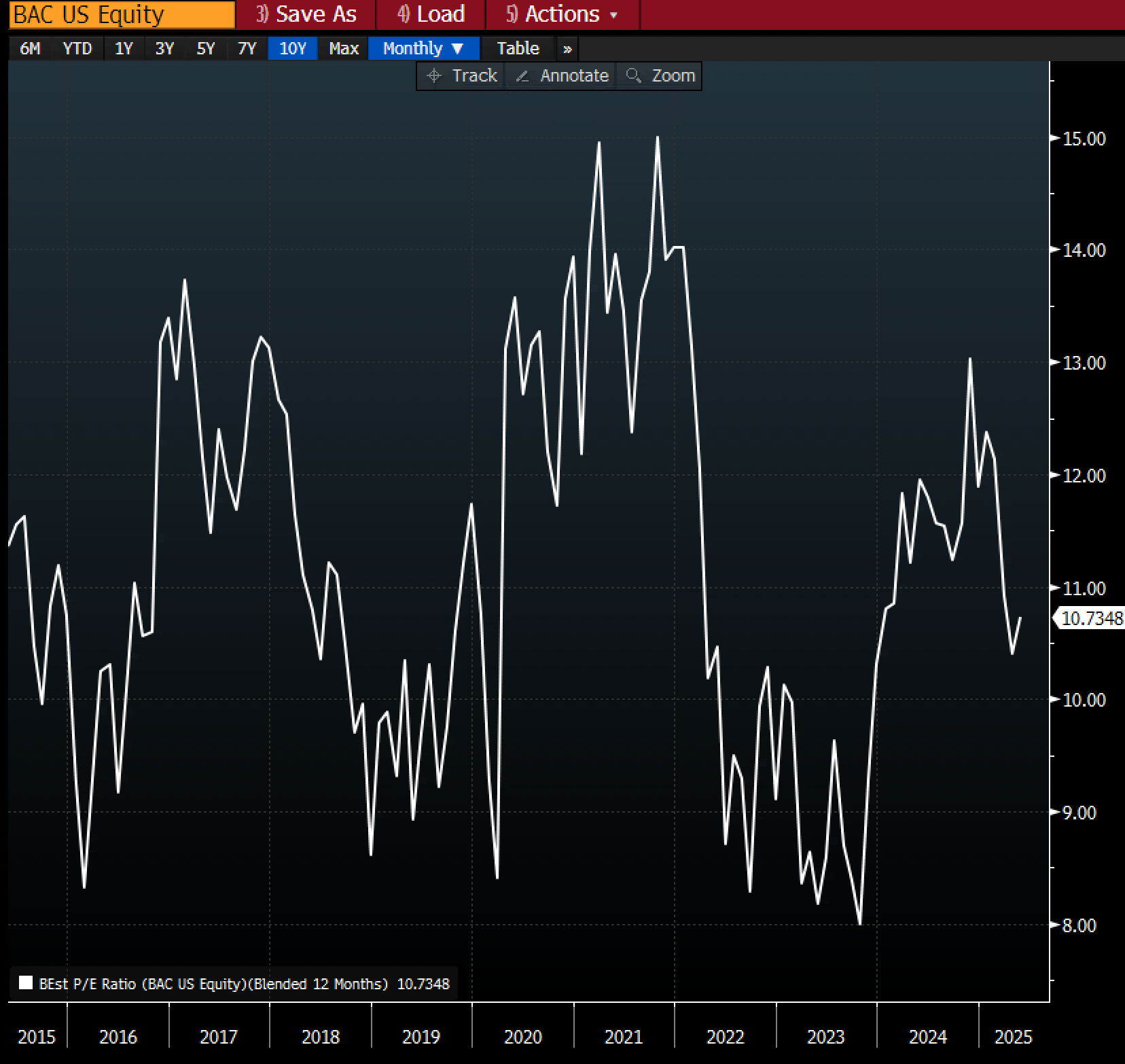
Bank of America (BAC): $310B Market Cap / $41.27 Price / 11x Forwards / $3.39 LTM EPS
Bias: Short
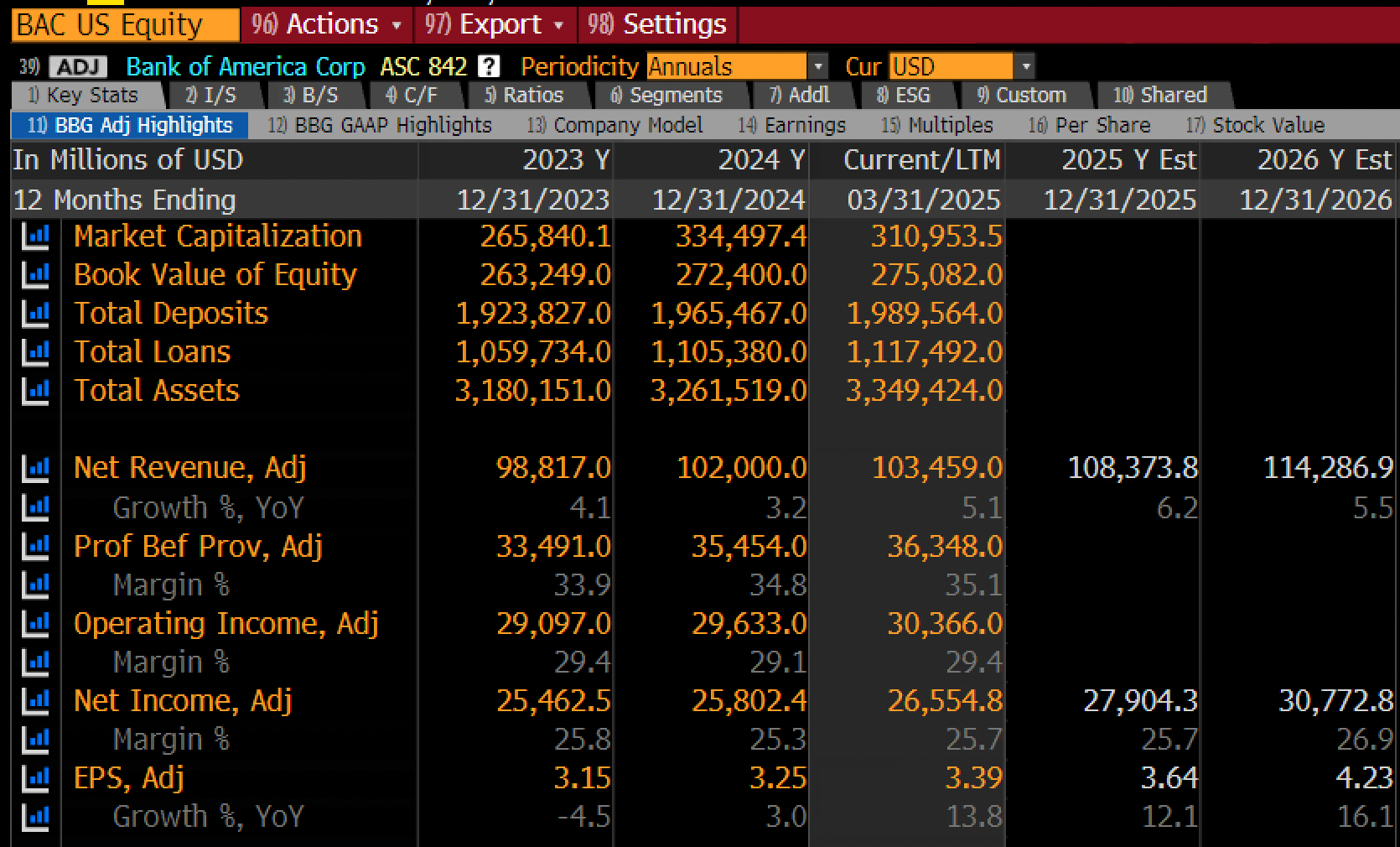
Bank of America has completed $15.7 billion in M&A volume year-to-date, which might sound respectable in isolation. But context matters. Their announced deal volume is down more than 80 percent year-over-year, a staggering collapse that puts them firmly in retreat mode on the advisory front. And while BAC isn’t a pure-play advisory firm, they’re a massive retail and commercial banking franchise, the advisory slowdown is still a drag on overall momentum.
The stock trades at 11 times forward earnings. On the surface, that looks cheap. But not when you zoom in on advisory. That multiple is carried by scale, balance sheet heft, and retail banking stability, not deal momentum. And unlike the boutiques or focused platforms like MS, BAC doesn’t have an advisory franchise that’s firing. They’re not winning mandates. They’re not building backlog. They’re not even holding ground.
Morgan Stanley is converting backlog into revenue. BAC is sitting on its hands. Morgan is gaining share. BAC is hoping for a turnaround. BAC might be a decent retail bank, but in the context of this trade, it’s simply a short. It funds better ideas. It offsets names that are compounding actual wins. This isn’t about whether BAC is broken. It’s about whether it belongs in the same breath as firms that are clearly outperforming. And right now, it doesn’t.
Six Things Most Investors Are Missing About Investment Banking Revenue
Backlog is not revenue. Backlog is a starting point, not a finish line. It's potential energy, not kinetic. If you're slapping a 1:1 EPS boost on a backlog headline, you're doing it wrong. Evercore might convert 60 percent of theirs because they’ve got mandate depth, sector mix, and execution velocity. PJT? Probably closer to 40 percent given the lumpiness of sponsor and special sits. Lazard? You’re dreaming if it’s more than 25. Don’t build fantasy earnings off a pipeline that may never hit the tape. Sharpen your pencil. Backlog is a tell, not a promise.
League tables are backward-looking. If you're waiting for the year-end ranking to figure out who's winning, you're already late. The real edge is in tombstone flow, the deal flyers, the footnotes, the fine print. Who’s showing up on the $1 to $5 billion sponsor mandates? Who's underwriting mid-cap cross-border tech deals no one’s tweeting about yet? That's where the money is. It’s not about who won last quarter. It's about who’s winning this morning. Real-time deal flow is alphal, league tables are just the receipts.
Tariff exposure is not theoretical. This isn’t about taking sides on politics. It’s about understanding risk. Firms like Lazard and Houlihan Lokey with heavy cross-border mix and global strategic clients are sitting in the blast radius of trade policy. A headline can erase a pipeline overnight. Meanwhile, names like Jefferies, PJT, and Evercore with domestic-heavy deal flow in healthcare, tech, and clean energy are better positioned. They’re built for resilience when uncertainty spikes.
Comp ratios are the silent killer. Everyone models revenue. Few people model comp rigidity. That’s a mistake. Advisory firms live and die by compensation flexibility. PJT and Morgan Stanley can adjust comp if revenue misses. Lazard and Houlihan? Not so much. Their comp models are sticky. When top-line slips, margins collapse fast. Nobody sees it until the earnings print hits the tape. By then, you’re the one getting fleeced. Watch the fixed cost base and how it reacts.
Capital return isn’t nice to have. It’s an edge. In a market that punishes uncertainty and rewards cash deployment, capital return is amplification of fundamentals. Morgan Stanley and Jefferies are actively buying back shares at attractive valuations. PJT has dry powder. Evercore can reload quickly. But others, especially smaller or structurally constrained firms, don’t have the flexibility. In sideways or rangebound markets, returning capital is what turns a decent quarter into a good one and a good one into a re-rating.
You are early. That’s the whole point. Backlog leads revenue. Revenue leads EPS. EPS leads price. If you wait for the beat to hit Bloomberg, it’s already in the stock. These trades aren’t about confirmation. They’re about positioning. The whole game is skating where the puck is going, not where it’s been. That means betting on backlog velocity, mandate quality, and margin setup before the Street connects the dots. If you need the green light to flash before moving, you’ll miss it every time.
Final Word
The edge isn’t in waiting for the all-clear. It’s in recognizing when the tempo shifts, when the noise fades and the signals start to align. You don’t need perfect visibility … you need conviction built on data, positioning, and the scoreboard. That’s what this whole setup is about.
Evercore is sprinting ahead with the strongest mandate velocity in the space. PJT is packed with latent torque and upside reflexivity. Jefferies is quietly executing with consistency and valuation support. Morgan Stanley is the foundational long—stable, dominant, and underpriced optionality. On the short side, Lazard is shrinking while the market pretends it’s still a contender. Houlihan Lokey is overvalued and underdelivering. And Bank of America is losing mandates, lagging backlog, and not cheap.
This isn’t a bet on M&A roaring back. It’s a bet on the firms already pulling ahead while others drift. You don’t need a booming cycle to make money here. You just need to know who’s paddling early, catching the swell, and carving through chop while the rest are still waiting for perfect conditions. Backlogs are building, mandates are shifting, and the current is already moving. By the time the Street sees it, the wave’s already broken.
The best is ahead,
Victaurs
The research behind essays like this one lives in the Terminal: open Research. 107+ companies and counting.