Nobody Can Pick Individual Momentum Winners, and That's The Good News
Momentum is a real, documented edge going back to the 1800s. It only pays if you stop trying to picking one offs.
I spent 5-6 years of my life getting paid to throw a baseball, so you’ll have to humor me here with the intro. Did you know that the greatest hitting catcher of all time and Hall of Famer was drafted in the 62nd round of the draft? Taken with the 1,390th pick (I was drafted inside the top 10 rounds) and allegedly as a favor to his father’s childhood friend, Tommy Lasorda.
If you don’t know, this player is Mike Piazza, who ended his career with 427 home runs and was a perennial All-Star.
Turns out the MLB draft is tough. Scouts are paid to travel the country, and now the globe, trying to find the diamond in the rough. Teams pre-calculate odds of MLB success, thoughts on costs to sign players, and every other metric Moneyball taught us. And yet at best it’s still a crapshoot. Most first rounders never carve out a real MLB career, and the hit rate falls off a cliff from there.
What you may ask does this have anything to do with Momentum investing?
Everything.
Sacerdote and Whale Rock
I recently listened to a podcast with the head of Whale Rock, Alex Sacerdote, that was eye opening. Like most quant work, a good amount was well over my head, but the concept I took away the most was surrounding S-curves. Mainly that the Street (and all humans) model straight lines, because compounding curves are hard for our little brains to fathom. The reality is that some companies bend. Far from linear, companies like Micron, Sandisk, or Nvidia experience accelerating results in what looks like the classic inflecting parabolic up and to the right function. The key is to find them before inflection, or early in inflection, and before multiples expand. This is far easier said than done.
By the afternoon that day I (thanks Claude) had a far from one-shotted screen with the goal of looking for two things. One, companies with inflecting or accelerating top lines. Two, accelerating top line companies that weren’t priced like it.
The machine worked, and it’s built into the Terminal, but the lesson it taught wasn’t the one I wanted.
Mean, Median, and Power Law
First, in keeping with the baseball theme, the screen gave me BATRA as the #18 accelerator in America. That company? The Atlanta Braves. And while it’s not impossible, I quickly realized this was a data issue. FMP (the same data engine Perplexity uses for financials) had mis-reported a quarter’s revenue, roughly adding a zero, and creating an S-curve where none existed. So check your data.
The acceleration screen reads mostly like a hype based X account pumping the last thing that went up 300%, but there are certainly gems in there too. The question always though is price, namely am I paying for acceleration nobody sees or pipe dreams?
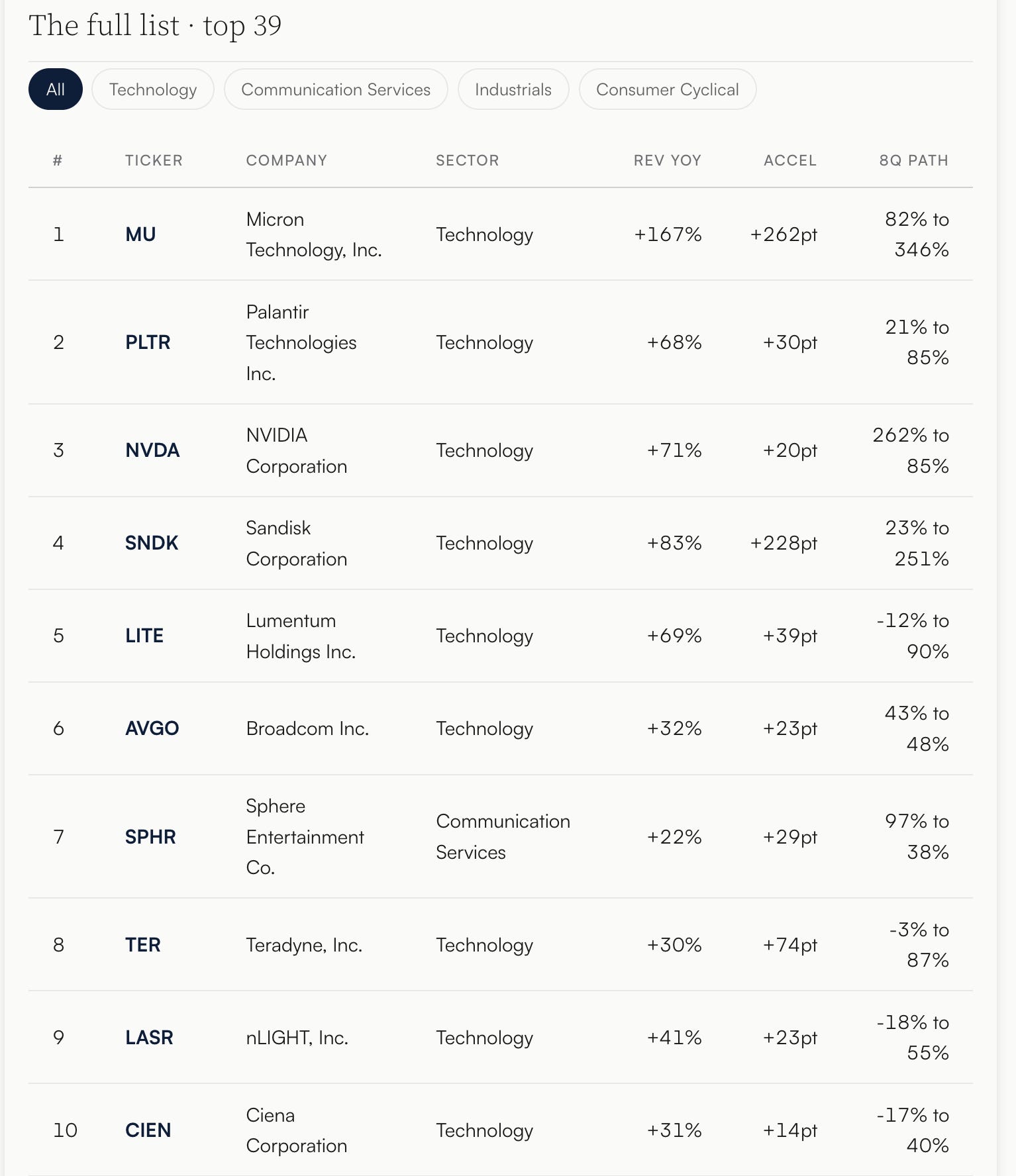
Before taking this as gospel, I did some backtesting. I took the top 30 accelerators, in quarterly cohorts from 2022 to 2025. I wanted to see if S-curves produced excess alpha at least using revenue acceleration as a factor.
What did I find?
That basket returned 34% vs. QQQ at 22% at 12 month intervals. The big catch: only 12 of 30 beat the market. More importantly, the typical pick made roughly 15%, below the index. Punch line being, the strategy wins, yes, but the average pick loses.
And worse. I layered “safety” filters on top of raw acceleration: first a clean weekly uptrend, then a strong beat streak on top of that. The returns got progressively worse. Acceleration only, 34%. Plus uptrend, 31%. Plus the beat streak, 23%. Every filter made the picks look safer and made less money, because the filters trim out the right tail, and the right tail is the whole point.
In Momentum, This is the Whole Point
I’m late to the party, because this concept has been documented for a century. Bessembinder’s “Do Stocks Outperform Treasury Bills?” studied 1926-2016 and found that the median stock loses to T-Bills over its life, and around 4.3% of companies created all net US market wealth over that period. Call it a Pareto Law on steroids.
AQR, via Asness, Frazzini, Israel, and Moskowitz, did a wonderful study, “Fact, Fiction, and Momentum Investing,” that added that more than anything momentum needs rules, not conviction. It’s a real edge in documented data going back to the 1800s. But the premium comes from disciplined rebalancing into whatever just won, which humans hate doing. In this way the edge exists because it’s uncomfortable.
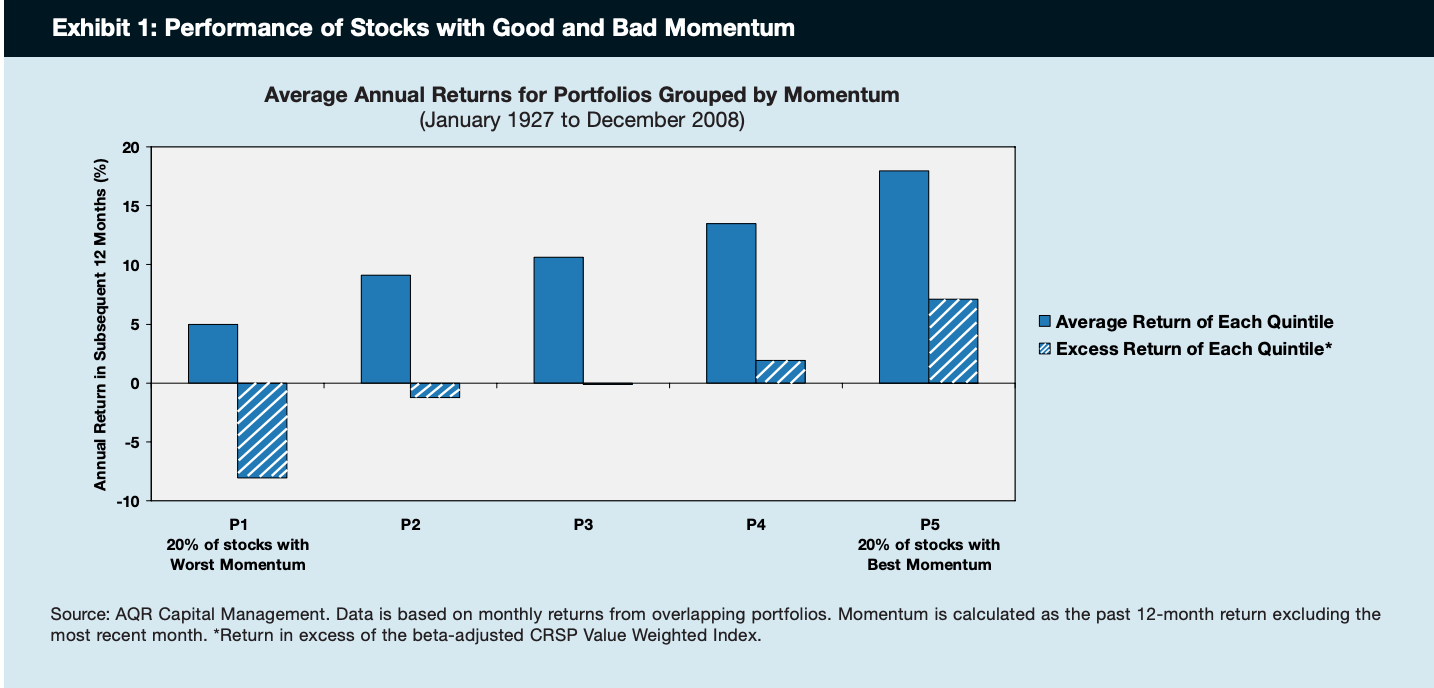
So the factor works, but you can’t be emotional. And trying to cherry pick individual momentum stocks could lead to ruin. I repeat this again, unless you are a trained professional, be very careful trying to pick just one as fun as it may seem.
Momentum is On One Right Now
Momentum just took a beating. The factor realized 36% annualized volatility over three months, which Goldman's Tony Pasquariello called the highest in 45 years outside a recession. Thirty-day momentum vol ran near 100 while the S&P sat at about 14. Their high-beta basket had its worst two-day fall since the COVID crash and the index barely flinched. Then it turned around and ripped 9.4% in a single session, one of the best one-day rallies in five years. Par for the momentum course actually.
And yet the weekly trend is still intact. SPMO, the biggest S&P momentum fund, is about 11% off its high while the S&P is down under 3%, and it hasn't lost its 21 week moving average.
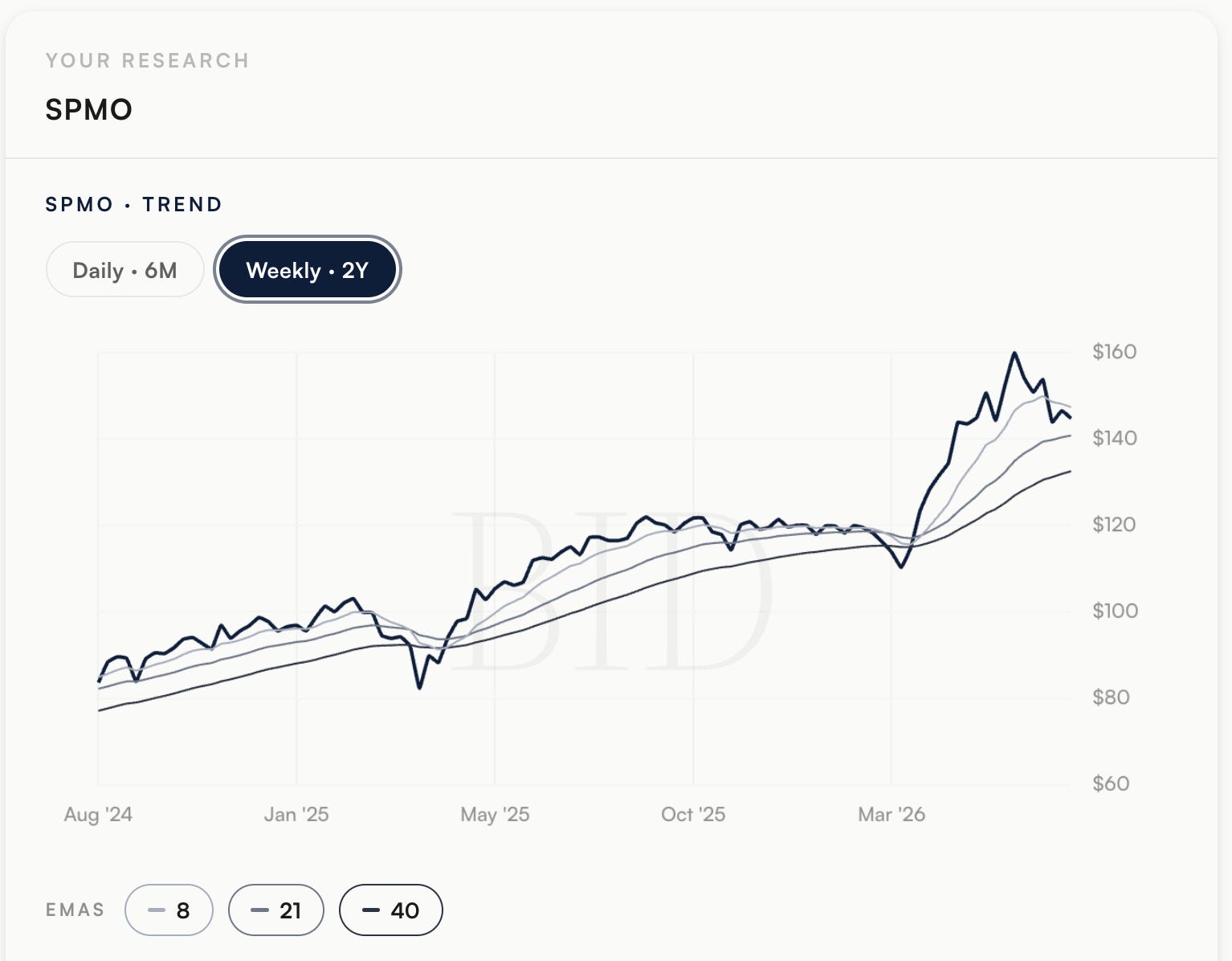
So what do you do when the factor breaks? Some say buy the dip, but only as a basket and only briefly. Goldman went back and studied these breaks to 2019. A week later the basket was up about 4.5% on average and it bounced roughly three-quarters of the time. Go out a year and the edge is gone, or at least diminished.
The bounce is real but the window is short, and it belongs to the basket rather than any single name. In my backtest on the S-curve screen, a loser cost one unit and a winner paid five or ten.
Or put another way, you really only win if you have exposure to the entire factor, not just one or two.
The Baseball Parallel
Hitching your wagon to one pick in a baseball draft is a terrible idea. Imagine taking all your spend and putting it on one 19 year old player.
Hitching your wagon to one pick in venture capital is similarly a terrible idea. It’s well documented that the Uber’s patch over hundreds of binary losses.
When you draft a baseball team you realize that your max cost is the signing bonus for the pick you made. Spread over larger numbers, the math says you need only one Piazza, or one Pujols (drafted in the 13th round), to cover the cost of the entire draft several times over. Momentum investing is similar.
So for an MLB GM or a momentum investor, my advice to you is this.
One, be so good at analyzing players or companies on their own that you can ignore my advice. Realize you have circles of competence, areas you’re good at, and don’t lie to yourself about whether you’re good enough to pick individual winners. Even Dave Karaff, the scout who drafted Pujols, said “My one fear was whether he was going to hit, if you can believe that” before the Cardinals signed him for $60,000. It’s highly unlikely that the average investor has this skill. It’s highly unlikely that I have this skill in tech momentum. Baseball? Maybe.
Two, the real advice, is to think of momentum as a factor applied to a basket. Taking a basket approach increases your odds of good luck happening, because the good ones will pay and the bad ones you’ll forget about. There will be lots of losers, but you won’t be shaken out emotionally from picking a bad one. Stay rational and realize that the factor itself requires you to do something humans are bad at.
Here's the part that stays with me though.
With Pujols arguably one of the best hitters ever, the Cardinals didn't know. Karaff filed the reports and still doubted the bat. A Devil Rays scout named Fernando Arango did know, pounded the table for Pujols, watched his team pass anyway, and quit over it. Four hundred and one players went first that year. The team that won didn't win because it saw the future. It won because its system let it be wrong over 30 rounds of picks and still cashed the one ticket that mattered.
Build a process that survives your misses, hold enough tickets to catch your Pujols, and spend your actual effort where your edge actually lives.
Power law wins,
BID
PS - some of you will be getting exclusive access to the Terminal tomorrow. Be on the lookout. For the rest, most posts will be premium going forward. I have upcoming posts planned on some recent passes I’ve made, some bank thoughts, and more.
The research behind essays like this one lives in the Terminal: open Research. 107+ companies and counting.