The Fair-Value Flywheel: SoFi’s Greatest Strength and Its Darkest Shadow
How SoFi turns model-based loan marks into growth fuel, how it parallels MSTR and their crypto accounting, and how the same playbook could reverse fast.
There’s an odd type of investor & human in this life. The one that associates so deeply, so strongly with their positions that any comment made, feedback given, any dissent implied, any “I don’t take every word you say as gospel” triggers them into acting like a cornered animal. We all know the type, no matter what is said everything is an attack. It’s almost as if they have the ability to turn themselves into a victim suffering unjustly, just because something was said that may have disagreed with them.
Lesson number one for today friends is, don’t be that person. Turning yourself into a victim is not the solution to life’s problems, in fact it sows the seeds for future failures. But lesson number two is that as an investor your job is to seek and embrace all feedback. Your job is to take in as much as possible with a completely open mind. Your job is to try to poke holes in even your most devout beliefs, because that’s how you learn and that’s how you improve. And learning and improving are the keys to growing friends, both as an investor and as a human walking the Earth.
So, today’s is not about hate or dissent, it’s about caution. It’s about knowing what you really own. And it’s about how SoFi and FMV accounting creates a reflexive loop in the same way MicroStrategy (MSTR) creates one with it’s “crypto treasury” strategy, even if MSTR’s is ironically more transparent. These reflexive loops are absolute unadulterated bliss on the way up, but can become pure terror and disaster on the way down.
The CFA’s in the room will call this “convexity”. Convexity in finance terms is the move from linear to non-linear path, where increases in certain variables create increasing returns or moves. Convexity in layman’s terms is when things go from moving one for one, to moving parabolic or “to the moon” as the crypto folks say. But if you take one big lesson away from this write up today, it would be that convexity cuts both ways, both on the way up … and on the way down. If you’re an investor in MSTR or SOFI (or NEWT in the bank space) and you want to understand how the machine really works, beyond the “line go up”, this is for you. This is for the people that seek a deeper understanding and try to remove blindspots from their thinking.
Back in January, I wrote “What’s SoFi Worth?”, a back-of-the-napkin “I see what you’re doing letter” to the company’s Amazon Prime for money ambitions. I was right on fundamentals and a little light on price, which I’d call a win. At the time, they were running near $2.1 billion in trailing revenue, and Wall Street figured they’d wrap 2024 around $2.5 billion. As a boring old “bank investor” I got several, “are you serious” type notes from the community, but if you bought in based on that write-up, you’ve been on a ride that ended with gains relative to KRE’s flat returns. All told about a 40% to 50% gain.
Funnily enough, when I did my work, I wanted to hate on SoFi, but they were a good way within financials to own growth. And growth has worked.
“I started researching SoFi and wanted to hate it. But I don’t. As an investor, you need to keep an open mind. If Trump in the White House means lower regulations, higher growth, a better economy, and good times rolling, then you want to own growth. It doesn’t have to be your whole portfolio, but you should own growth.”
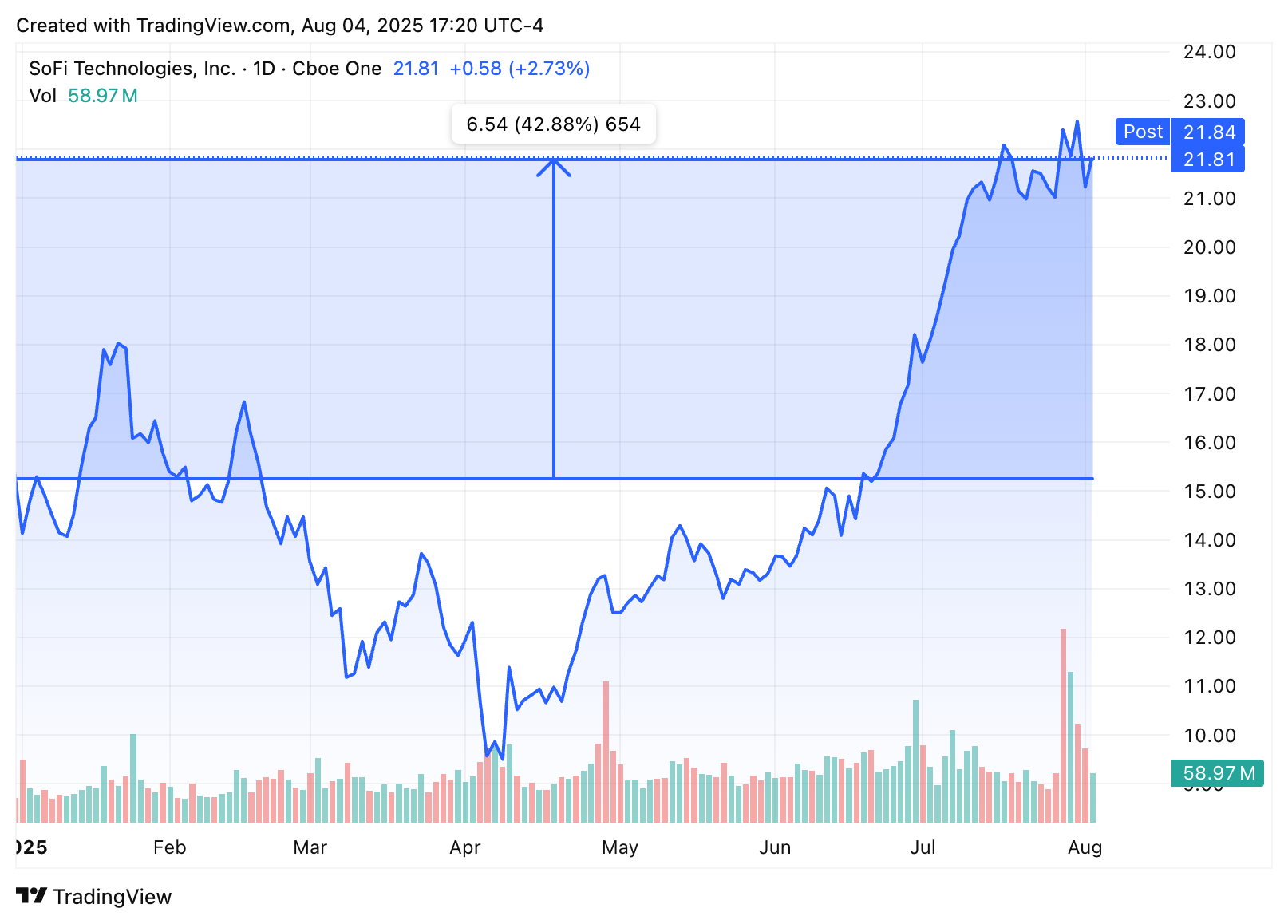
Today, SoFi already posted $1.6 billion in adjusted net revenue in the first half of 2025 and management is now guiding to $3.4 billion for the full year. That’s a pace rising from the low 2s to north of $3 billion in just eighteen months. The stock chart looks like a roller coaster, the financials look like a launch ramp, and buried beneath both is a topic worth learning from: the rocket fuel behind the surge and the blowtorch that could reverse it. SoFi’s fair-value flywheel, and if you are a retail investor you should at least know that the accounting that builds the growth can unbuild it just as fast. And yes, with no shade, this is almost the exact same as what MSTR does.
Mark to Model Inflating Capital Buffers?
There’s a moment in The Big Short that sticks with me. Michael Burry is sitting across from the banks who sold him credit default swaps. The mortgage bonds he bet against are imploding and he is in the money, about to get vindicated. But the banks won’t pay him out, because they haven’t marked down the bonds. “There is no market,” one Goldman banker shrugs. No market means no mark and no mark means no loss. Or, in Burry’s case, no big gain. It’s not “mark to market.” It’s “mark to model.” And that’s the trick, because when you control the model like Goldman did, you control the story at least for a while.
SoFi controls the model right now, and that’s the biggest takeaway for today’s post. SoFi isn’t hiding anything either, what they’re doing is GAAP-compliant, clearly disclosed, and increasingly common among fintech lenders in the consumer space. But it’s also deeply misunderstood. The short version is this: SoFi marks almost all of its loans to fair value (FMV). That means upon booking a loan and despite the fact that the loan could default or prepay, they recognize earnings upfront, not when the loan pays. Not when the borrower delivers. And key for SoFi, when the model says it’s worth more than face, SoFi books a gain, that gain then flows through earnings, and it feeds reported revenue. Taking it one step further it boosts CET1 capital, which is the regulatory gold standard for regulated banks. This is the ratio you must protect if you want to operate safely and soundly, and your buffer against losses.
And truth be told, non bank investors generally have no clue this FMV accounting is even going on, let alone has a big impact. For SoFi, as of Q2 2025, they’ve tallied $1.66 billion in cumulative fair-value uplift. Which helps SoFi report a 14.3% CET1 ratio, a strong ratio. One that implies a fortress balance sheet in the same vein that JPM’s 15% plus one allows Dimon to do as he pleases. But the difference is SoFi’s CET1 is inflated at worst and economic impacts and earnings are fast forwarded upon origination whereas Dimon’s reflects a more real current state of affairs. And none of this extra $1.66 billion with SoFi is technically cash equity, it’s a model-based number. One that’s highly subjective and largely up to the intepretation of management.
GAAP Accepted, Yet Subjective
The mechanics of this all are built on two pieces of GAAP which again are completely in bounds and legal. ASC 825 lets SoFi elect the fair-value option on each loan at origination. ASC 820 tells them how to mark it. They use what’s called Level 3 inputs; discount rates, expected default curves, prepayment speeds, and liquidity spreads. If market data is thin, the model leans harder on judgment. Ironically ASC 820 and ASC 825 were born as the U.S. economy was launching itslef into a credit bubble. FASB issued ASC 820 (then FAS 157) in September 2006 was there to define a single, standardized notion of fair value, an exit price between willing market participants on the measurement date. It introduced the now-famous hierarchy: Level 1 for quoted prices, Level 2 for indirect but observable inputs, and Level 3 for models. ASC 825 followed in early 2007, giving entities the ability to elect fair-value treatment for certain financial instruments. At the time, these standards were meant to bring order and transparency to inconsistent accounting practices. But just months later, the world learned how fragile those marks could be. When the market froze in 2008, Level 3 exploded. Traders couldn’t find bids for the securities, but models kept printing their values. That’s when the phrase “mark-to-myth” entered the lexicon. Prices weren’t grounded in market reality, they were outputs of spreadsheets. The same rules that were supposed to reduce opacity had opened the door for accounting subjectivity at scale.
Today, SoFi uses those same provisions, ASC 825 to elect fair value, ASC 820 to justify the models, to record $1.66 billion in cumulative gains on its loan book bolstering it’s capital ratios and fast forwarding the earnings they show, creating a reflexive loop. Good times beget good times and get magnified. And bad times? Well 16 years or so into one of the greatest consumer credit environments known to man, why would you ever worry about bad times?
MicroStrategy, When FMV Really Rips.
This might sound technical, but it’s not unique, and it’s used by one of the most popular tickers on the planet. MicroStrategy (MSTR), run by Michael Saylor, uses the same fair value accounting logic on its crypto treasury as SoFi does on its loan book. Ironically Saylor’s version might even be a bit more objective since he’s at least using observable prices on an asset, whereas SoFi uses fairly subjective spreadsheet level inputs on fairly opaque consumer loans.
How does this reflexive loop work? Saylor buys Bitcoin. When Bitcoin rises, MicroStrategy now books mark-to-market gains under ASC 820, even if they never sell a coin. Those unrealized gains flow through the income statement, boost reported net income, inflate equity per share, and feed into the premium valuation the market assigns the stock. And because MSTR trades as a Bitcoin proxy, that higher valuation lets the company raise capital through convertible notes, at-the-market equity offerings, and private placements. They then use fiat dollars from the sale of shares to buy more Bitcoin, which drives further markups, more reported earnings, and more investor demand. It’s a reflexive cycle and a kind of financial perpetual motion machine. And, aslong as Bitcoin rises, the machine keeps spinning. But the gains are non-cash, and the leverage is real. If the cycle turns, the unwind can be just as fast.
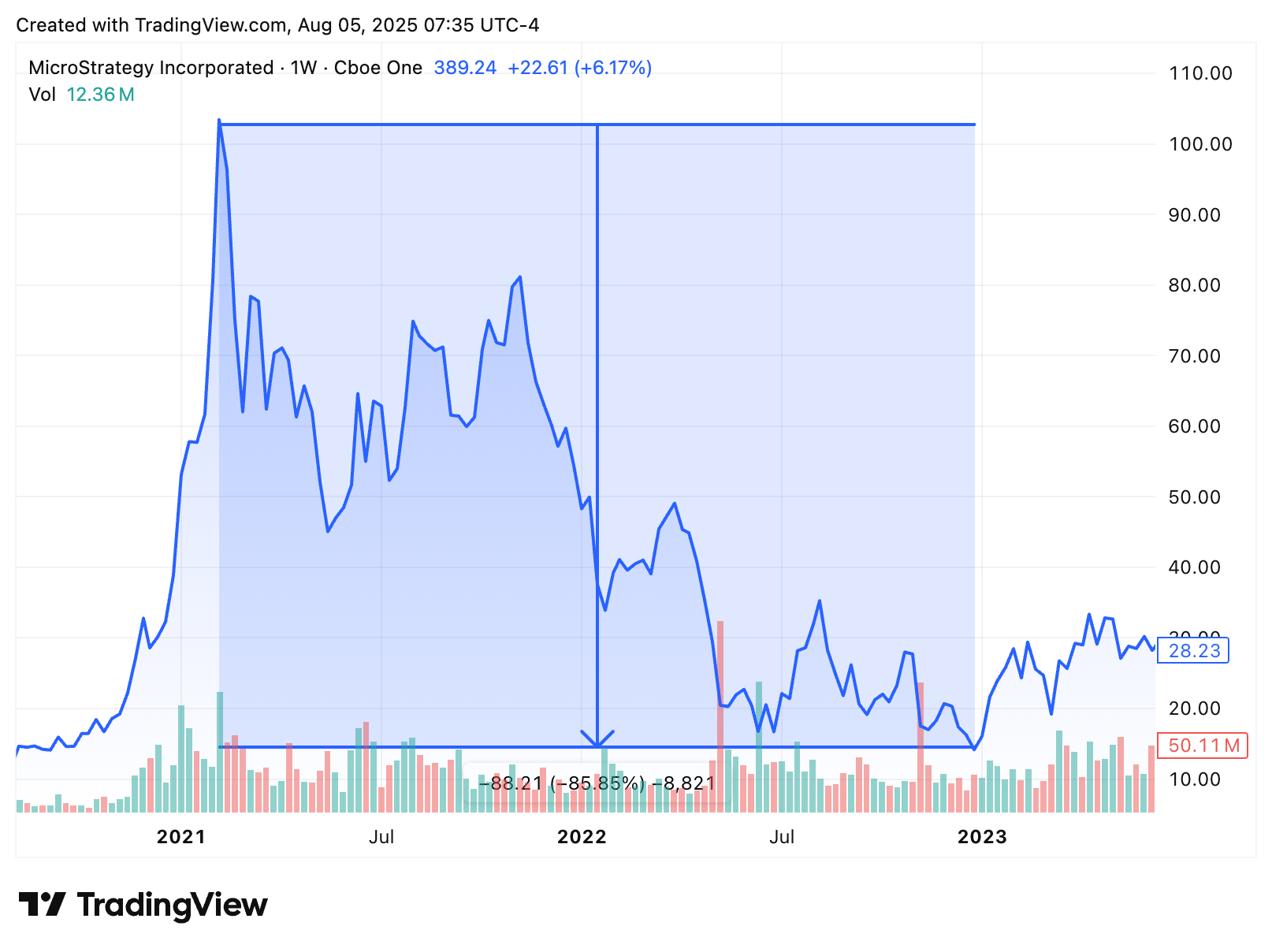
If Bitcoin falls hard, MicroStrategy’s reflexive machine doesn’t just slow, it turns violently inward like a black hole collapsing on itself. If BTC drops, net income turns negative, and the stock trades down even faster, compressing the premium to NAV that made capital raising easy. When the stock weakens, they can’t issue equity or convertible debt without dilution, which means in theory they stop buying more Bitcoin. If Bitcoin keeps sliding and collateralized debt triggers margin thresholds, MicroStrategy could face forced selling, the very scenario they vowed would never happen. And if that happens, the flywheel turns reflexive in reverse. Lower BTC crushes equity, equity collapse freezes capital, no capital weakens conviction, and selling pressure drags Bitcoin down again. The same mechanics that turned paper gains into momentum on the way up now turn disbelief into destruction which is exactly what happened to it from 2021 to 2022.
Levered Bets On The Underlying Asset.
What Bitcoin is to MicroStrategy, consumer loan valuation assumptions are to SoFi. Change the input, and the story re-rates. And both at their core are levered bets on their underlying asset, and now you know.
It’s worth noting that today, most traditional banks don’t do this. Newtek (NEWT) the SBA lender and BDC cousin to SoFi down in Florida run by Barry Sloane does it. And it drives short’s absolutely crazy. They hem and haw about “financial shenanigans” and how earnings aren’t really what they seem as a result of FMV, but remember this is all very legal and very hard to fight against. You should also know that the vast majority of regulated banks, they stick with amortized cost, apply CECL reserves, and recognize income slowly as it’s earned. It’s conservative, boring, and built to withstand cycles. Fair value does the opposite, it accelerates income when times are good. And then gives it back, sometimes violently, if or when assumptions shift. That’s the heart of the trade-off. It works until it doesn't. And again, we have been in one of the greatest crypto bull markets known to man over the past 2-3 years and one of the greatest consumer credit bull markets over the past 16 years, in my opinion.
Which is why SoFi’s $1.5 billion equity raise in July mattered to me. With $1.66 billion in paper gains already sitting in capital and more growth projected, maybe management knew a fair-value markdown could hit hard. A few turns in the model and their CET1 could fall toward regulatory minimums. So perhaps, the raise wasn’t about offensive growth, perhaps it was defensive insulation. The market absorbed it, because more capital means more growth, and growth is what investors want.
But the truth is, the raise tells you the FMV model is powerful, and also fragile. Or maybe I’m wrong all together and the team at SoFi is just saying, we want to grow even faster than our FMV capital base can allow, so we are selling more shares to finance “durable” hard dollar equity. No matter what you believe, capital raises always tell you that management believes their stock is on the expensive side. And functionally they put short term ceilings on stocks, because it is management’s way of telling you, maybe, just maybe we are a little expensive at this price relative to what our near term fundamental value is.
The Rearview Mirror for SoFi Looks Rosy
Right now, the model is working. SoFi expects $3.4 billion in revenue this year, growing more than 30%, with 11.7 million members and a lending book marked above par. Their personal loan portfolio carries a 743 average FICO and $161,000 in average income, the cream of the borrower crop. Ninety-day delinquency rates recently fell to 0.42%. Charge-offs dropped 48bps sequentially to 2.83%. The company estimates total losses, including recoveries on delinquent loans, to be around 4.5%. Vintage data backs this up with the 2022 to 2024 loan cohorts having cumulative losses of 4.23% with 41% of principal still outstanding. Their 2017 benchmark vintage had higher losses at the same seasoning point, which again is a positive credit signal. On the student loan side, credit quality looks even stronger. Average FICO is 768. Income is $136,000 and delinquencies held steady at 0.13%. A temporary charge-off spike to 0.94% was due to a servicing transition and an acquired portfolio with known risk. Adjusted for those, the rate looks closer to 0.68%. These numbers, for now, justify the model, but that justification depends on credit staying tight and funding markets staying open.
Am I predicting a consumer credit recession, no. But let’s walk the other direction, just for kicks. And not because I’m projecting some SoFi specific doom, but because FMV cuts both ways. Say 30-day delinquencies tick up. SoFi bumps its expected default rate from 4.28% to 5.78%. Spreads widen and the model lifts its discount rate from 4.67% to 5.42%, a 75 basis point move. For a loan book with a four-year average life, that adjustment alone could shave 2.5% to 3% from present value. That’s a $600 to $750 million markdown on a $25 billion portfolio. And because SoFi uses fair value, that impact runs straight through earnings and runs straight through capital. That 14.3% CET1 ratio? It could drop toward 12% or even 11% in one quarter. Net income, which clocked in at $97 million last quarter, would likely flip negative. Adjusted EBITDA would fall, the growth story would slow, and the model would reflexively feed the slowdown. Fewer gains then means less retained capital. Less capital means less loan growth. And less growth means weaker top-line momentum, which is krytponite for the momo growth community. And on the side, in this bad credit world if the ABS market freezes, and SoFi can’t offload loans through whole-loan sales or securitizations, that effect compounds. What once reinforced becomes self-limiting.
Remember, none of this is inevitable. But it’s worth understanding. Especially because the accounting that accelerates growth on the way up can magnify risk on the way down. This isn’t a knock on SoFi because they’re playing within the rules. But understanding the rules matters. Fair value accounting is leverage. When the engine runs hot, it delivers dazzling results. When the assumptions falter, the unwind can move just as fast.
Mark Twain?
At the start of The Big Short, a Mark Twain quote scrolls across the screen: “It ain’t what you don’t know that gets you into trouble. It’s what you know for sure that just ain’t so.” That’s the spirit behind this FMV discussion. It’s not because I know where markets are going. It’s not because I’m short or long either SOFI or MSTR. It’s because what works so beautifully on the way up can work just as brutally on the way down and if you didn’t read this you likely would be blissfully unaware.
Hopefully now you understand how the mechanics actually work, so at least you’re aware of what the market knows for sure that just ain’t so.
Bull markets convince you of all sorts of things. That you’re smarter than the market. That your model is flawless. That the good times will never end. And almost always, they teach you that you weren’t thinking enough about the downside in real time. Both SoFi and MSTR are in the middle of powerful bull runs. They’re very different businesses, but they’re both running the same GFC-era playbook, fair value marks that create reflexive loops. You book the asset. Mark it up. Let the gain flow into earnings. Watch capital rise. Use the income statement to build a story. Growth, baby, growth.
But these non-linear convex stories, these ever-accelerating perpetual growth machines, are always tethered to the performance of a single underlying asset. For SoFi, it’s consumer credit. For MSTR, it’s Bitcoin. When the music’s playing, the loop compounds beautifully. And as Chuck Prince once said, when that music is playing you gotta dance. But when it stops? When it stops, people don’t walk off the dance floor they run.
Until next time,
Victaurs
The full SOFI research, with the durability test and the verdict, lives in the Terminal: SOFI research. 107+ companies and counting.