StoneCo: 14x Earnings for 20% EPS Growth?
PIX didn’t kill it, buybacks boosted it, and EPS is compounding faster than peers still priced richer.
Found a book called Smart Brevity: The Power of Saying More with Less recently and so you all benefit, by seeing a brief Friday write-up on a name a lot of people didn’t know about when the year started, but one that has trounced it’s peers and broader markets.
I wrote up this name in March this year and said it was asymmetric upsdie, backed by execution, with a rerating setup hiding in plain sight. If you followed along, you’re up 70% on the name, proof that you don’t need to chase AI to outperform the market.
But the real question for longs is, should I own this stock now?
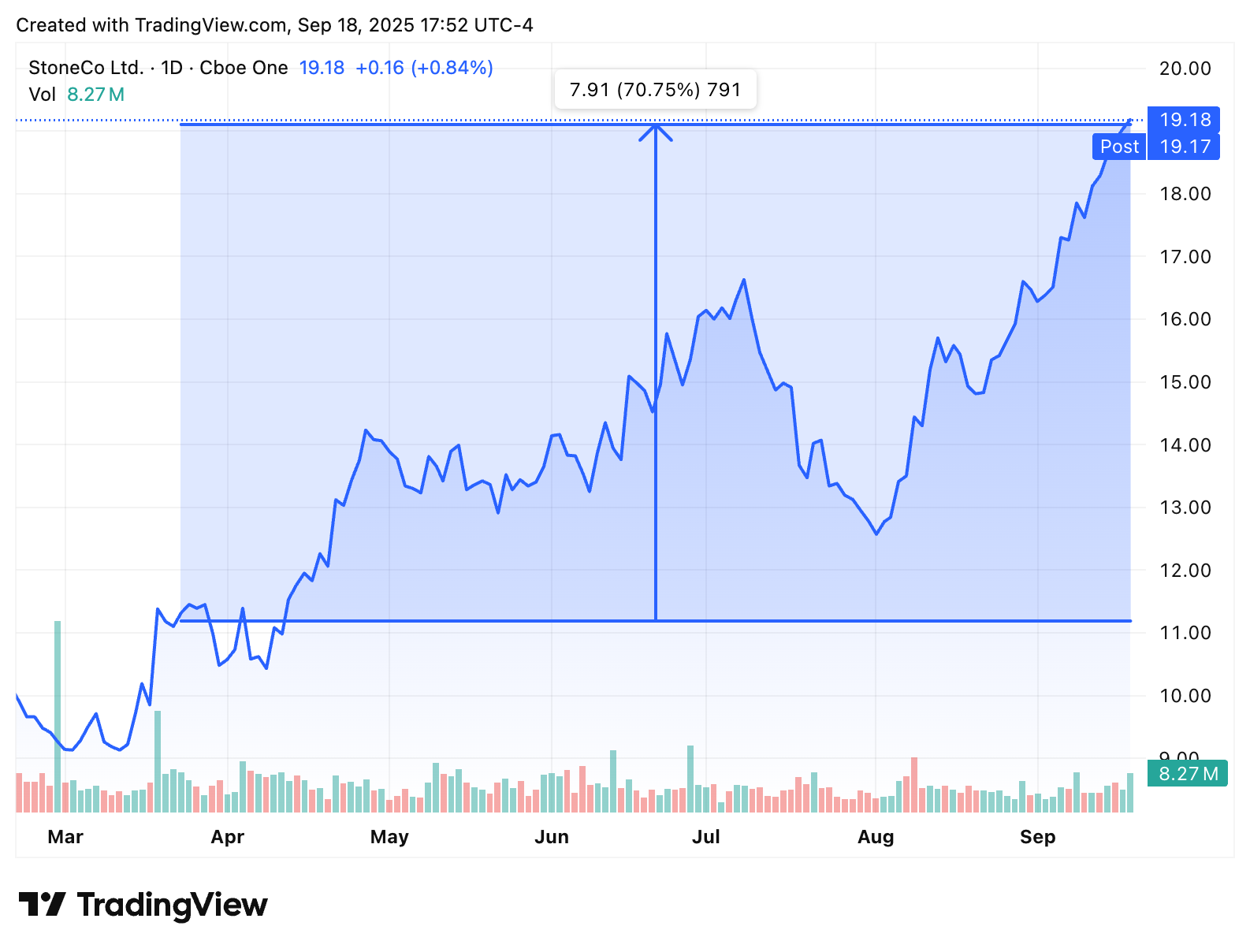
The siren song back then was that PIX (the free money movement app in Brazil) was supposed to kill StoneCo. But instead, the company recently posted a quarter that shows it is built to compound earnings for investors, at least for a little while longer.
Far from dead, Stone is now an EPS machine: increasingly deposit funded, buyback fueled, ready for credit hiccups, and with a management team that’s delivering on what they say.
The Company itself is now rare, an Brazilian fintech that has grown EPS 30%, is guiding to grow 20% next year, returns excess capital, and has big upside should interest rates in Brazil fall. It’s benefitted from the weak dollar. It’s benefitted from management excellence. And it is still a long for me.
To start why it’s still a long, StoneCo is cleaning up the liability side of the balance sheet. Retail deposits grew 36% YoY to R$8.8B (~$1.66B), with 83% in time deposits. Brazil’s CDI averaged 14.5% in Q2, up nearly 400bps, yet StoneCo’s financial expenses only expanded 210bps YoY. That gap shows how powerful deposit funding already is, and the kicker: when rates fall, costs will drop while lending yields stay stickier. That means a potential 20–30% EPS lift just from the funding side coming back down.
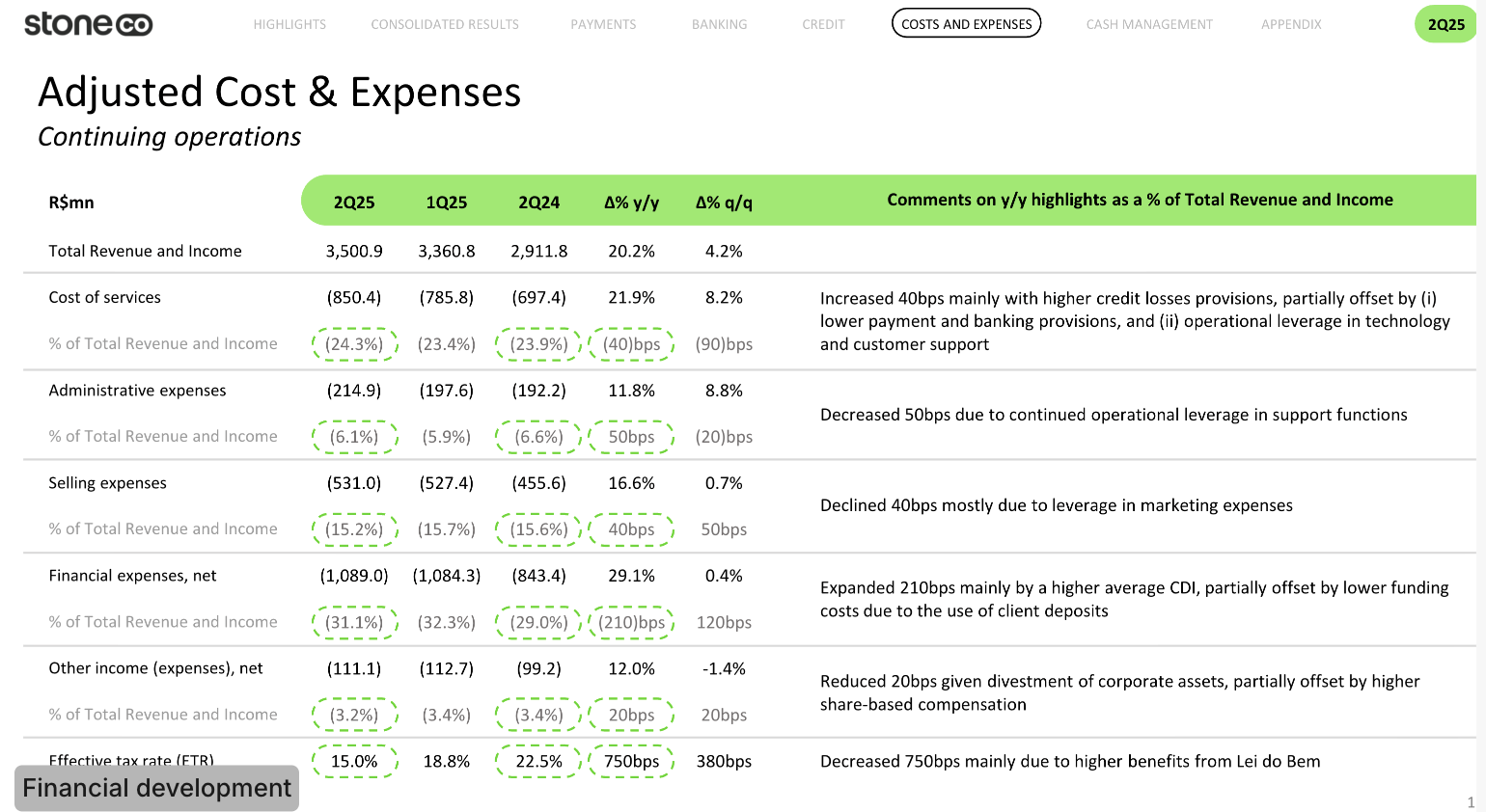
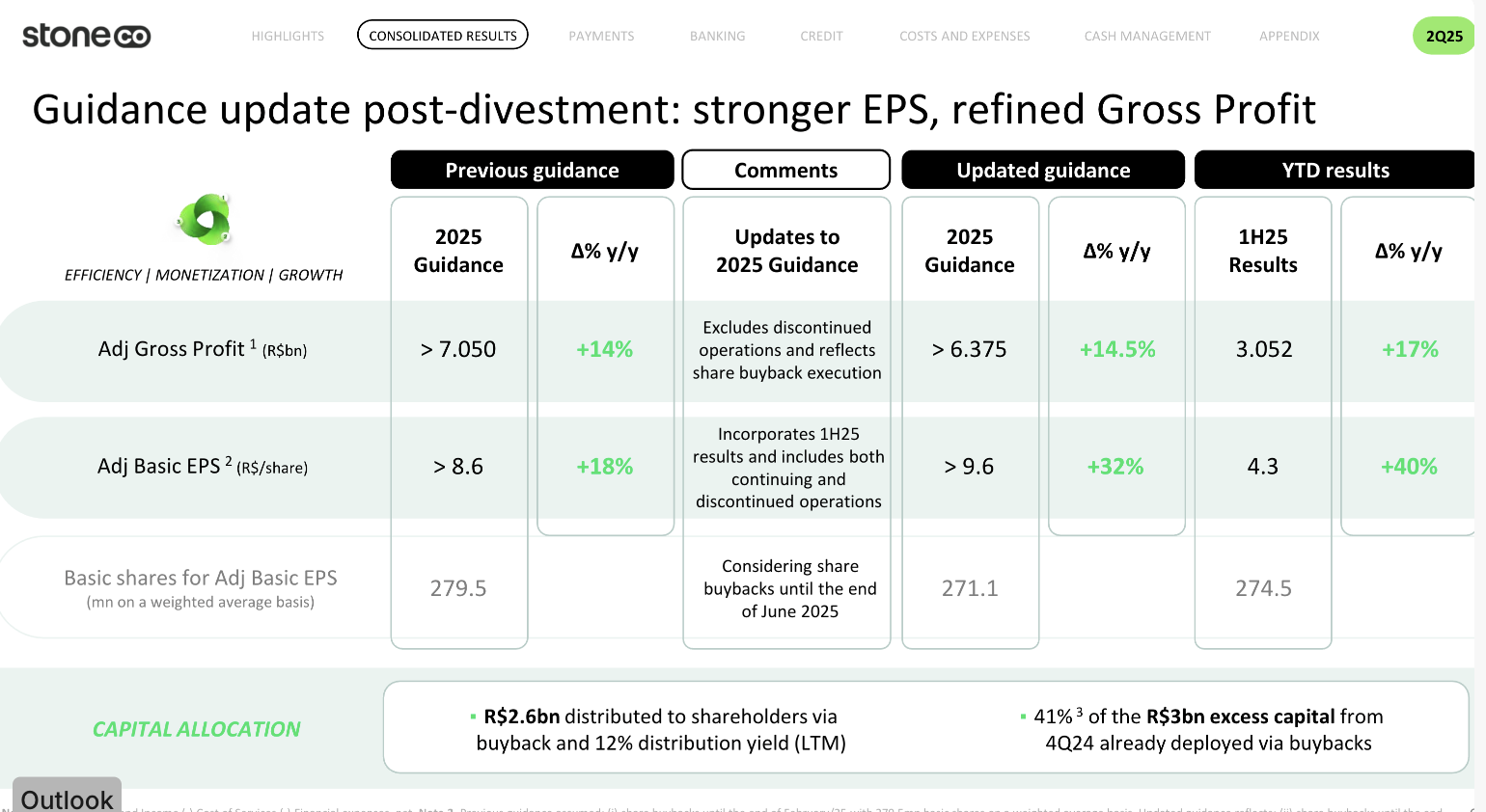
Point two. Net income rose 24% to R$598m (~$113m) and EPS rose even faster clipping 45% YoY to R$2.33 (~$0.44) because management bought back 42m shares. Recycling roughly 25% of market cap unlocked from the software divestments is the exact type of capital allocation discipline that Buffett would be proud of. Sell distractions, buy back cheap stock, lift EPS, and focus on your core business. The market doubted Stone would actually cut loose the software arm, but management followed through. That credibility boost matters as much as the capital return itself. And while guidance for the year ended up being lifted to 32% EPS growth YoY, there is some deceleration coming down to a high teens to 20% growth next year in 2026 to be aware of.
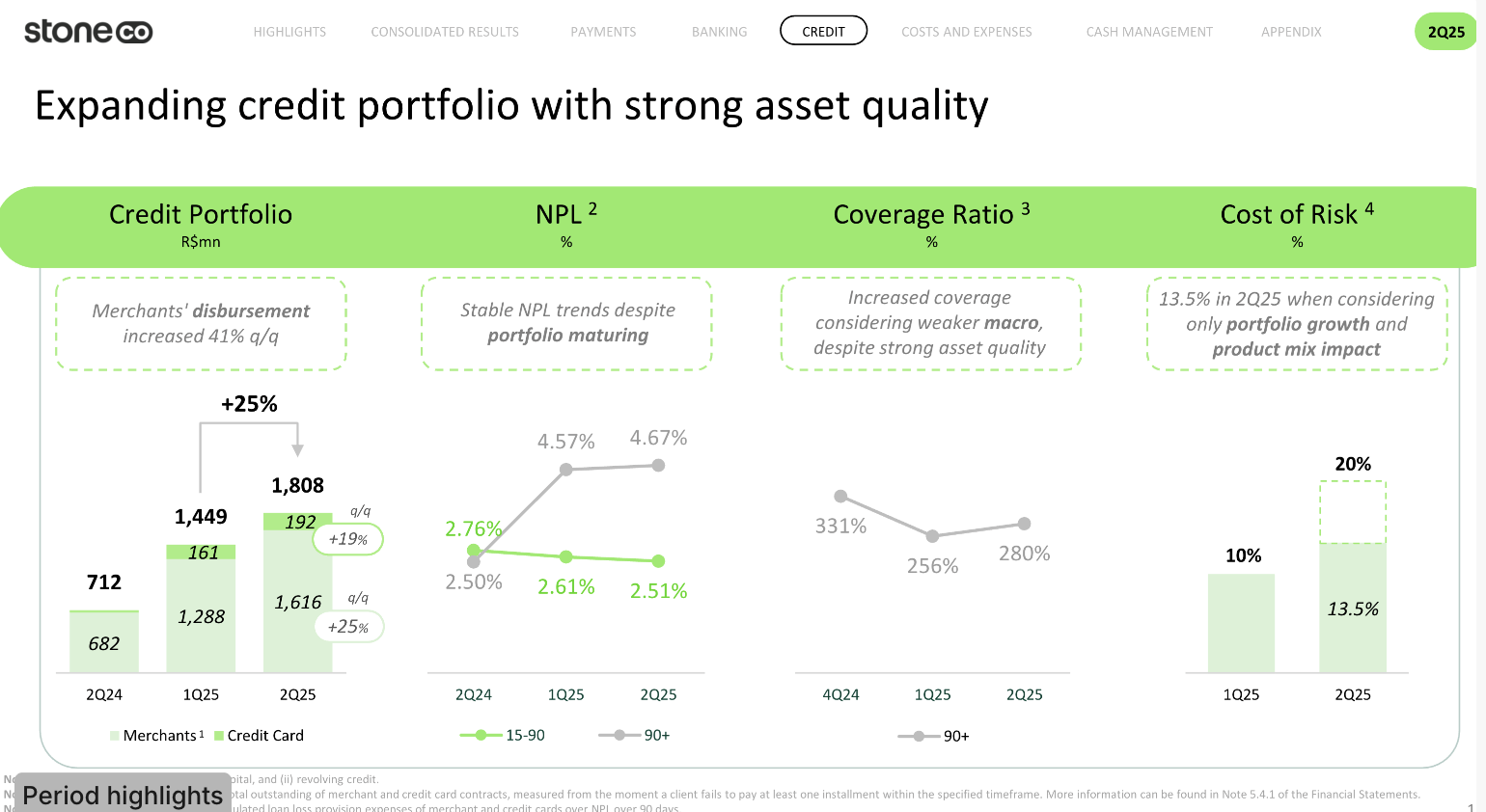
Point three, credit. Their credit book reached R$1.8b (~$341m) which was up 25% QoQ. But the team maintained discipline and doubled provisions pushing their coverage to 280% despit NPL’s in the 15-90 bucket coming down and the 90+ bucket staying flat-ish. Relative to others like a Nubank, their total credit risk outstanding is small, so credit won’t hit near as bad should the economy in Brazil soften even more. The bigger issue for Stone would be if merchant acquiring slows which causes the EPS ripple. Lower TPV means lower take-rate revenue, smaller base of receivables to prepay, and then to a lesser degree weaker credit demand.
PIX was supposed to be a stone-cold killer for merchant acquirers like STNE because free instant payments were going to wipe out fees. And while it is gaining share over debit card transactions, they didn’t kill margins. Merchants still need terminals, support, and cash-flow financing. And when PIX transactions flow through Stone accounts, their deposits rise, and lending potential grows too. Analysts like to ask about it and management usually brushes it off and pointing out that PIX is actually an opportunity. PIX is one monetization driver amongh many for them.
So where does this leave me?
At $19.10, STNE trades at ~14x trailing EPS of $1.37, ~11x 2025 EPS of $1.73, and ~10x 2026 EPS of $1.98. If rates fall you get an extra 20% to 30% lift to EPS. The buybacks are low risk and are going to continue. Less a lofty assumption play and more a compounding of good decisions play.
Domestic peers like Fiserv are growing half as fast yet trade richer. StoneCo is compounding faster but priced like an average fintech. It continues to benefit from a weak dollar and will in the future as well.
If you believe the dollar will strengthen then owning this is not for you. And if you believe Brazil’s macro gets worse, this is not for you. But for me right now, I still own and like the story. At some point price will fully catch up to fundamental value, and that’s when it’ll be time to re-evaluate, but that is not today.
The story is simple: StoneCo isn’t a growth-at-any-price fintech. It’s a compounding engine running on cheaper fuel, still priced like it’s ordinary. That disconnect is why I remain long.
The best is ahead,
Victaurs
Disclaimer:
This content is for informational and educational purposes only and does not constitute investment advice, an offer to sell, or a solicitation of an offer to buy any securities. The views expressed are solely those of the author and are based on publicly available information believed to be reliable at the time of writing, but no representation or warranty is made as to its accuracy, completeness, or timeliness. Any opinions or projections expressed herein are subject to change without notice. The author may have a financial interest in the securities mentioned. You should not rely on this content as the basis for any investment decision. All investments involve risk, including the risk of total loss. Please consult your own financial, legal, and tax advisors before making any investment decisions.
The full STNE research, with the durability test and the verdict, lives in the Terminal: STNE research. 107+ companies and counting.