Only an MIT Led Company Could Find a Way to Work with Alinea and Applebees
What to do when fundamentals inflect higher, multiples de-rate lower, and why cyclicality is never to be messed with.
If you’re not a foodie or didn’t grow up in Chicago, Alinea probably means nothing to you. But it is one of the highest end restaurants on Earth. So amazingly dedicated to their craft, so detailed, so intense, and yet so artful that excellence is their standard. Applebee’s, if you’re like me, you know perfectly well and is not exactly 5 star. So if you look at a technology that has the ability to serve both, you know something is going on. And more interesting that that range is the fact that while the stock is down 40% or so from its highs, its locations grew 22%, ARR grew 26%, and operating margin went from effectively 0% in FY24 to just shy of 7% in the March quarter.
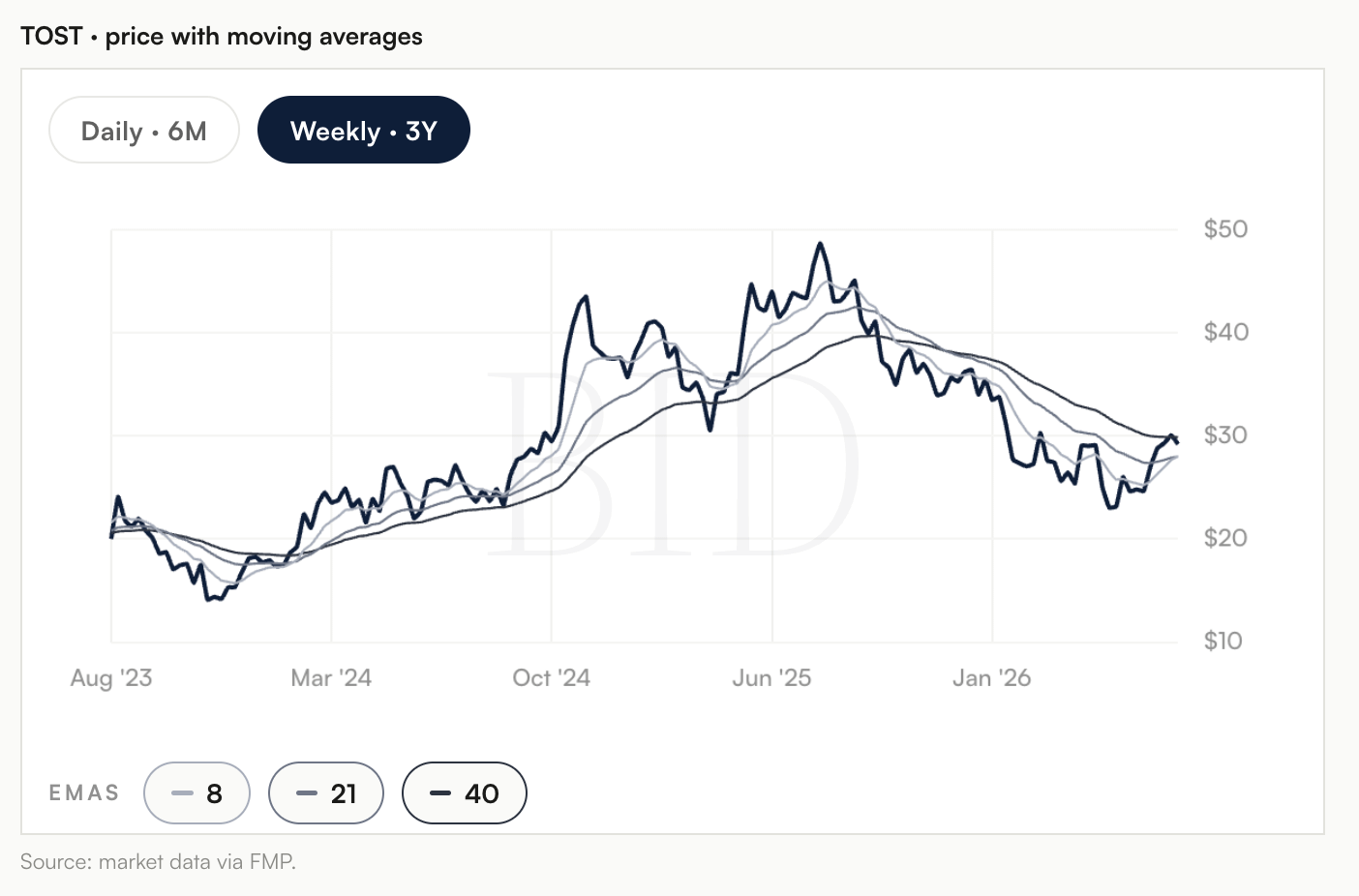
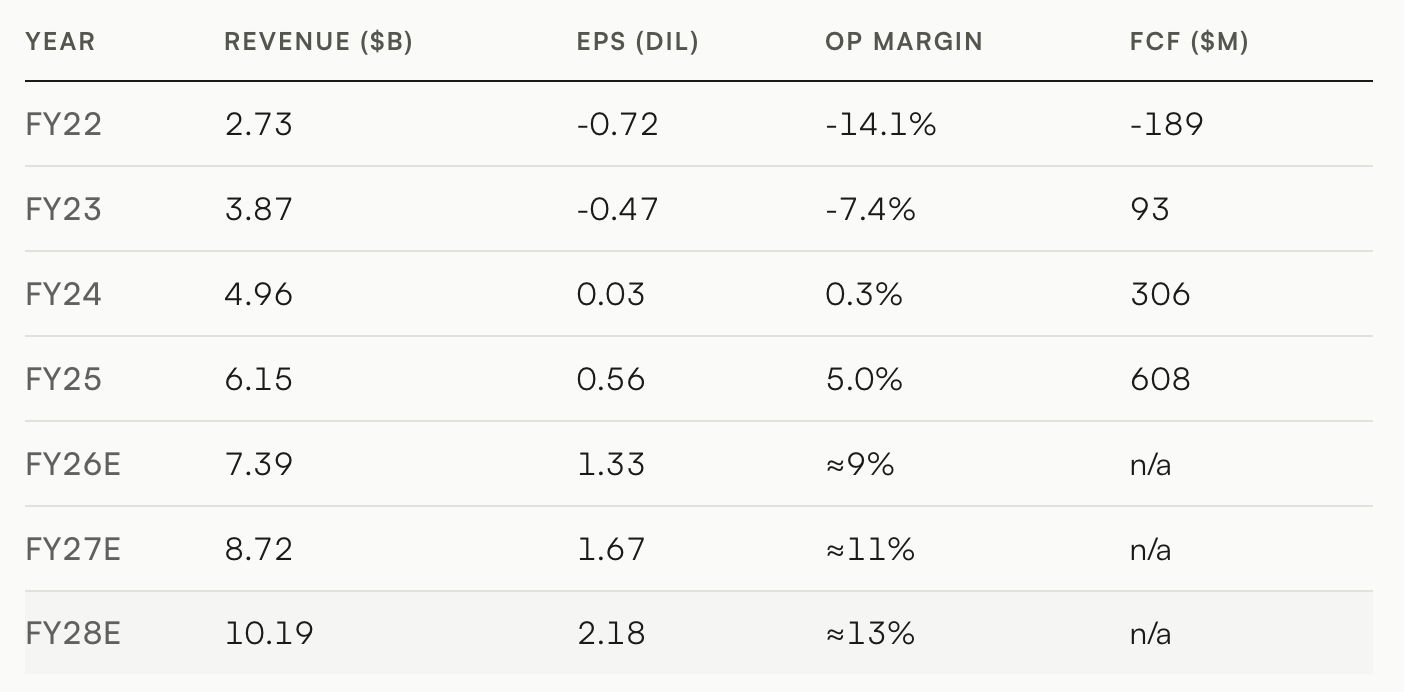
Looking at these two, something doesn’t jive here.
Every payments person on Earth has written about Toast, so instead I’ll give you the things you need to know about the Company before you invest, or don’t.
They Legitimately Care About Their Customers
Great companies have soul & noble missions. And this is pure intuition, but I know Toast cares because of how they attempt to simplify & improve the lives of their customers. Restaurants used to have a register from one vendor, a card terminal from another, online ordering from a third (with those unbelievable fees, I’m looking at you DASH), payroll, gift cards, and loyalty, amongst others. And none of them talked to each other and that miscommunication leaked money making an already thin margin business even harder. Toast’s solution was to collapse all of that into one, beautiful, coherent system. Orders go direct to kitchens, online orders hit one menu so 86’ing items hits everywhere, payroll knows who clocked in, and smart systems even nudge ordering of kitchen items in real time. A working capital vertical lends against the sales the system sees so advances take days & agentic marketing uses the restaurants own data on customers to drive ad spend and revenue.
When you make your customers lives better, shockingly, your customers grow loyalty. And this loyalty turns into a reason people do business with you beyond price. This is powerful.
Their Moat is Stronger Than You Would Think.
When people think of payments companies they think of toll-roads with price taking behaviors. They hardly think of companies with long-term moats. But Toast is a bit different. The majority of their revenue comes at the payments layer, but the switching cost moat sits at the software layer. The menus, the kitchen screens, the staff training, the sales history all of it becomes enmeshed with a restaurant’s operating system and solves so many problems for so many people in a restaurant that it becomes effectively frozen in place.
Let me break it down simply.
Payments is 82% of revenue (about $5B), 23% gross margin.
Software is 15% of revenue (about $930M), 72% gross margin.
So software is a seventh of top line, and over 40% of gross profit. The sticky layer and the profitable layer are the same layer. And while payments volume is what a recession could take away, software should in theory survive it. On top of this TOST’s 109% net SaaS retention is not technically top-tier, but remember it’s distorted by restaurant death rates and multi-site adds.
Management is Smart, and Strategic but They Haven’t Been Battle Tested.
The number one risk not called AI is a recession. The founding team came out of MIT, sharp as tacks, and while I haven’t met them, likely great humans. Strategically I like their vision, especially the one to sell hardware below cost, just like the razor and blades strategy we’re all used to.
I also like that they’ve channeled the soul of their customers. But that doesn’t change that their customers are the smallest, most fragile, and most cyclical businesses out there. Small restaurants. Restaurants fail quite often and the US economy has been unbelievably strong for a long time. No one remembers the Great Financial Crisis anymore in finance, but that time was a bad one for small businesses and in particular restaurants. This should make logical sense to you.
Toast Capital is the working capital line provider originating loans by WebBank and serviced by Toast. And they just started adding “loans held for investment” of $22M and have disclosed that these are not delinquent. Small now, but a thing to watch that has the potential to add cyclicality risk. Adding cyclical lending businesses to a cyclical business does not cancel risk out.
And while on management, SBC constantly comes up. FY 2025 SBC ran around $292M against FCF of $608M, so roughly half of FCF is paid in stock. This isn’t atypical for younger, growth companies, but it still doesn’t make me feel great. Yes, it’s down from almost 9% of revenue to just under 5% of revenue and share count as of Q1 2026 actually shrank, but the point remains. Never trust FCF for early stage companies or recently inflecting companies. Never.
Cyclicality Will Be How You Lose
A post mortem on a Toast investment that failed will tell you that you forgot it was cyclical.
True the moat is better than you would think. True the strategy is intelligent. True the results are getting better. And true it’s cheap relative to its own history at 23x forwards. But none of that can change the fact that it’s heavily, heavily cyclical. Catering to the economically fragile customers that are most impacted by changes in unemployment or the broader economy is risky.
So are fundamentals inflecting? Yes.
But is the thing cyclical? Very much yes.
The holy grail in investing is less cyclicality. Or buying cyclicality when the investing universe thinks the world is going to end. That’s the way you win over the long run.
Never trust FCF,
BID
The full TOST research, with the durability test and the verdict, lives in the Terminal: TOST research. 107+ companies and counting.