The 16x FCF Mirage: Should You Buy Uber?
Deeper analysis into Free Cash Flow and Uber's growth premium. Quantifying the AV and cyclical risk by modeling five future outcomes. And showing you the real bet being made on Uber's stock.
I read a tweet on X claiming Uber was ‘dirt cheap’ at just 16x Free Cash Flow (FCF). It seemed too clean to be right and reminded me of the days when Buffett bought Apple at 10x FCF in 2016. The Abe Lincoln internet joke applies here: if a number on the web looks too good to be true, it usually is. So I retweeted it, listened, and then ran the numbers myself. And while 16x FCF is a widely accepted headline figure, it crumbles the moment you examine what sits inside that cash flow.
Uber has become a strong cash generator; that is true. But the idea that it trades at 16x FCF is economically misleading. A quick run through the numbers shows Uber is closer to 42x once you strip away what accounting treats as free cash but shareholders cannot actually use. An investor’s job is to look beneath the surface and understand where the real, deployable cash is coming from.
From 16x FCF to a 42x Reality
The biggest analytical mistake is confusing the cash flow accountants report as FCF with Shareholder Cash Flow (SCF). This valuation is a case where the 16x multiple is technically correct, but it is analytically misleading. It ignores two major flaws: the real cost of dilution via Stock Based Comp (SBC), and a massive pile of cash that is legally trapped via (Insurance Reserves).
Start with the insurance reserve float. Uber manages its own captive insurance, which lowers long-run insurance costs, but as the business grows, the required reserves grow too. That reserve increase shows up as operating cash flow even though it isn’t cash available to owners. Roughly $2.7 billion of Uber’s TTM Q3 OCF came from reserve growth. Removing it takes the company from 16x to roughly 29x FCF.
Next is SBC. It is added back to cash flow because it is non-cash, but for shareholders it is a real cost because it dilutes ownership. Treating SBC as an expense removes another $1.8 billion from cash flow. That leaves about $4.1 billion in true SCF that can actually be used. $4.1 billion of SCF vs. $4.5 of adjustments that can’t be utilized.
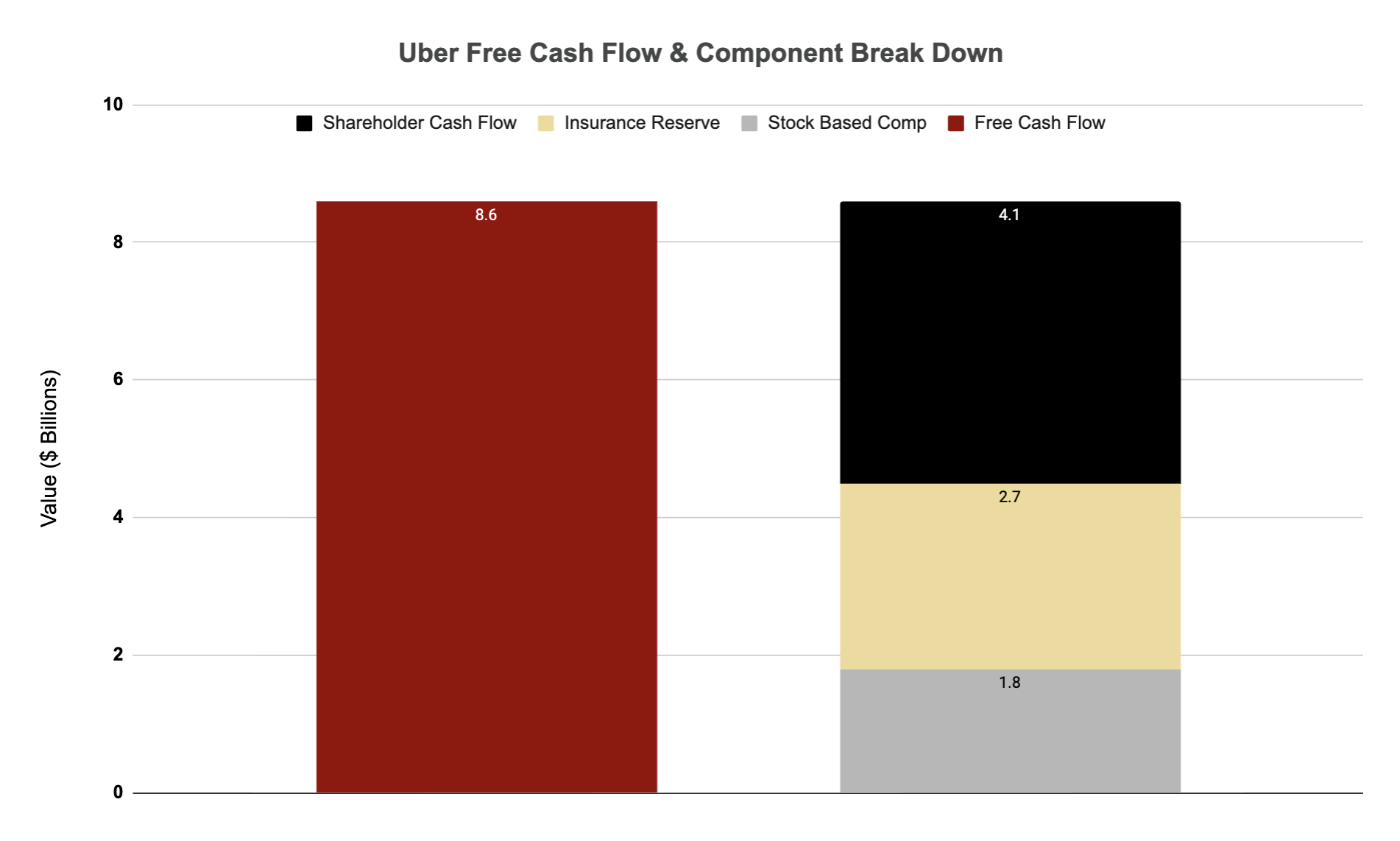
So now, divide Uber’s $174 billion market cap by that SCF, and you get roughly 42x, a premium multiple more in line with the Mag 7 than with a supposedly ‘cheap’ compounder at ‘16x FCF’.
The Market Pays a Big Premium Because of Growth
There’s an old, reliable adage that frustrates value investors: buy accelerating top lines. Uber is the perfect example. Revenue growth is the ultimate signal of momentum, and Uber has delivered: In 2023, revenue grew 17%, in 2024 it accelerated to 18%, and consensus for 2025 is for growth to hit 18-20% or so beyond.
This consistent, large-scale top line acceleration is one fundamental reason the stock has rerated so violently, up about 320% since the 2022 lows. The market is willing to pay today’s premium because the core business is absolutely firing and the economy seems good, if not great.
Under the hood from Q3’s report, total trips grew 22% year over year, and total Gross Bookings grew 21%. What really matters for Uber investor though is the network effect: users active across both Mobility and Delivery spend 3x more and stay 35% longer. The model is to get people in on rides and begin to take more of their mind & wallet share across delivery. Furthermore, Uber’s Take Rate has been steadily increasing, proving the company is using its scale to improve its profitability faster than its revenue grows. For context take rates (Revenue/Gross Bookings) in Mobility sit just above 30% and just below 20% for Delivery.
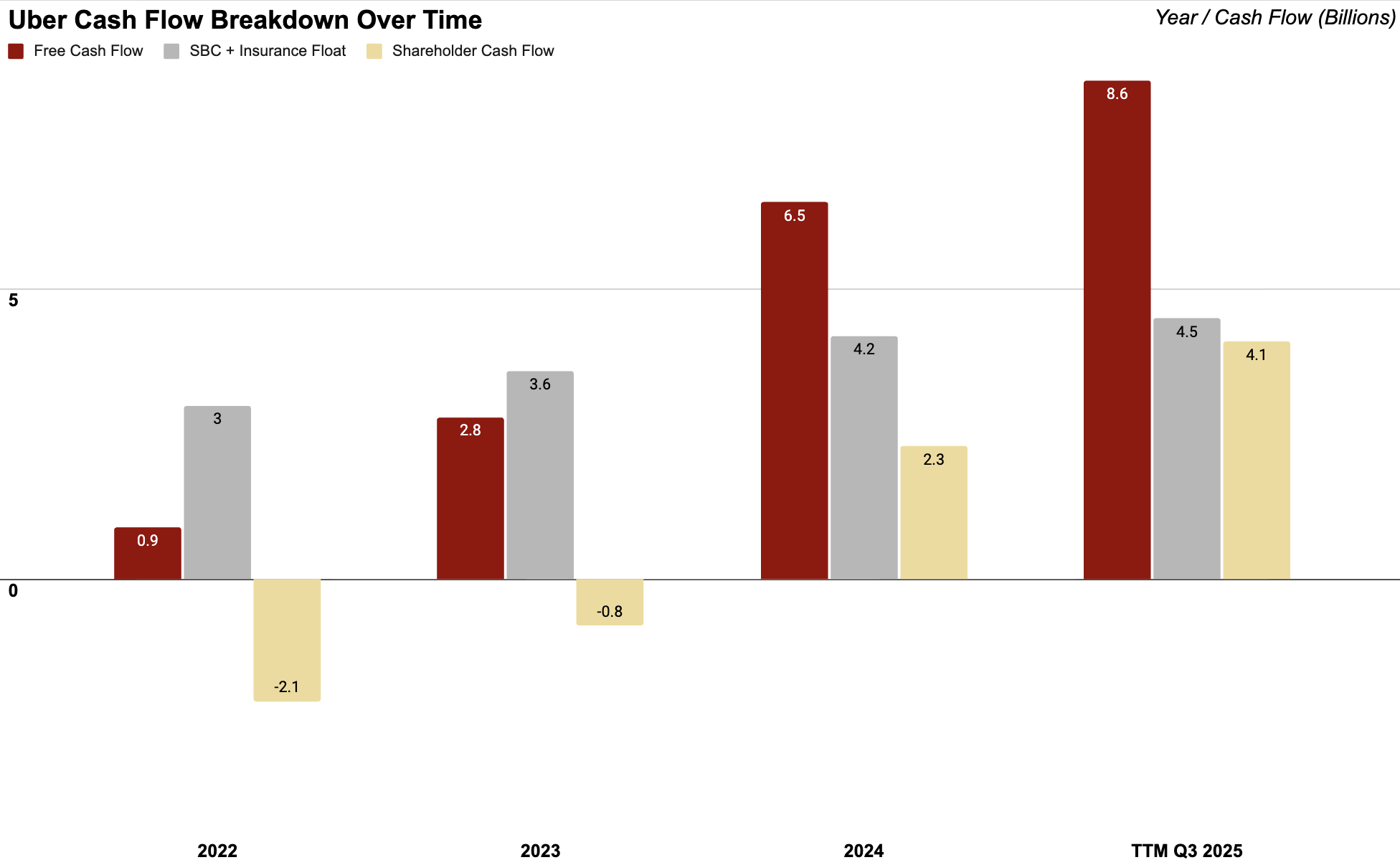
The big picture, despite my critique of FCF vs. SCF, is that not only is top line growing, so is SCF. This at the core of any bull’s argument and below you can see it swung from $803 million burn in 2023 to $4.1 billion today, an 81% growth rate. And looking below, what else do you notice?
SCF is actually growing as a percentage of FCF as well, and rapidly.
CEO Dara Khosrowshahi elaborated on this turnaround in his recent All In Podcast interview, discussing how Uber was always a Cash Flow machine under the surface. While he and the company often refer to the larger $9 billion FCF figure, the key proof for the bulls is that Uber successfully proved this underlying profitability at scale, even if you debate the “usability” of roughly half of that figure due to the controversial insurance reserve. What I think he wouldn’t debate though is the cyclical nature of the cash flow operating leverage.
The Bets You’re Making Buying Uber at 42x SCF
So the debate becomes, join Bill Ackman in Uber or sit on the sidelines? To start, a disciplined investor must understand the two big forces shaping Uber’s next five years: the economy and autonomous technology.
Here’s as plainly as I can put it: Uber is still a cyclical business. When the economy is strong and people move and spend more, cash flow expands quickly; when the economy weakens, that same operating leverage works in reverse. Buying Uber today is implicitly a bet that the current favorable environment persists, because that’s what is driving the cash flow growth. And premium cash multiples are typically reserved for businesses less exposed to economic swings, not ones whose earnings rise and fall with the cycle. I’m not going to pick on Covid when bookings stopped, but Q4 of ‘24 shows this risk.
The other force shaping Uber’s future is autonomous technology. Waymo and Tesla are already operating AV fleets, and Uber’s strategy is clear: own the demand layer rather than compete in the hardware race. If autonomous rides become structurally cheaper, the platform that aggregates demand, not the company that builds the car, captures the economics.
The financial leverage for autonomy is immense. Industry projections show that a robot-driven mile will be roughly 70% cheaper than a human-driven mile within the next five years, even if predominantly in dense urban areas. That cost advantage is precisely why Uber must own the demand layer, regardless of who builds the car. For you to invest in Uber you must believe that the AV operators must partner with Uber to maximize utilization, and that Uber’s platform provides a data moat that no single AV competitor can match. History tells us that in platform wars, the aggregator tends to win, exactly what Ackman’s long thesis demands which I agree with.
In AVs, Waymo is the safer, compute-heavy, city-level threat; Tesla is the cheaper, scalable, global threat, if it solves FSD. Neither is existential unless they reach 20–25% U.S. market share and operate as closed networks, which they are far from today. Tesla’s incentives also differ: robotaxis would raise the utility and residual value of its installed base, supporting unit sales. Its likely strategy, if FSD works, would be hybrid, run its own high-demand network while partnering with aggregators for filler demand.
Your Margin of Safety Investing In Uber at Today’s Prices
So should you buy Uber at 42x SCF or ‘16x FCF’?
First I’ll concede that the SBC + Insurance portion of FCF should trend lower as a percentage of total cash flow over time. But remember all revenue and profitability going forward are dependent on more consumer movement and delivery ordering.
A bad macro world would break the multiple, and away from that the multiple only truly ‘breaks’ if AV adoption jumps quickly from negligible to meaningful, specifically if Waymo reaches 15–20% share and refuses to integrate with Uber. Uber is in a place to handle slow migration better than anyone else.
The second level question though is: are riders and AV fleets structurally predisposed to aggregation or fragmentation? Will they want to create their own networks or will they plug into Uber’s demand aggregation network? I don’t know this answer to a high degree of confidence far out into the future, and truthfully no one does. It’s all a guess. Domestically here in the States, Uber likely wins as the demand aggegator. But globally I think Uber has more challenges since people don’t like our tech companies controlling major infrastructure.
Third level questions and thoughts are all over the place in Uber too. What about drone delivery, logistics, and all of the other TAM building markets that don’t exist yet? These are all “call options” on more and cheaper modes of delivery. These are fun to think about but you need to ground yourself first in what is and these are all likely 3-5 year max out from here.
A last point with Uber is on the market share vs. TAM expansion debate. Industry reports cite that the global ride-hail industry is going to grow 18% to 20% annualy on it's own. Meaning that Uber can lose share in key U.S. cities where Waymo is doubling down, but still grow as the overall market grows. But this again assumes what? A perpetually good economy.
Two sets of future realities, one that I’ll call the “rosy multiple” in red and the other a “multiple reality” in grey.
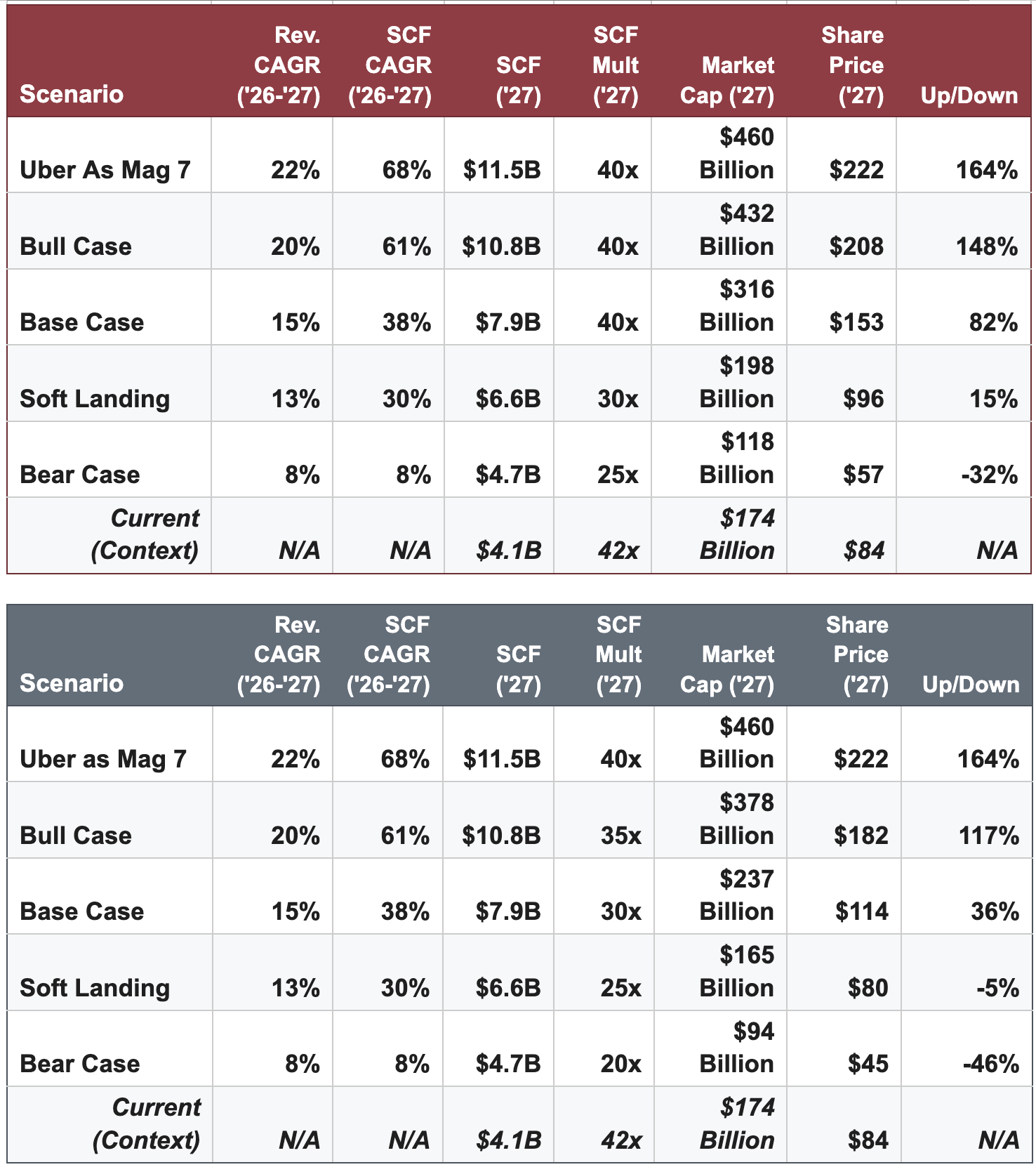
What I takeaway from this is that the base case, a world where revenue grows 15% a year through 2027, where SCF continues to grow at 38%, requires you holding the line on the SCF multiple of 40x to get to an 82% return. This would be a wonderful outcome for longs, but is not one I’m confident in. I think it’s hard to fathom a world where Uber hits the Bull Case or the Uber as Mag 7. And while this note isn’t a macro call, the Soft Landing case shows that even a little lack of faith in Uber’s multiple makes this tough bet.
The Final Word
The most important traits needed to really compound durable returns are discipline and honesty. I grew up in financials and banks, the ultimate cyclicals, and they taught me an important lesson: the worst mistake you can make is lie to yourself and say a cyclical business isn’t cyclical. Ride-sharing and delivery are no different. When the economy is strong, people move and spend more, operating leverage kicks in, and FCF and SCF expand quickly. But when the economy weakens, that same leverage works in reverse. Uber is a great company and Dara is a strong operator, but at this valuation it serves as a reminder that you’re not simply buying a business, you’re buying a belief about the next few years of the economic cycle.
Uber’s long-term value won’t be determined by LiDAR or AI breakthroughs, but by platform structure: whoever controls the routing layer controls the user, and therefore commands the premium multiple. I agree with Ackman that Uber’s demand-aggregator model is the right strategy, and I don’t expect Waymo’s model to suddenly shock the world and take 20% of Uber’s share fast. Tesla, in theory, could be a faster threat given its software-first, compute-light approach, but full self-driving remains one of the hardest unsolved problems in technology no matter what Elon says.
The opportunity for Uber to escape cyclicality and become a secular cash-flow machine is there, but at today’s ‘16x FCF’ the stock requires too much to go right, economically, competitively, and structurally, and with very little margin of safety. I think Uber is better than most cyclicals in the sector like DASH or LYFT, and I want to own it, but I’m fine waiting. Buying cyclicals at high prices when the market is paying for years and years worth of optimism rarely works.
Afterall, Munger said wonderful businesses at fair prices, not wonderful businesses at high prices.
The best is ahead,
Victaurs
The full UBER research, with the durability test and the verdict, lives in the Terminal: UBER research. 107+ companies and counting.