Yellow Pages Had a Great Moat, Until the Internet Came Along
The 3 companies most likely to be around in 20 years, the 6 worth exploring more, and why beaten down doesn't always mean worth buying.
$60.50 a share and $53.4 billion. That’s what Stripe just bid for PayPal, and it’s what got me looking at the entire space.
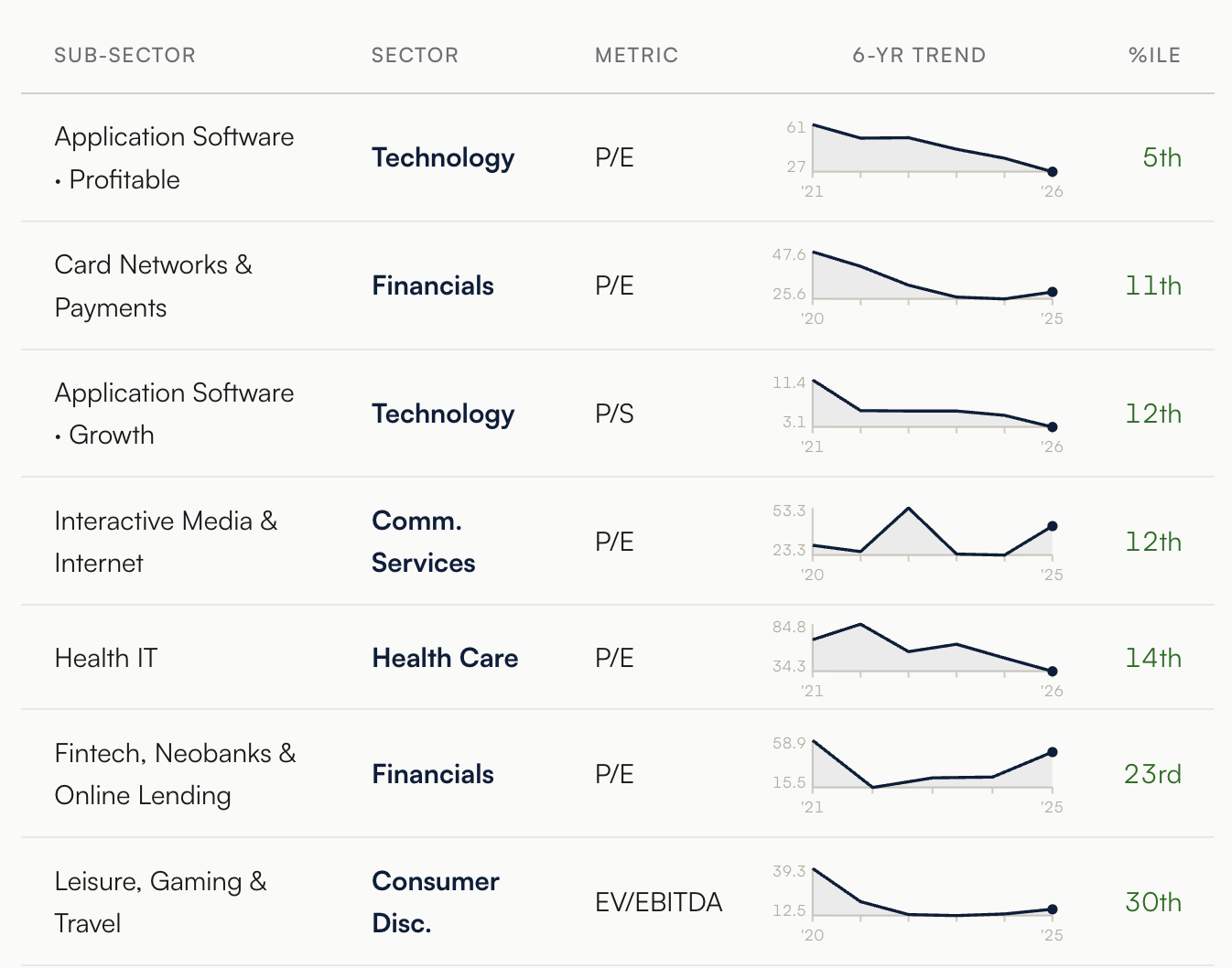
Cards and payments sit in the 11th percentile of valuation going back six years, one of the cheapest corners of financials, or of anything really. Why? Part stablecoin fear, part agentic commerce, part software de-rating, and part nobody wants to own them.
The key to winning in this space is to properly assess Chris Hohn’s concept of a moat. Or put simpler, to answer who is going to be around in 20 years and who might not be. As an investor, try to answer this question first, before trying to figure out who is cheap and who is expensive. Munger’s inversion is essentially the whole method. Ask how it dies before you ask what it’s worth.
And how does a payment company die? Let me count the ways.
Moat Rankings, Durability, and Risk/Reward
A moat is not a great product or a big customer base. It’s a structural reason a customer can’t leave even though they want to, kind of like the Hells Angels in A Bronx Tale. It could be a two-sided network nobody can cold start, a system of record too complex & dangerous to rip out, a closed loop that captures all economics (what Stripe is trying to do with PayPal), a legit cost advantage, or a regulatory edge.
After looking across 26 names, there are 3 tiers of moats.
Tier 1, the most durable and most fairly valued.
Tier 2, durable but beaten down and worth more work.
Tier 3, a bit too fragile, no matter how cheap.
Tier 1: V, MA, & AXP
V’s scale is unassailable, despite the uninformed tech elite and crypto enthusiasts calling it Blockbuster every day. They have roughly five billion credentials against more than 175,000,000 seller locations, which means a challenger has to solve issuance, acceptance, disputes, fraud, and settlement all at once. What most don’t realize is that payments volume went from $4.9T in FY 2015 to $14T in FY 2025 while net take rate stayed essentially flat across the decade, at 28bps. Their biggest risk right now is the swipe fee settlement that gives merchants the right to decline premium cards, more an acceptance risk. The challenge as a long here is it’s at 27x forward earnings versus a 24-32x band since 2015.
MA is a similarly dominant moat that I believe will be around in 20 years. The wrinkle with them that most people don’t realize is that services is now 41% of revenue growing 22% as of Q1 and operating margins have expanded while volume has compounded. Neither thing says disruption. The main risk to MA is the big US banks exploration of the STAR network, which would route debit around MA and V. But similarly to V, MA is priced around 27x forwards against its history which is historically above 30x.
The last one in tier one is AXP. Roughly in line with their own history at around 19x forwards versus a ~18.5x 10-year average, and at a discount to V & MA, because they carry the lender risk the others don’t. On the credit side charge-offs have been roughly 2% against an industry average of 4% plus and delinquencies have been 1.3-1.4% for two years. What they do really well is keep their consumers captive in their moat and grow it with lounges and rewards. You can basically see the moat in action the next time you are in a major airport and see a line of people outside the lounge waiting to eat really average “free” food.
Tier 2: JKHY, ADYEY, CPAY, PAYX, FIS, & TOST.
These names are more interesting because there’s more debate on their moats and valuations.
JKHY is the system of record for about 7400 banks and credit unions. For those that know, a core conversion is the equivalent of a root canal, on every tooth in your mouth without drugs. They’ve established a high amount of trust and it’s why 99% of clients stick around every year. The disconnect going on right now is that the stock has sold off hard, while the company beat and raised three consecutive times, which is confusing to me. Maybe it’s the perfect moat in a shrinking pasture, or maybe people see a way to disrupt core technology in banking and that’s why it’s cheap. It’s valued around 21x forwards against a high 20s to mid 30s band over the last decade.
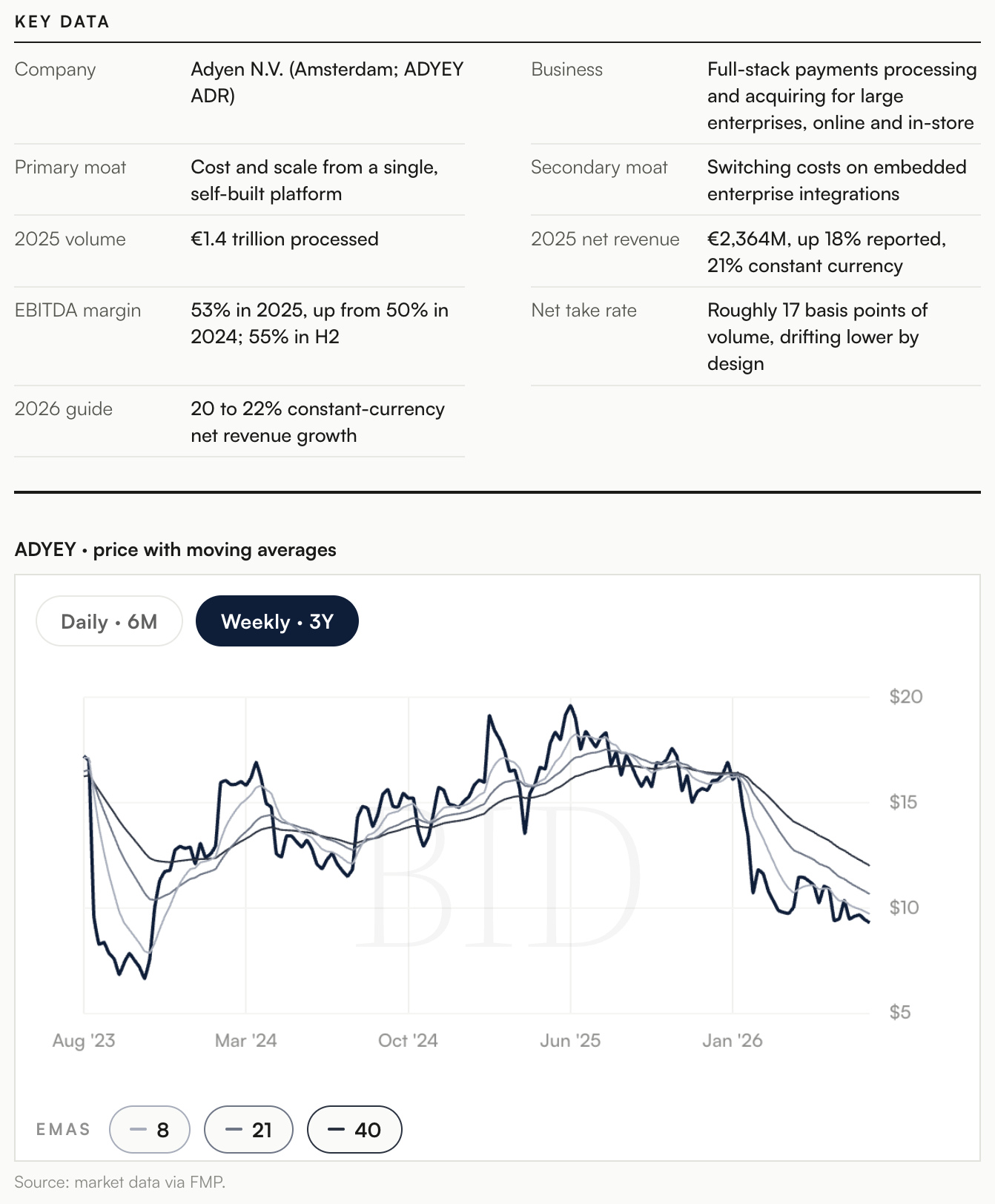
ADYEY’s pitch is running a single codebase for the entire world, which makes it the lowest-cost operator in enterprise acquiring. Their take rate is 17bps compared to Stripe’s estimated 34-36, and EBITDA margin still climbed from 50% to 53% in 2025. This low cost model reminds me a lot of Amazon, Costco, and Interactive Brokers. Charge less to earn more, which Nick Sleep might even appreciate. Growth is the biggest market challenge right now, not that they don’t grow, just that their most recent guide stepped down to 20%. If a Stripe and PayPal merger happened this would open up a green field for ADYEY since it would signify a shift to the consumer stack from enterprise at Stripe. Plus at around 21-22x forwards for 20% growth it’s fair, but not cheap.
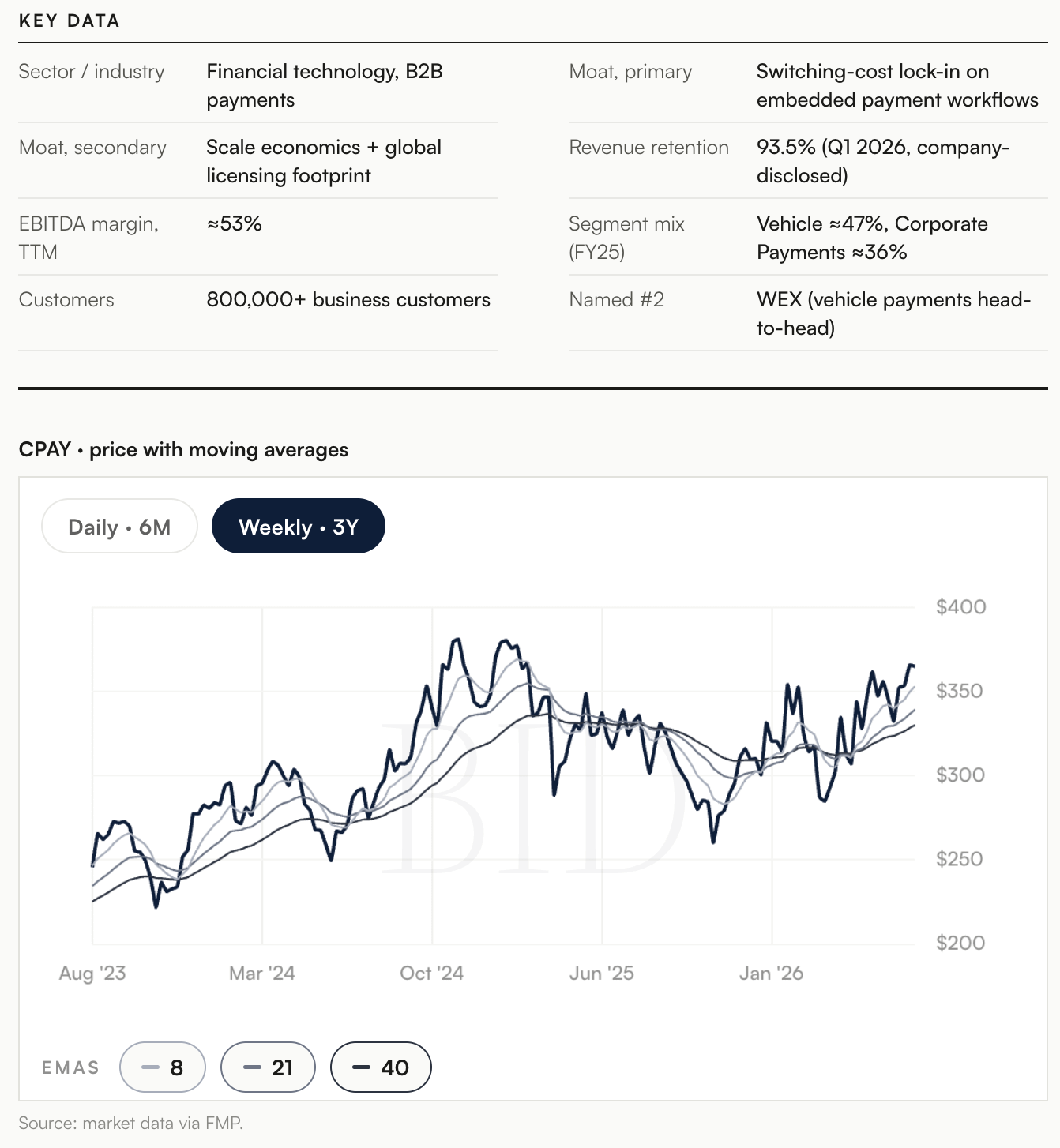
A bit more debatable, but CPAY should also be around in 20 years. They sell control over business spending and once their plumbing is wired into ERP & fuel policy the idea of leaving is more attractive than the reality of leaving. Revenue retention in the low 90s and growing proves this point out. Corporate Payments is 36% of revenue and growing. They also have done what every great company does in hindsight, try to disrupt themselves. Their biggest risk, stablecoins eating payments revenue, are less of a risk to me because they actually proactively embedded the technology in their rails via a JPMorgan and BVNK partnership. Valuation wise they’re around 14x forward for company-guided ~25% adjusted EPS growth and buying back roughly 4% of shares per year.
PAYX is the process moat provider for small businesses, normally the strongest moat type. They handle withholding across state and local codes, filings on the right dates, and hitting a payday. AI could eventually disrupt this, but anyone that’s used LLMs knows that the pain of “you’re right, I should’ve paid your employees yesterday” is a real and non-zero possibility for anyone looking to disrupt this workflow. I’d rank this one as lower durability than Corpay, because end user ratings are not great and that tells me that the pain of leaving, rather than a wonderful product is a reason they have a moat. Valued at 19x versus a historical high 20s is cheap, but maybe reflective of the moat being shakier than the rest, funny how that works.
FIS is another other system of record for bank cores. Same root-canal switching pain as JKHY, and it throws off cash accordingly: roughly a 13% free cash flow yield at 4.4x EV/EBITDA, while retiring about 6% of the shares a year. It’s down more than 50% from its high at $41 against an $83 year-high because the moat is real and the capital allocation has not been. Worldpay was bought, written down by roughly $7B, and sold in pieces, and the balance sheet still carries the evidence: intangibles are about two thirds of total assets and return on invested capital sits under 5%. With them you are buying a genuine core-banking moat at a distressed multiple from a management team whose history says the cash may not find its way back to you.
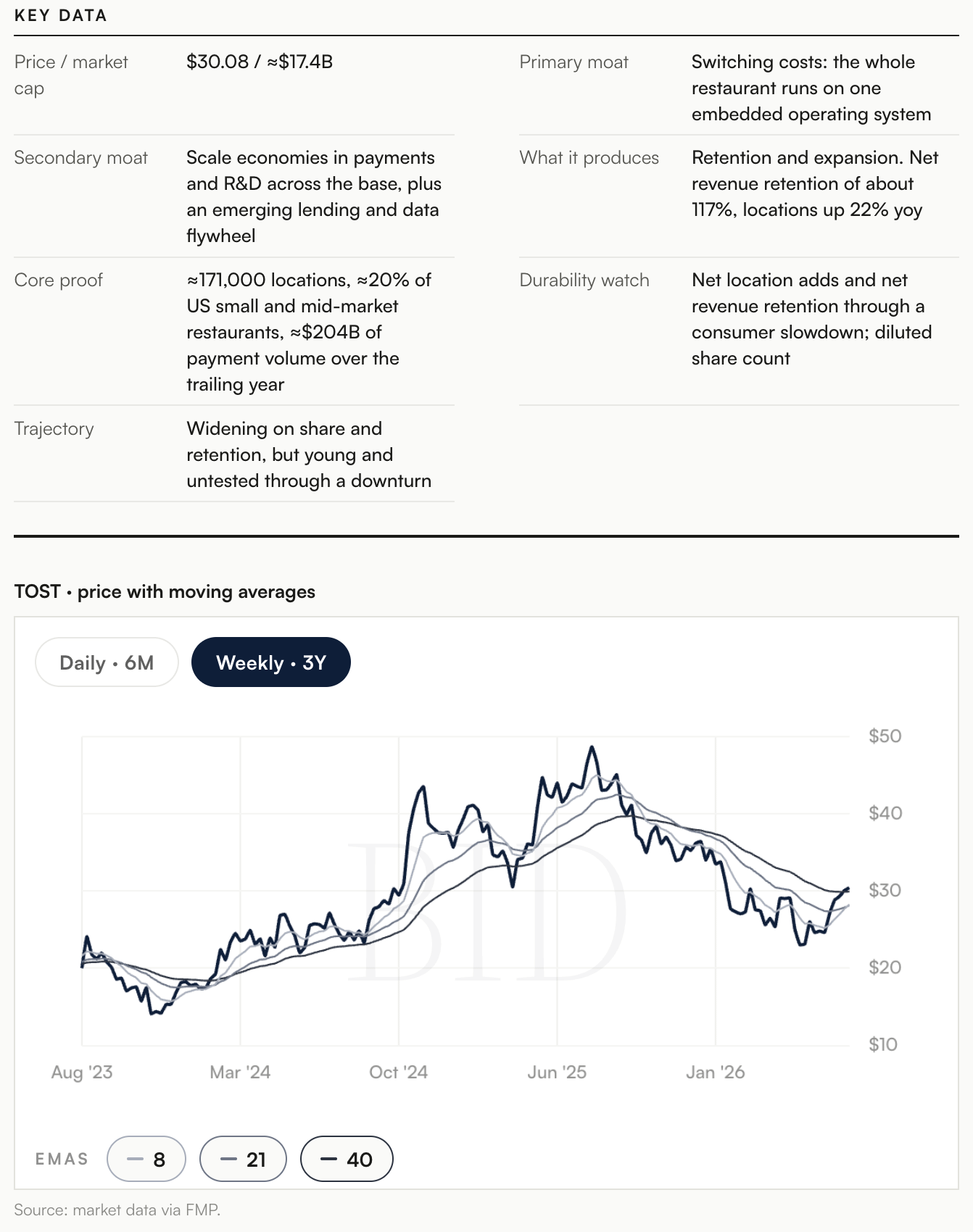
TOST is a fun one. It’s the operating system for about 171,000 restaurants and from research, pulling this out is functionally impossible. They are deeply entrenched into their customers’ workflows intelligently. They’ve thought of every detail, from waterproof terminals to intelligent supply ordering to AI marketing that lifts restaurant revenue. From their materials & reviews it feels like they understand the soul of their customer and make their lives better. Gross margin sits around 26% on $6.4B of revenue driven by take rates on payment flows. The biggest question mark on TOST though is not that the MIT founder led company is smart and tech forward, but that they have never seen a recession. And at 23x forwards and despite an inflecting operating margin higher, it’s still subject to the whims of the economy 16 years into a great credit and employment cycle.
Tier 3: A Longer List of Less Durable Names
These are all weaker moats. Remember too that the point here is not to debate valuation versus next quarters earnings, but instead to think about true longevity and durability of moat. This speaks to the larger point that sometimes beaten down doesn’t mean you should buy it. Sometimes it means there is a question of if the business model survives.
DLO has lots of concentration risk, 10 merchants are over 60% of revenue and they can reprice the toll when they want, and recently have, from 1.05% in Q1 2025 to 0.84% in Q1 2026.
FISV another bank ledger like JKHY, but the merchant business and ~3.1-3.2x leverage make it questionable. Add in the Murphy’s law of earnings misses, recasts, management changes, and it may be around in 20 years, but who knows.
QTWO feels weak only because core processors in the bank space eventually can just bundle their digital front end into flat-fee contracts. It also has SBC at 10.5% of revenue which never makes me feel great.
GLBE is is the merchant of record for SHOP, handling duties, taxes, and compliance. So they are renting its fastest growing channel from SHOP, who has already extracted warrants once, which means they can be repriced or replicated pretty easily if wanted.
PYPL their branded button is under attack from SHOP and AAPL and their thin margin Braintree business is the one growing, branded TPV up 2% last quarter against 11% for the unbranded side. The recent takeout offer from Stripe, which does almost the same $1.9T in payments volume but has a $159B valuation vs. $50B for PYPL, shows there’s value in the consumer data exhaust but beyond that probably not.
XYZ weaker because a rising share of gross profit is Cash App Borrow and Afterpay, which means some of the re-acceleration is the cyclical lending type not the durable payments one. SBC is typically high, which isn’t a moat thing, but let’s you know what management cares about most.
BILL the workflow is a bolt-on above ledgers like QuickBooks and Xero, which means it only survives if those two let it. And SBC 11% of revenue too.
FLYW sits inside the university billing office workflow which is legit sticky, but schools run two or three cross-border providers on the same page. Competition and a small market make for tough future gains.
FOUR owns something scarce in Global Blue, roughly 70% of tax-free shopping built on four decades of customs integrations. The restaurant core though is openly contested and the lock there is contractual rather, not earned. They’re also at almost 5x net debt to EBITDA, so investing in their moat isn’t happening for a while.
WEX built a closed loop with 19 of every 20 US fuel stations, which is a real moat. But they compete with CPAY and are also quite levered.
RELY has the hard part, cash-in from a US paycheck and cash-out at a corner store in Manila with compliance at both ends, but the middle rail it feeds is exactly what stablecoins are built to commoditize. Wise too competes with them and is cutting prices.
GPN merged processing into merchant software, which was a moat until software-led entrants started owning the merchant relationship above it. Super levered, negative ROE, just absorbed Worldpay. The story is one of distraction, not focus.
EEFT owns where cash meets the banking system. They have cash access mandates in about 15 European countries oblige. It’s cheap and not levered compared to the rest of tier 3.
STNE built switching pain from bundling plus a service network the big banks would not build. Pix and the regulators keep opening the rails underneath it, though. For what it’s worth, rates down will be good to them.
PAGS sells a Brazilian merchant their whole financial life in one app, but three larger or better funded ecosystems sell the identical closed loop. Similar to STNE, rates down will be good to them too.
EVTC owns the ATH network and the rails of one island, which is a genuine local monopoly until you remember a monopoly on Puerto Rico is still a monopoly on Puerto Rico. They are pushing for diversification into Latin America via Brazil, using the cash flow from Puerto Rico to fund it.
WU has 500,000+ agent counters that are genuinely hard to replicate, guarding a payment medium in retreat, and the profit is the FX spread rather than the counters. The physical location edge is a moat in a sense, but as money goes more electronic it gets harder to value.
Invert, Always Invert
The cards and payments space is beaten down, but beaten down does not mean worth owning. Rather than starting with valuation, start with the inversion.
How does this company fail?
Will it be around in 20 years?
Answer that first, then argue about price.
That principle is a mental model that keeps you out of trouble. And it has certainly helped me over time. It’s a little bit more work, but it builds a process that should stand the test of time and returns that should be more durable.
Always invert,
BID
PS - fundamental analysis and moat dives are available for all 26 of these companies at The Bid Terminal. At current there are over 150 single company write-ups, 46 moat dives, and weekly market scans.
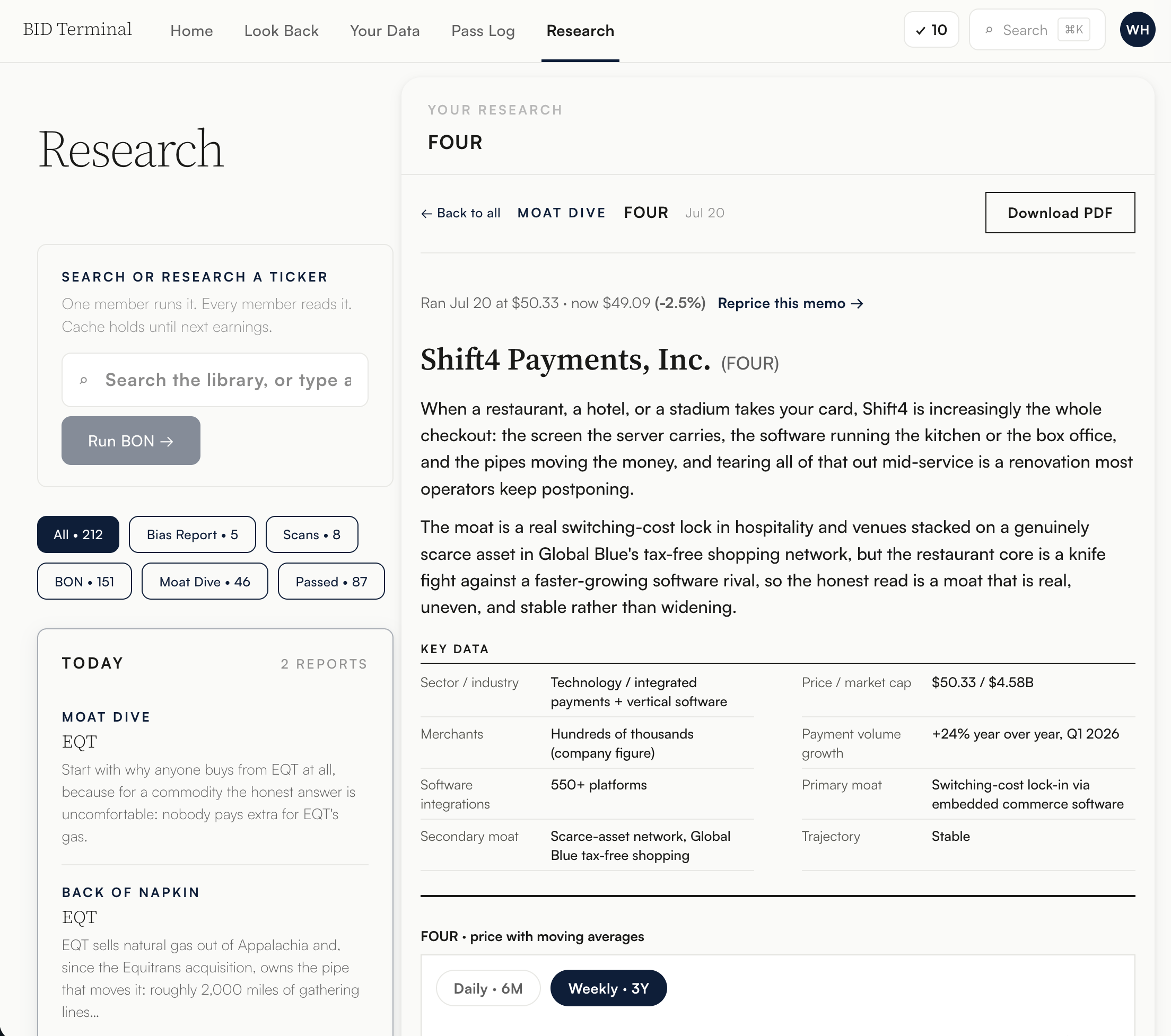
The research behind essays like this one lives in the Terminal: open Research. 107+ companies and counting.