Can Wise Outrun Stablecoins in the $32T Cross-Border Market?
Stablecoins cut fees in theory, but Wise is cutting them in practice.
Some companies grab the spotlight. They build a story around themselves, pump the headlines, and become shorthand for whatever hype cycle happens to be running. Others work in the shadows, laying pipes, compounding slowly, and before you realize it, they’ve become indispensable.
Markets love the first type in bull runs, but they reward the second type over decades.
Wise belongs to the second camp, it doesn’t shout. It doesn’t slap its logo on stadiums or run Super Bowl ads. But it’s building a system that could end up moving trillions of dollars around the world. And if you care about investing in companies that quietly compound until they’re the default, Wise is worth your time.
The question is straightforward: if a company already moves £145 billion of money across borders each year, grows faster than peers, and makes money doing it, should you own it?
They’re doing about £1.2B in revenue with a £10.9b market cap today while growing revenues at 20%+. Margins are 20% too (even though management will reinvest excess north of 15%) and if the bull case plays through, Wise could be worth £20B or more within five years, with Platform as the upside kicker. The UK economy isn’t a big swing factor, and if sterling weakens, reported revenue and profit actually get an optical lift.
Wise started life as TransferWise in London, born out of frustration. Two Estonian founders realized banks were doing what they do best, skimming fat spreads on FX every time they sent money home. They figured out a hack: match people who wanted to send pounds to euros with those sending euros to pounds. Everyone got the real rate, and Wise charged a tiny fee.
That spirit of radical transparency, showing customers the true mid-market rate and the fee upfront, hasn’t changed, what’s changed is the scale. Today Wise is a multi-currency account that lets you hold and spend in 40+ currencies. It issues a debit card, businesses invoice and get paid through it, and increasingly, Wise rents out its rails to banks themselves, letting them power transfers through Wise’s pipes. It’s created something so good, and so useful, at such a cheap rate that even the big banks are saying “we’ll just use your rails”.
Think of it less as an app and more as a payments operating system. Wise charges a small fee when money moves, earns a little on balances, and increasingly takes a cut when banks plug in. Every new customer, every new integration, spins the flywheel faster: more volume lowers unit costs, which allows lower prices, which attracts more customers, which deepens the moat.
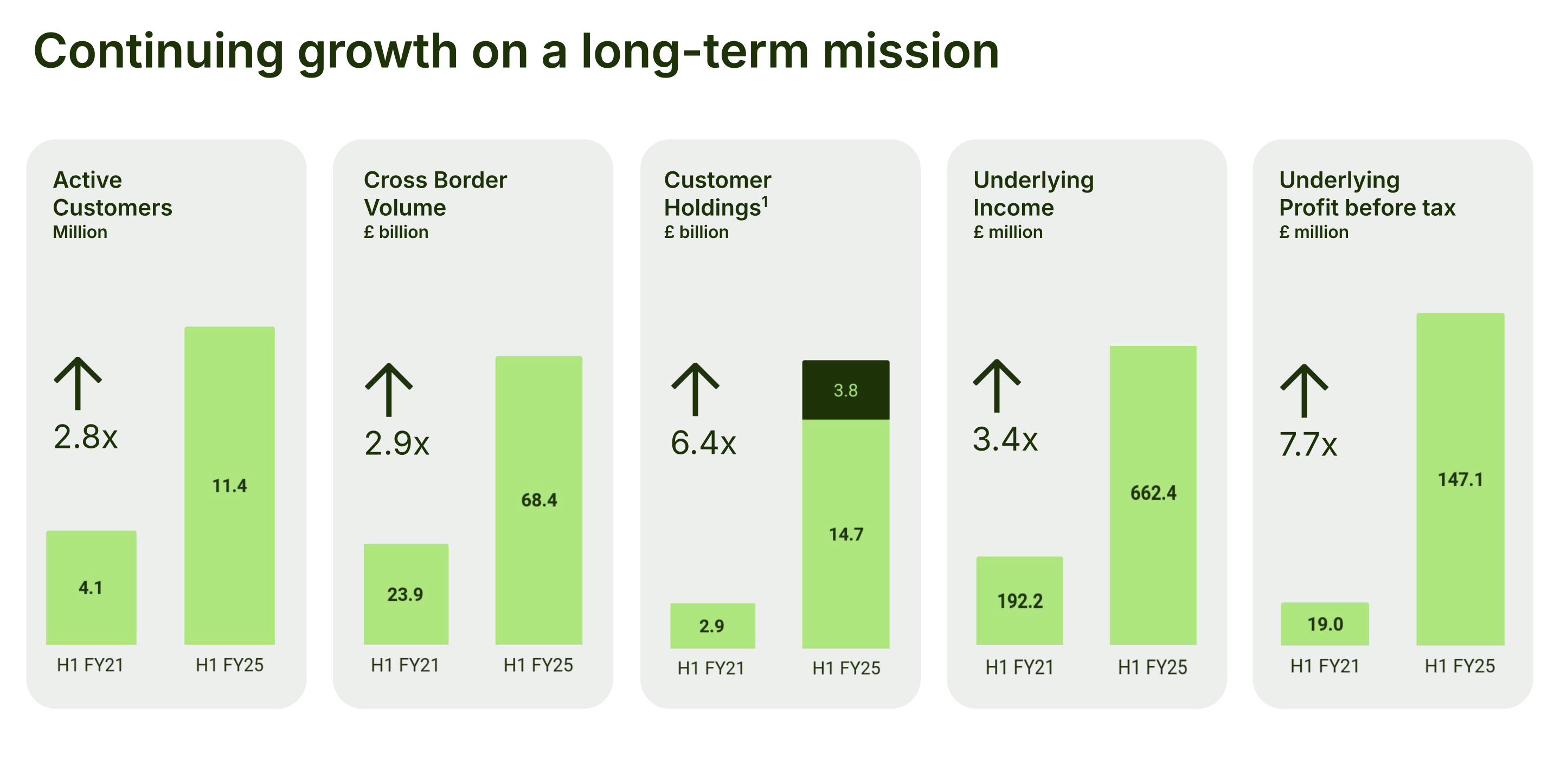
Fiscal 2025 tells the story in hard data. Wise served 15.6 million active customers, up 21% year over year. Cross-border volume reached £145 billion, up 23%. Underlying income climbed 16% to £1.36 billion. Pretax profit margins sat at 21%. Free cash flow conversion was over 100%. Let me be clear here, these are numbers that most “mature” companies would kill for. And yet for Wise, it feels like it may just be the beginning.
On top of this, customer acquisition is where Wise looks almost alien compared to peers. Over 70% of new users come from referrals, giving Wise a CAC of just £20–30 per customer. Chime spends $100–200, PayPal spends billions. Wise’s ARPU is ~£87, higher for SMBs. Low CAC, high ARPU, sticky cohorts are a growth engine peers can’t match.
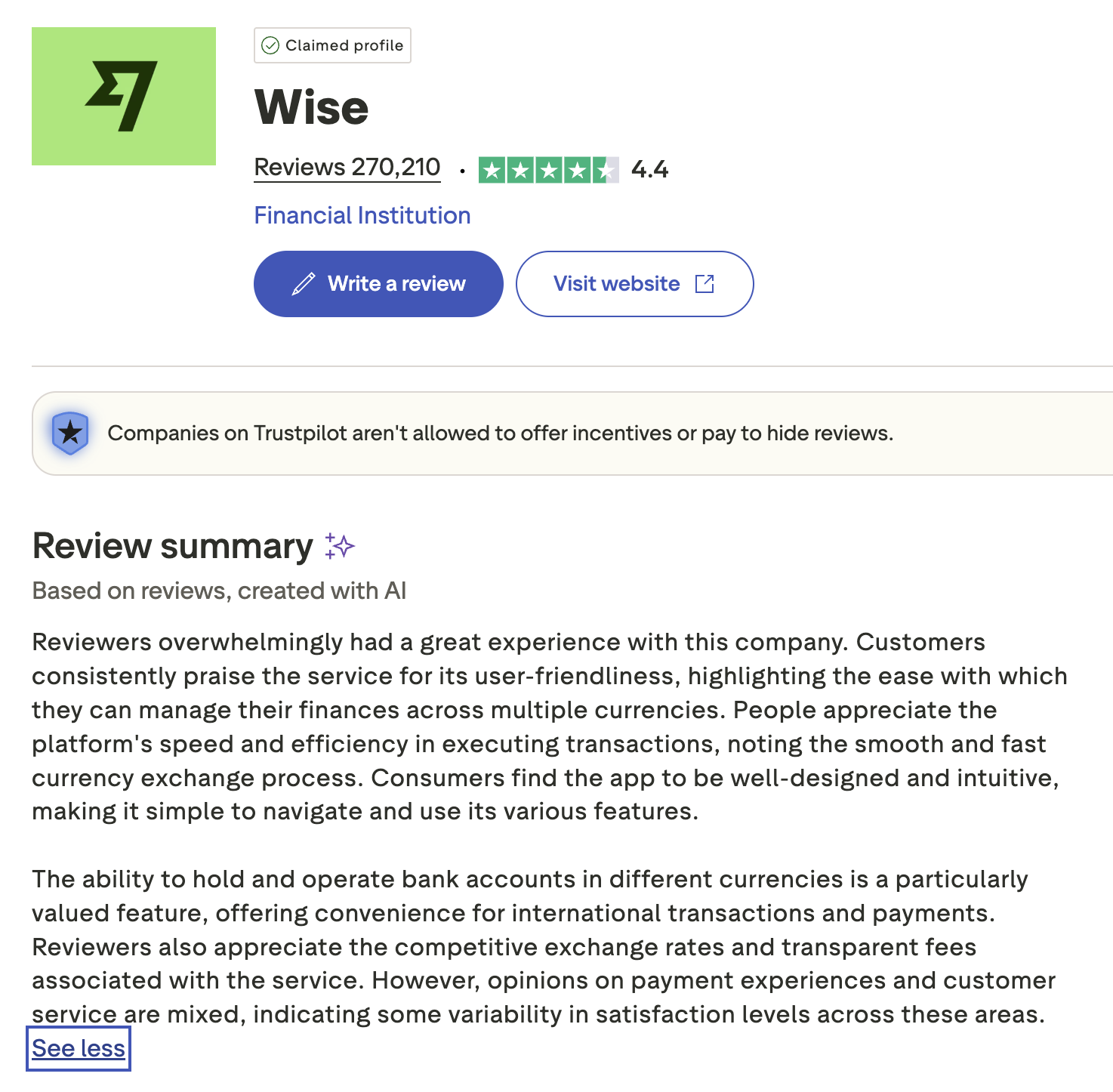
Even the reviews tell the story. On TrustPilot, customers don’t just use Wise, they evangelize it. That’s rare for something as boring as moving money across borders.
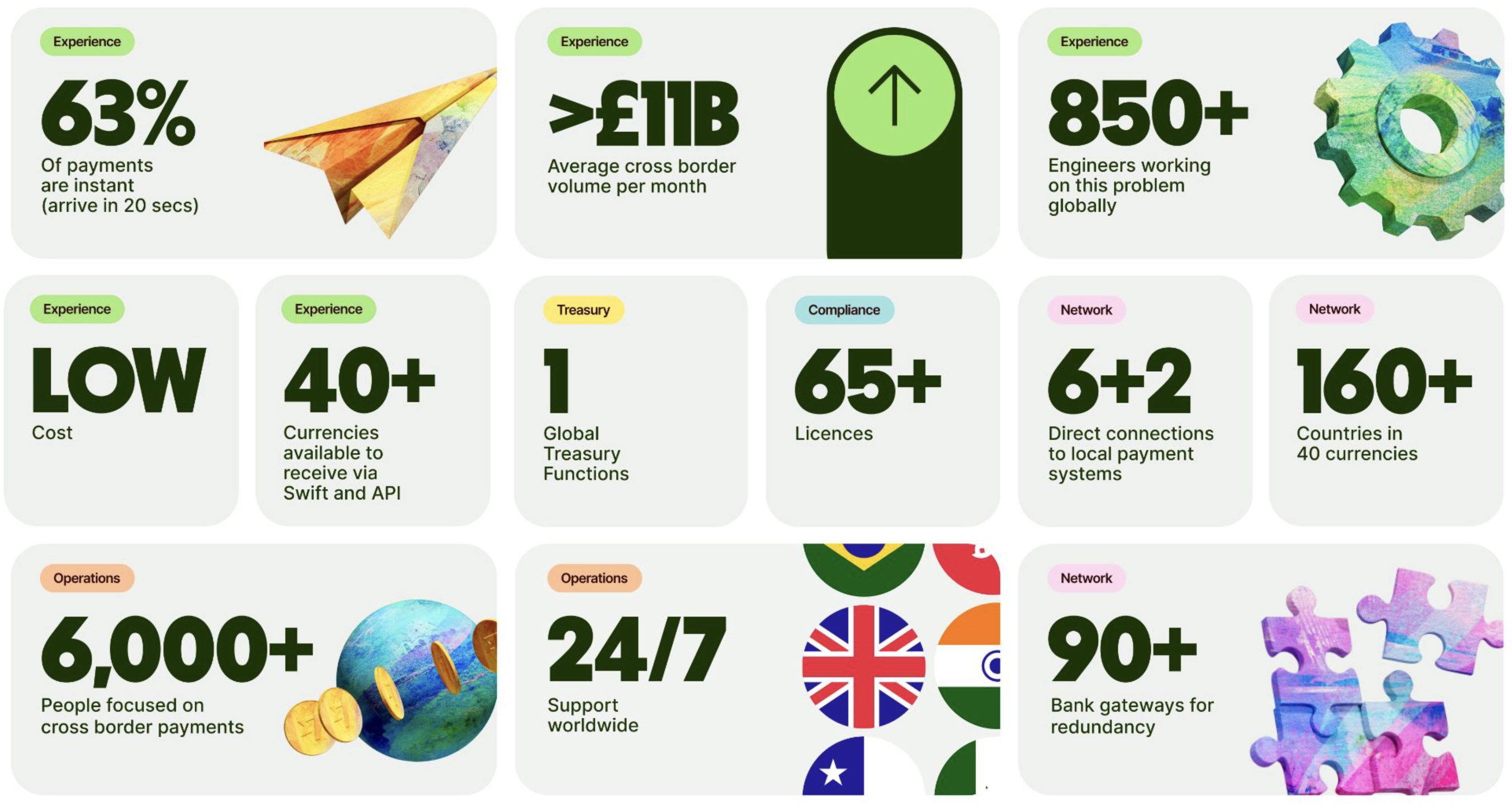
Customer love matters, but the real moat isn’t the app, it’s the rails underneath. Wise has already poured £3 billion into infrastructure, with another £2 billion committed. Quietly it built a global single tech stack spanning 160 countries and 40 currencies.
You have to remember that banks still move money through a patchwork of correspondent chains, where funds hop between intermediaries, each adding cost, friction, and delay. Circle, and the USDC stablecoin technology was supposed to solve all of this with Ethereum rails, but in the end users still have to convert back into fiat.
Wise on the other hand built those rails from the ground up and circumvented the correspondent bank toll booths. Half of its transfers now run on direct connections into local clearing systems in places like the UK, Australia, Singapore, and the Philippines, with Brazil and Japan coming online next. When Australia went live, instant transfers surged from 24% to 83% and costs fell 9x.
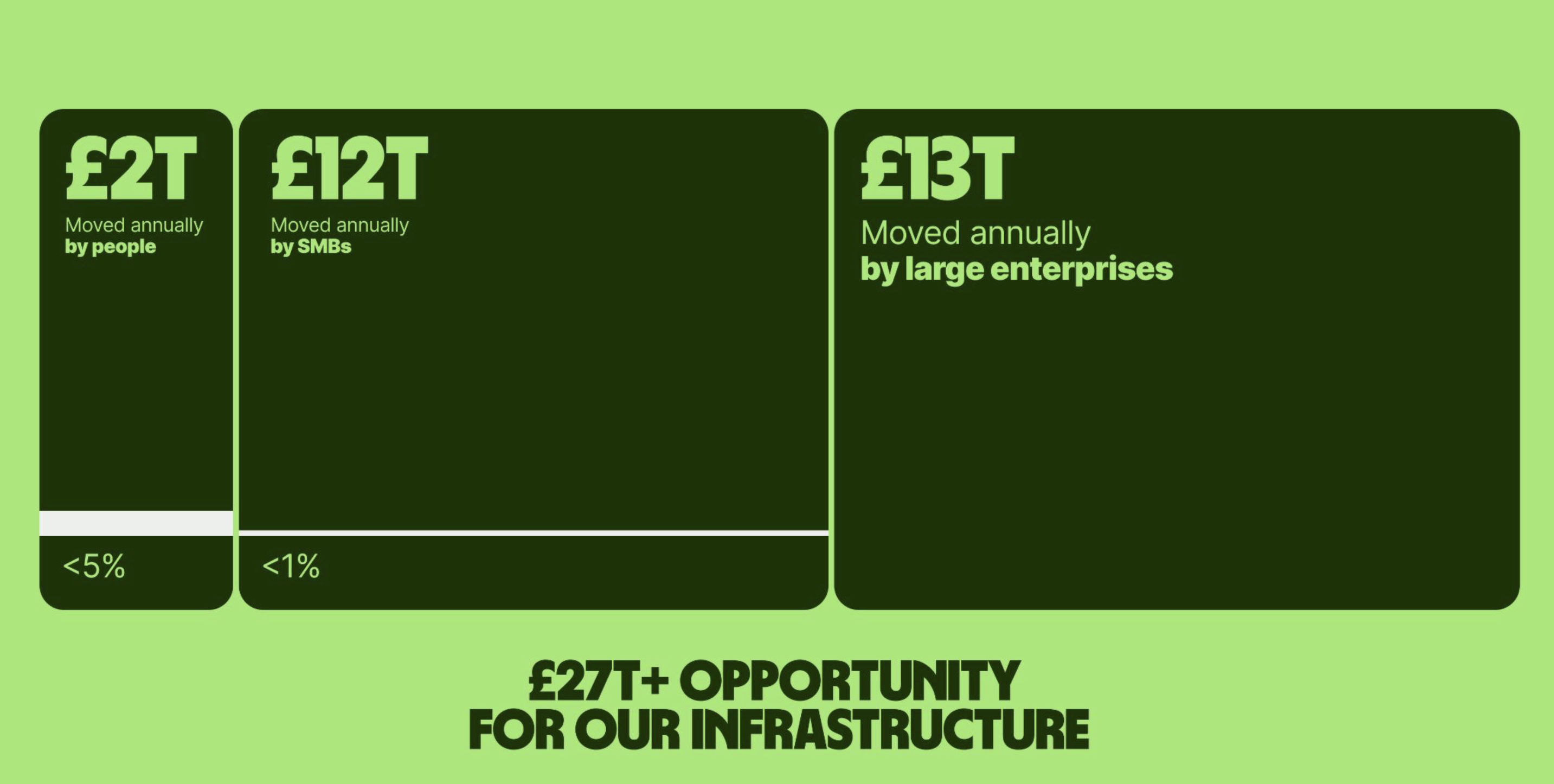
And on top of all of this sits a single global tech stack, with AI engines predicting liquidity needs and catching fraud faster than banks’ legacy systems. Add 65+ licenses worldwide and full transparency, always showing the mid-market FX rate, and Wise has designed rails that are faster than crypto, cheaper than banks, and trusted by regulators. This is the foundation, and it’s the very infrastructure banks themselves are now embedding through Wise Platform, turning what began as a consumer app into the pipes that can carry a meaningful slice of the world’s £32 trillion in cross-border flows.
For all the talk of speed and cost, the trust factor may be even bigger. Moving money across borders is a magnet for fraudsters, and regulators scrutinize every link in the chain. Stablecoins promise instant settlement, but they don’t solve KYC, AML, or off-ramp costs. Wise does and that’s why I think it’s positioned to win in the long run.
And this isn’t some abstract “value” argument. In core corridors like GBP/USD/EUR,. which make up 40–45% of volumes, Wise’s take rates are already down to less than 0.25%. That’s almost as cheap as a stablecoin transfer, but with full compliance and consumer protection. Wise shows the fee upfront, radical transparency with no hidden spreads. And its systems are good enough that review times for suspicious transfers fell from 13 hours to 2 hours last year.
Banks and regulators trust Wise to move billions securely. Customers trust it to tell them the truth about costs. That trifecta, compliance, transparency, reliability, is a moat no “fast and cheap” upstart can fake.
So why is this valuable? Because all of this put together means Wise isn’t just a one-off transfer app anymore. Customers are leaving balances on the platform: £21.5 billion by FY2025, up 33% year on year. £4.5 billion of that sits in Wise Assets, where customers earn interest through pooled BlackRock money market funds. Just like a stablecoin for those of you keeping track at home.
More than half of Wise’s users now use multiple features, accounts, cards, investments. This deepening engagement is the key. Once your business invoices through Wise or your salary hits a Wise account, you’re not shopping around for a marginally cheaper transfer fee. You’re embedded.
And every dollar held on Wise is a dollar the company can monetize, via debit card interchange, via spread on balances, via assets. In case you can’t tell, I admire these companies who take a real customer pain point, like FX fees, and use that as a trojan horse to build trust, add value, and become a larger and larger percentage of their customers day to day finance.
There’s one more piece of Wise that investors consistently underrate. Before valuation, here’s a bit about Wise Platform.

Wise Platform is about 4% of volumes today, with management guiding for 10% by 2030. Goldman’s upside case is 23–33% by 2030–2040. The idea is simple: banks like Nubank, UniCredit, or Standard Chartered route flows through Wise’s pipes, customers stay in the bank’s app, and Wise runs the rails in the background taking a fee. It is wholesale infrastructure hiding in plain sight.
The model is land and expand, like a trojan horse. Wallet share is about 2%, yet Wise’s partners already touch 310 million people. Even 10–20% penetration would be transformative. To win those contracts you need licenses, trust, and proven rails, and Wise has all three. If Platform works, Wise shifts from consumer fintech to embedded infrastructure, the plumbing behind trillions.
A recent Nubank partnership shows how this plays out. At first glance it looks like a competitor, but Nubank is domestic while Wise is cross-border. Building global rails would take Nubank years and billions; embedding Wise is faster. Nubank keeps the customer front-end, Wise the pipes. Local distribution meets global rails and the seeming “frenemies” actually both win.
Risks remain. Cross-border could commoditize if incumbents slash fees. Stablecoins are a long-term threat in volatile markets. U.S. expansion is also difficult; Wise has made progress with JPMorgan and Morgan Stanley, but direct access to FedNow or RTP is uphill, and many European champions have stumbled abroad.
Based on what I can read from the street, people are assuming longer term growth rates of 10-12%. People are also betting on longer term margins of 15% or so. This meshes with management’s comments that they’ll re-invest anything north of there.
Among fintech payment processors, Adyen trades around ~25x forward EV/EBITDA, growing 20–25% with ~50% EBITDA margins. Block sits closer to ~18x, with mid-teens growth and much thinner 10–15% margins. PayPal is cheaper at ~12x, but growth has slowed to the low-single digits, even as it maintains ~20–22% margins. Wise, at ~14x, slots right between them: cheaper than Adyen, steadier and more profitable than Block, and growing faster than PayPal.
Among remittance specialists, Western Union trades at ~7x, weighed down by flat to declining volumes despite ~20% margins. Remitly, on the other hand, fetches ~30x, delivering 20–25% growth but still scraping along at breakeven margins. Wise again stands out as unusual in the space, growing like Remitly, but already profitable like Western Union, and priced far more reasonably than either extreme.
And above them sit Visa and Mastercard, trading at 20x+ EBITDA with slower growth but 60%+ margins. Wise is nowhere near those margins, but its growth is faster, and if Platform scales, the market may start to see it in the same league of infrastructure rails. Maybe.

Right now Wise trades at ~8–9x sales, which isn’t cheap. It’s a high-quality business but still exposed to macro tides, and it’s riding the same growth multiple inflation that’s lifting the sector globally. I love the company, but not the price. So there are two ways to handle it: pair it long against Remitly, which is more expensive and bleeding margins for growth, or Western Union, which is cheaper but shrinking (or some combo). Or, as I’ve chosen, start with a small tracking position and wait for better entry points.
I’m wary of chasing growth stocks at inflated multiples (and already own enough), but Wise is a company I want to own. Druckenmiller reminds us that great investors wait for fat pitches and then swing hard. This isn’t that fat pitch yet, but when it comes, I plan to go for the jugular.
The best is ahead,
Victaurs
Disclaimer:
This content is for informational and educational purposes only and does not constitute investment advice, an offer to sell, or a solicitation of an offer to buy any securities. The views expressed are solely those of the author and are based on publicly available information believed to be reliable at the time of writing, but no representation or warranty is made as to its accuracy, completeness, or timeliness. Any opinions or projections expressed herein are subject to change without notice. The author may have a financial interest in the securities mentioned. You should not rely on this content as the basis for any investment decision. All investments involve risk, including the risk of total loss. Please consult your own financial, legal, and tax advisors before making any investment decisions.
The research behind essays like this one lives in the Terminal: open Research. 107+ companies and counting.