A Bank Long with Midwestern Values & A Trusted Track Record
The information provided is NOT financial advice. I am not a financial adviser, accountant or the like. This information is purely from my own due diligence and an expression of my thoughts, my opinions based on my personal experiences, and the way I transact. This information is provided for general informational purposes only and should not be considered as personal or professional advice. Your money, your outlay, your risk. This presentation does not provide investing advice in any way shape or form. You will be solely responsible for any decisions you make. If you need to seek any advice, speak to your advisers, accountants or other professionals who you may be relying on for your wealth creation journey. Please do your own due diligence. And by due diligence I mean actually think for yourself before investing your money.
Picture this …
You’re in a Midwestern bar, you know the one: sticky tables, cracked booths, and a dartboard hanging crooked on the wall. The Bears are playing on a flickering TV in the corner, and the air smells like Budweiser and bar popcorn being pumped out of the machine in another corner.
You’re with friends, hashing out a bold idea: starting a bank (you must be a glutton for punishment). And not just any bank, but one that values relationships, makes smart moves, and stays true to its roots. The plan is clear, the vision sharp, but the name.
Nothing fits. And the beers aren’t helping remove the writer’s block.
Scraps of paper clutter the table. Every name feels wrong—too slick, too corporate, too far from what you’re building. Someone jokes, “Let’s just throw a dart and be done with it.” You laugh, then pause. Why not? You grab a book of English company names, flip it open, and throw.
The dart lands on one word: Wintrust.
That’s how Wintrust Financial Corporation (WTFC) got its name. No focus groups, no consultants. Just instinct and action. That name wasn’t just a label—it was a mission. This wasn’t going to be another cookie-cutter bank. It would be one that earned trust, one handshake at a time.
From the start, their founder Ed Wehmer built Wintrust differently. With a background as an M&A advisor at E&Y in the 80’s and time as the CFO of Corus (he left in 1991) his background built his personal DNA and the DNA that would end up driving WTFC. He understood and appreciated the power of discipline and smart capital allocation. Financial strength wasn’t a goal; it was a tool to seize opportunity. And when the 2008 financial crisis hit and others were scrambling of failing (like Corus), Wintrust was ready. They kept their powder dry and acquired failed banks, expanding their reach and reinforcing their mission.
If there was ever a screaming “buy this management team” signal, this kind of discipline and foresight would be it.
And remember that unlike many banks, Wintrust has never chased size for the sake of scale. Growth was purposeful, always with an eye on shareholder value and community impact. Every acquisition, every expansion was rooted in that philosophy. Ed said it best in a 2022 article, “People ask how big we’re going to be in five years. I have no idea – I don’t care,” he says. “I’m just going to take what the market gives us and work to preserve and increase shareholder value.”
I cannot state it enough, I love this. If you are a shareholder, another screaming “buy this management team” signal would be quotes like this, beliefs like this, and cultures like this.
Ed is still a senior advisor, but in May 2023, the leadership baton passed to Tim Crane, a seasoned banker with 40 years of experience and a deep understanding of Wintrust’s culture. Having joined the company in 2008, Crane has been integral to its success. Now as CEO, he’s ensuring the same disciplined, community-focused approach that built Wintrust continues to define it.
Today, Wintrust is a $63 billion powerhouse, but it still operates with the scrappy determination of its origins. Its name is seen on Chicago Cubs and White Sox sponsorships—not for vanity, but to deepen its ties to the communities it serves. This is a bank built on trust, not flash. From a dartboard in a bar to a regional leader, Wintrust’s story proves that bold decisions, grounded in discipline, create lasting success.
3 Reasons WTFC is a Long Right Now:
They’re going to grow EPS, RPS, TBVPS
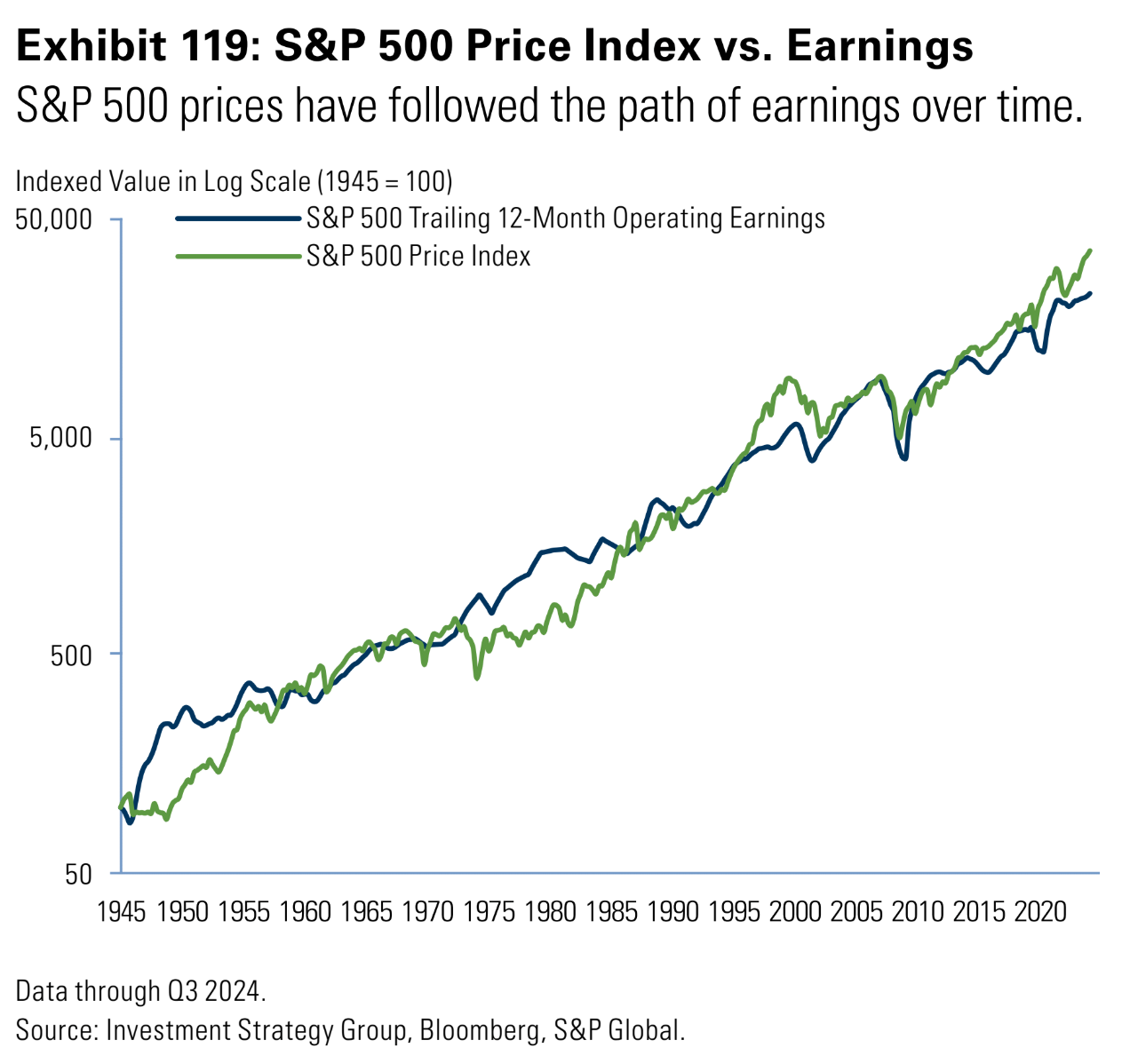
If I rock your world with this statement then I apologize, take a breath and collect yourself. But when you zoom out, the moves in a stock or index are typically driven by its earnings. Case in point this below from Goldman Sachs.
One more time, earnings drive long term stock value.
While bank investors are a tortured bunch that sometimes lose their heads in metrics like NIM, ROTCE, COF, ROA, NII, ALLL, NCL, NCO, CRE, and a hundred other metrics, my job here is to remind you of the most important things.
That is over the long term, banks with above average total shareholder returns outgrow their peers in a handful of metrics. On a per share basis, they are revenue (interest income + non-interest income), earnings (net income), and tangible book value. Basically, does the bank produce more top line, bottom line, and drop more into book value than anyone else. There are millions of decisions that impact these metrics that management CONTROLS, and similarly some core things like the macroeconomy & interest rates that impact that metrics that management CAN’T CONTROL.
The point being if over a long period of time, you are able to outgrow your peers (and not blow yourself up), then I have more trust in you to produce those in the future.
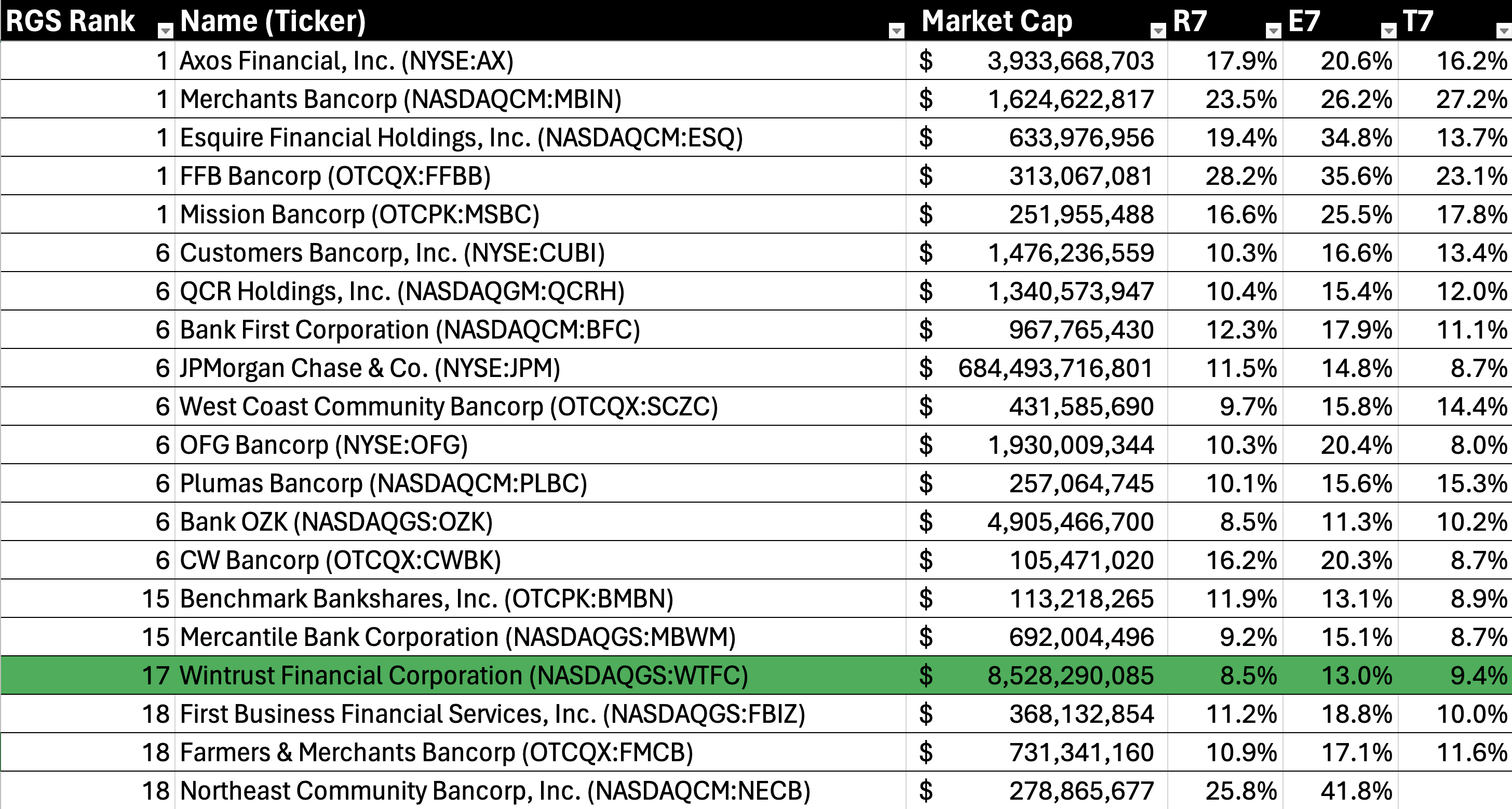
I did the work, and so here is the RPS, EPS, & TBVPS CAGR table for all public banks north of $200 million in market cap over the past 1-, 3-, 5-, and 7-year time horizons. Take a look at the numbers and give them some thought. Do they look like tech companies 40% plus growth rates? No. But surprisingly groups of banks are actually able to produce low single digit to mid-teens type numbers, which is not too bad.

When I built out the RGS (Relative Growth Score) I wanted to create a way to score banks based on their ability to grow the three horsemen of bank value (RPS, EPS, TBVPS) at a top tier level across many time horizons. The weighting considers all time periods uniquely and gives higher scores for 75th to 100th percentile performance and subsequently 50th to 75th percentile performance. It also subtracts points for below average performance and subtracts even more for bottom of the barrel performance. I wanted to weight different time periods to see how banks managed different economic and rate environments.
The punchline being, WTFC is a top 20 bank in terms of its ability to grow the three horsemen of RPS, EPS, and TBVPS. And while past does not equal future, it is a powerful starting point. Take a look here at the names on the list and the 7 year CAGRs. These are actually numbers at least on the revenue & earnings side that some tech companies wouldn’t mind. Bet you didn’t think you’d see that in banks.
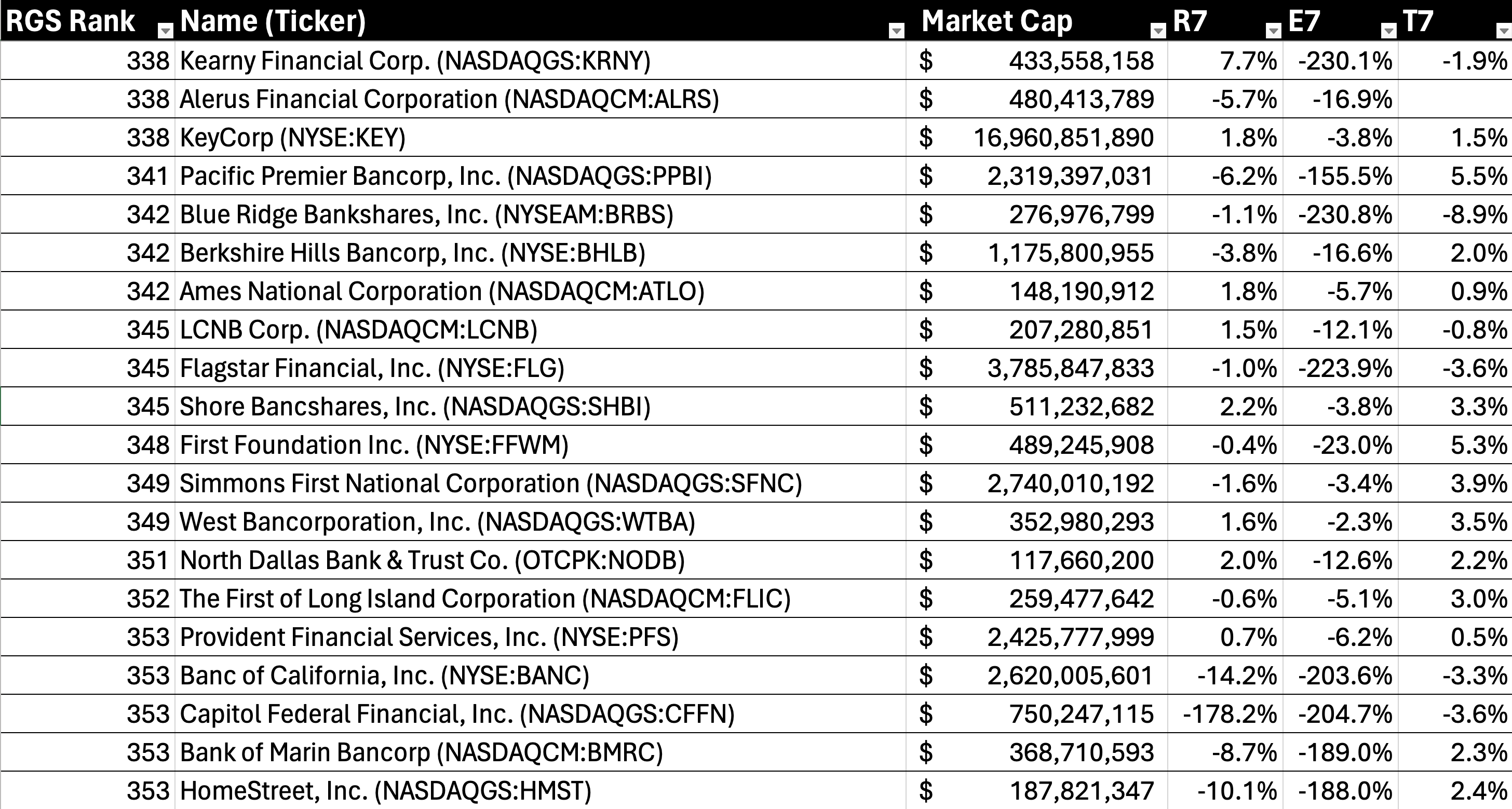
At the far far end of the spectrum, for fun below is the absolute worst growers of the three horsemen. And as you can quickly see, this kind of EPS, RPS, and TBVPS destruction typically comes with shareholder value destruction. Proof further that this framework “works” is that you probably couldn’t pay investors enough to buy a basket of these banks versus a basket of the ones at the top no matter how cheap they were. Another data point that this framework can help you see if you can “trust” management, is that these names at the bottom typically have had their management teams run out of dodge by now, had to recap, or are on the block to be sold.
Using this lens, why do I think WTFC is a long?
I can trust management to produce growth in the three horesemen over the long run. That means I think for the most part they can probably grow EPS around 10% to 15% a year, RPS about 7% to 10% a year, and TBVPS about 8% to 10% a year into the future.
And while the below violates every principle of stock analysis and is wildly ahead of consensus for the next year, my point is that good management teams with track records of growth can do wonderful things if you let them compound. Hypothetically speaking to show you the power of compounding and time you can see what happens to TBVPS and EPS if we take today’s number and CAGR it 9.4% and 13.0% a year into the future.

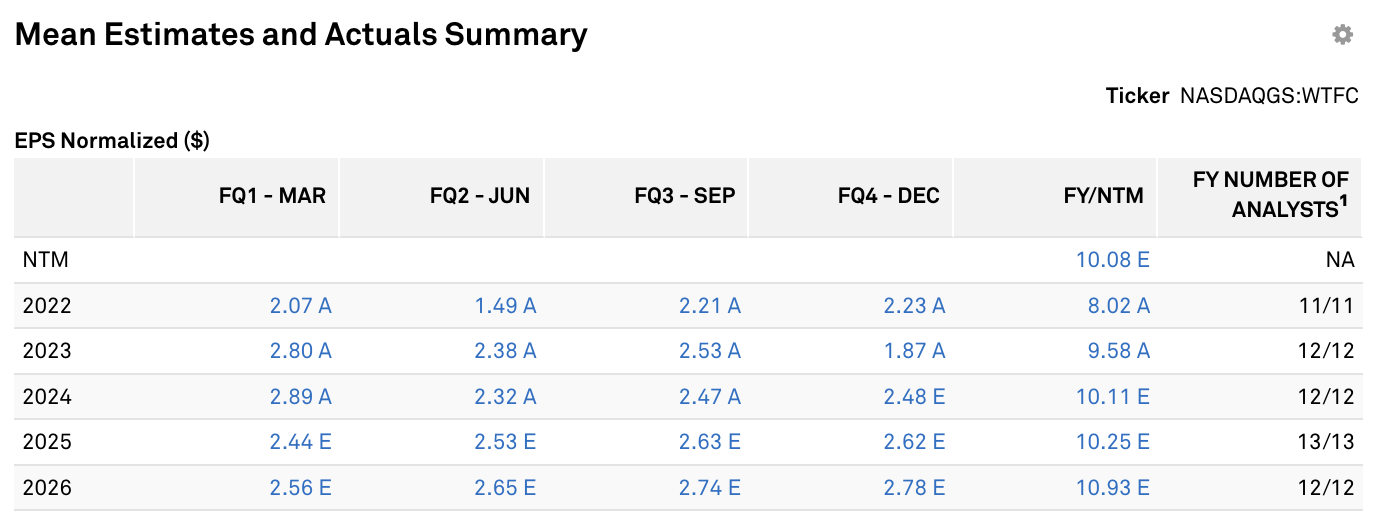
And before you get too excited, WTFC is in fact digesting a decent sized acquisition and so will not be CAGR’ing numbers at exactly that pace the next year or two. Back from fantasy land into reality land, here are the sell side consensus numbers for EPS for 2025 and 2026 at about $10.25 and $10.93 respectively. So lower near-term numbers than my voodoo hypothetical math.
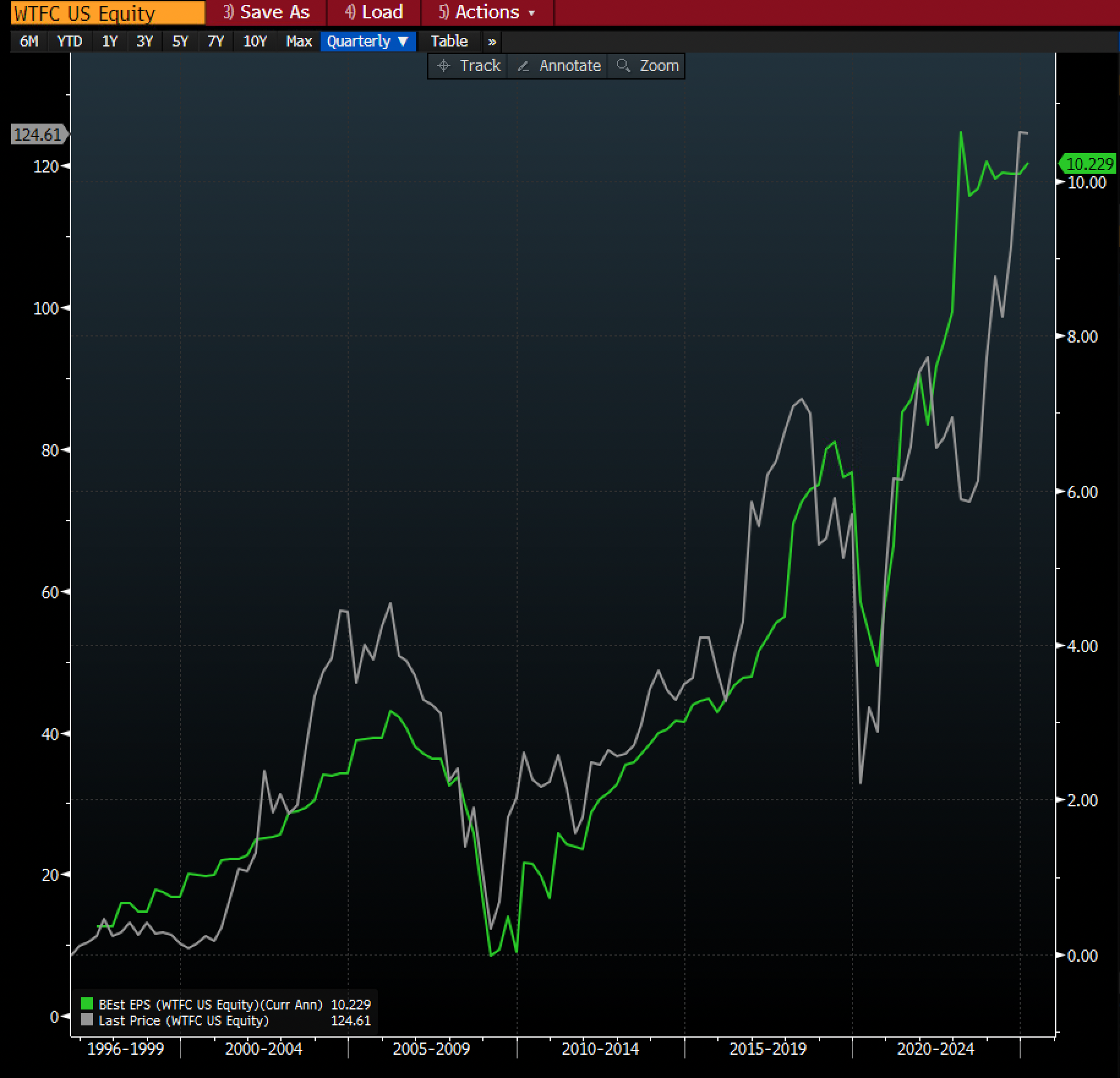
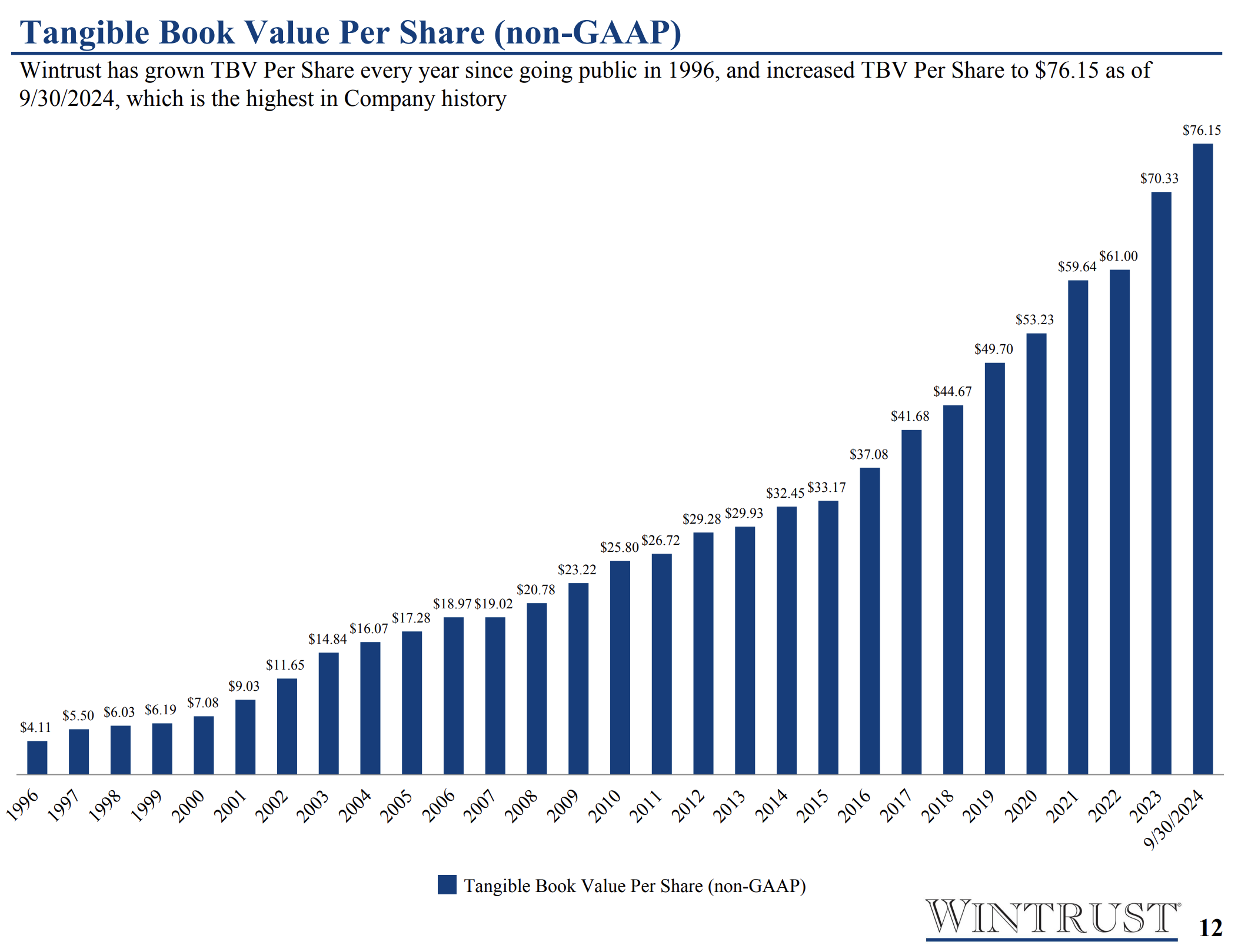
Putting a last point on this for WTFC is the longest view of their current EPS and stock price going back to the mid 1990’s. Similar to the S&P chart from above, earnings drive value. And below that is from a recent investor deck showing the growth in TBPVS over time for the bank since the mid 1990’s. Note: banks that have the reason & wherewithal to highlight this in decks tend to be good investments.
12x forwards is historically fair-ish:
WTFC currently trades around 12x forward earnings. It’s not super cheap by any stretch. But nothing in the bank space is cheap compared to the peak of the “Regional Banking Crisis” in 2023 when liquidity was gushing out of the system and multi-billion-dollar banks were failing overnight.
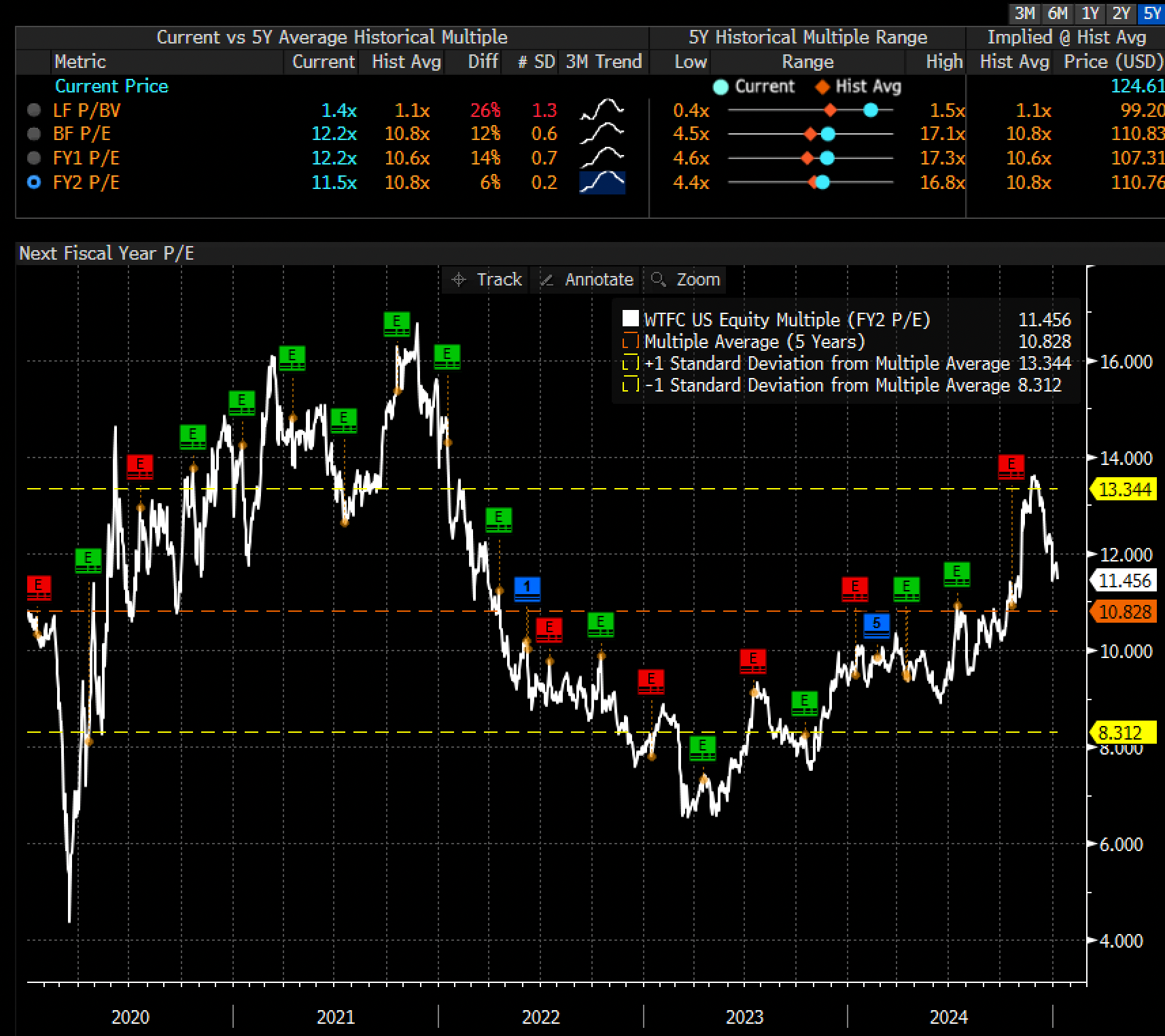
Below is the 5-year historical average multiple for WTFC on a forward basis. During the whacky COVID times when people were majorly bulled up, it got to 16x forwards. And while I don’t think that’s a base case there are several factors pointing towards the potential for all banks to experience higher multiples going forward. They are: higher rates, sloped yield curve, less regulation, easier M&A environment, more loan growth, and still limited loan problems.
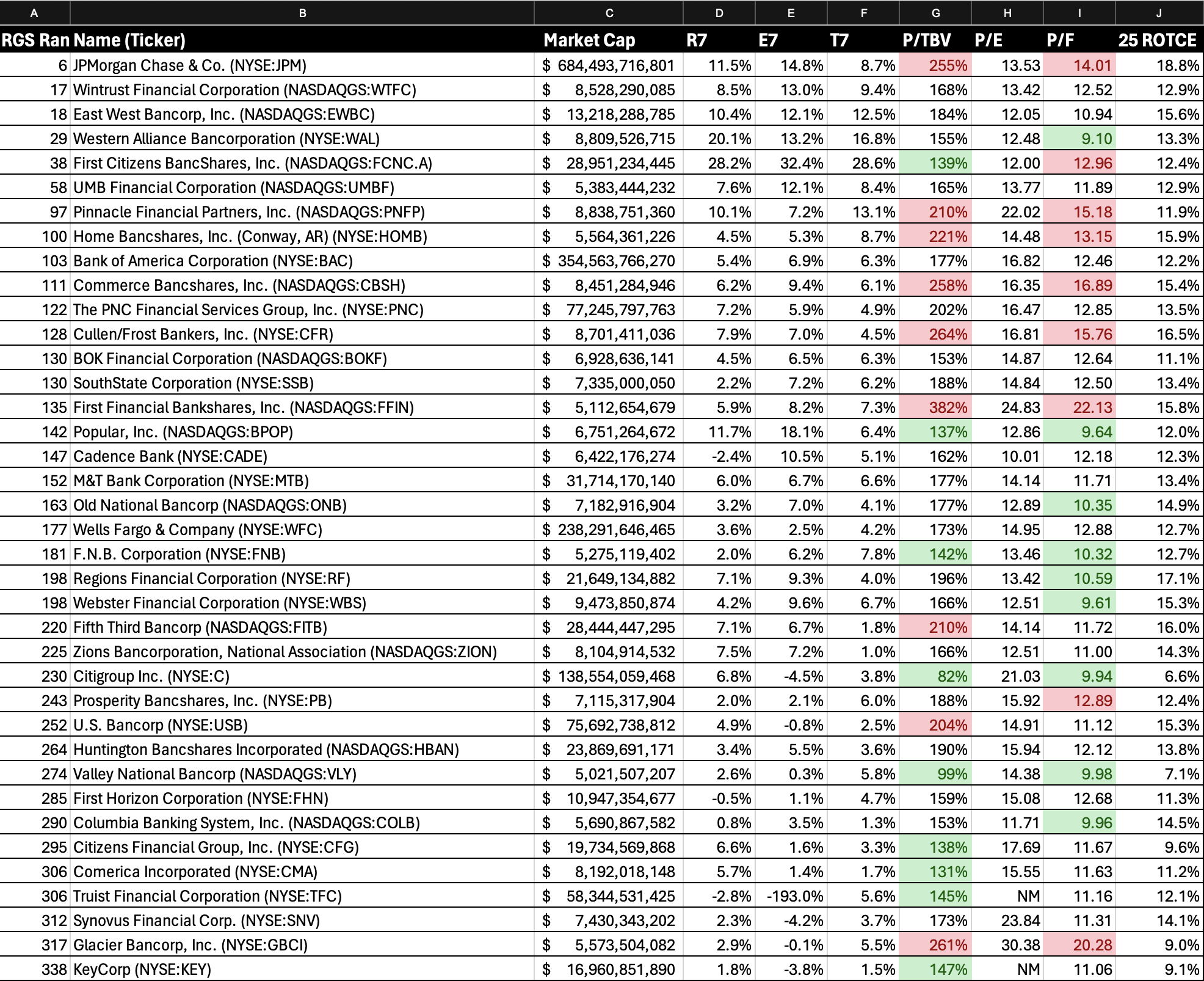
And when you look at the universe of banks larger than $5 billion in market cap, you also get a good sense of the fact that they’re fairly valued, but probably cheaply valued for the quality of returns and growth they’ve produced. All you have to do is look at the top of the list: JPM, EWBC, WAL, and FCNC.A are all top tier franchises that have produced above average returns to shareholders.
And looking purely at valuation next to the other $5 billion market cap plus banks, they are not top 25th percentile expensive on a P/Forwards or P/TBV basis (red) nor are they 25th percentile cheap on a P/Forwards or P/TBV basis (green). In fact, they’re kind of in the middle of the pack from a pricing standpoint. Or put differently, it’s a lot harder to buy JPM at 255% of TBV and 14x forwards or PNFP at 210% of book and 15x forwards. And they certainly have a less risky profile from a credit risk standpoint than some of the other “cheap” names like VLY, COLB, or WBS.
They Manage Balance Sheet Risk Well:
On the risk side, I’ll start with credit. They tend to not “overextend” themselves on credit, which is smart in a cyclical business-like banking. After learning more about Ed, it’s abundantly clear that this is not accidental and is instead cultural. What gives me the confidence to say this?
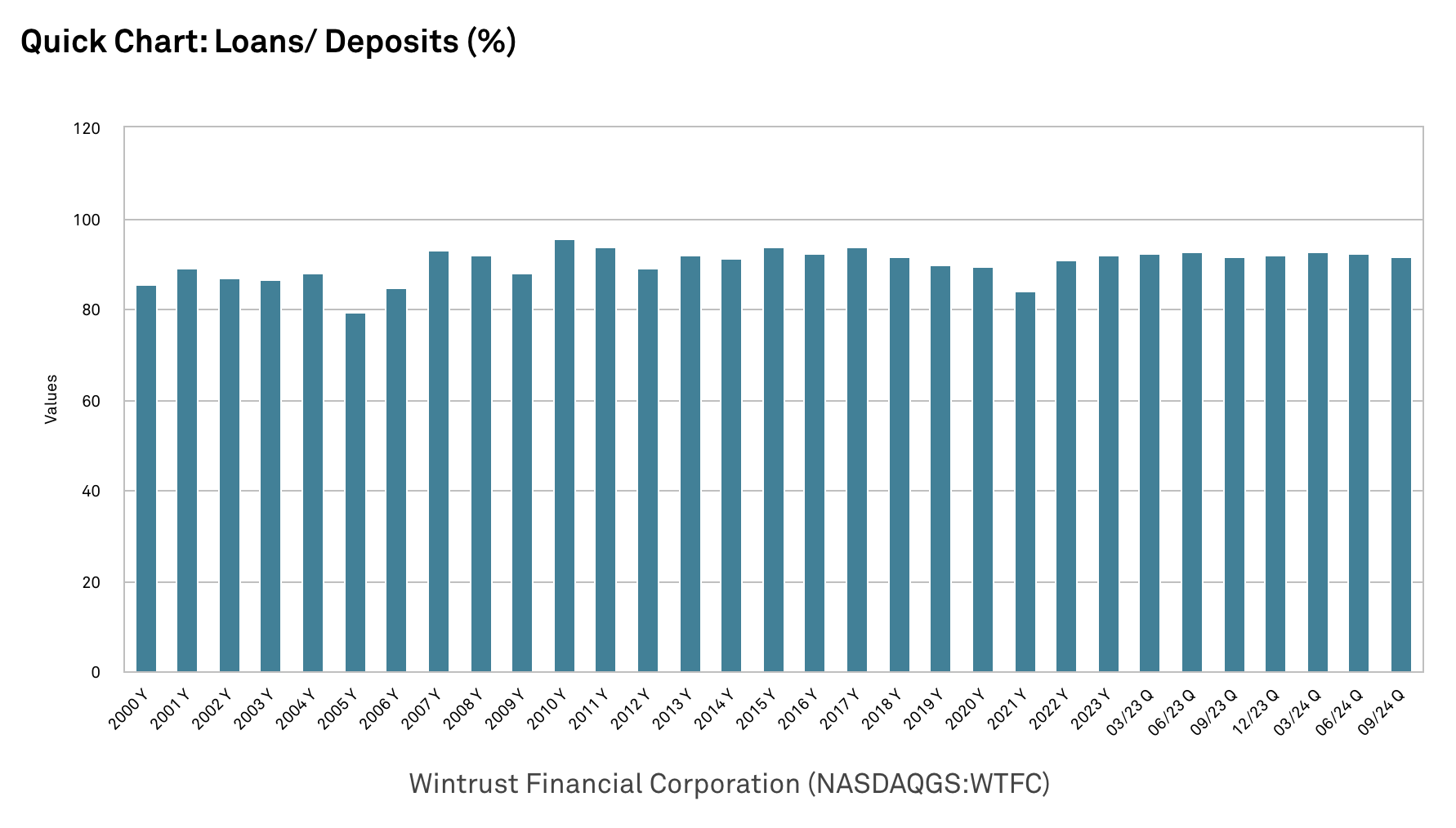
Well for starters, look at their Loan/Deposit ratio over time. The bank doesn’t feel the need to run hot on the loan side to juice returns. This is what the “bad growth banks” convince themselves of from time to time, that when times are good you have to grow. But running hot exposes banks to risks of rising rates and NIM squeezes (you can’t fund yourself), but also the cyclical swings of credit. With banks as you all know, it’s always credit. So to me, WTFC’s L/D ratio over time is a thing of beauty, stable and almost predictably flat in the mid 80s.
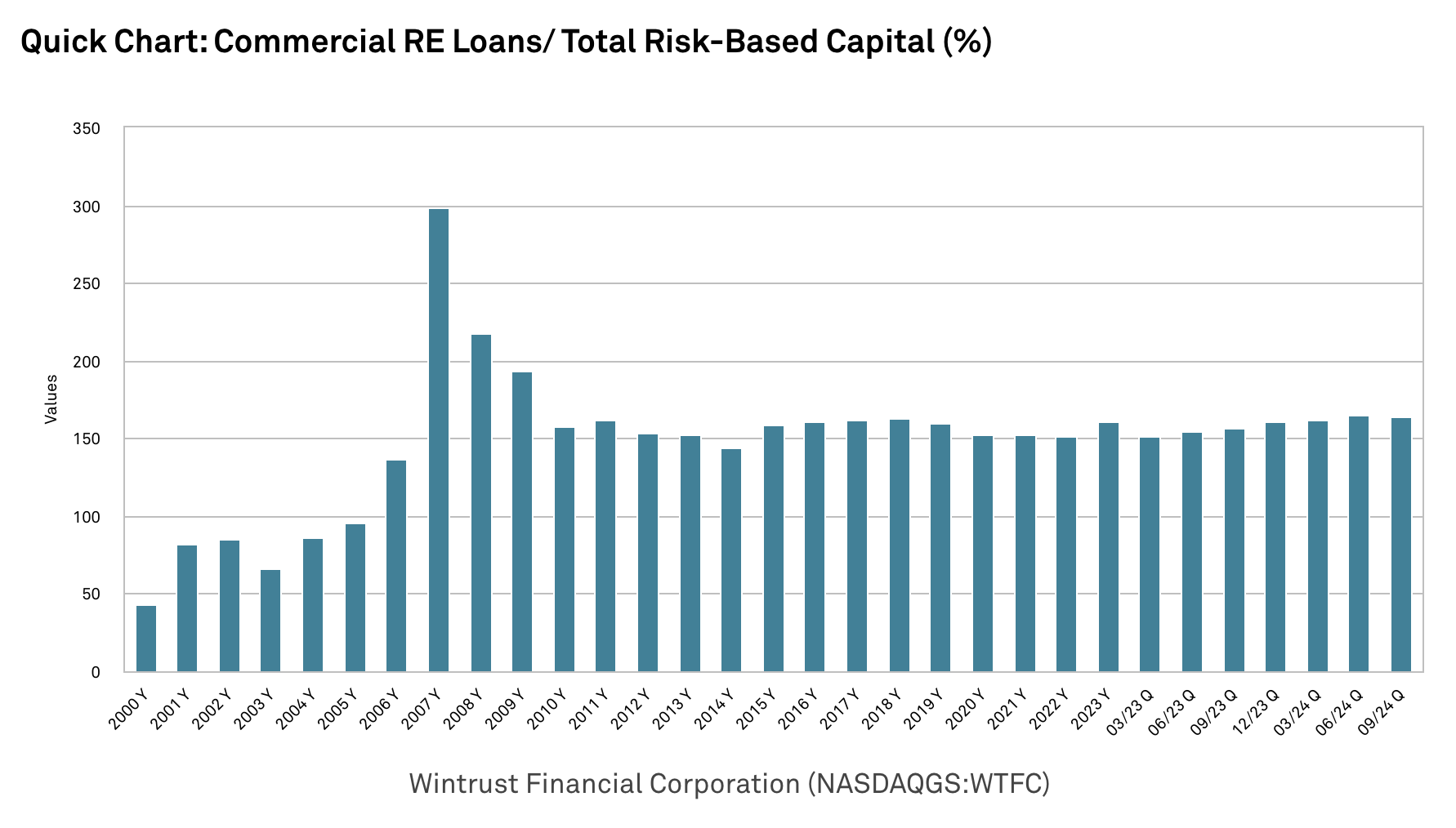
They’re also not overly exposed to the boogeyman of Commercial Real Estate. In sports they say that the greats only have to learn lessons once. And it appears as though WTFC learned this CRE lesson once going into the GFC and has never felt the need to run this book up ever again.
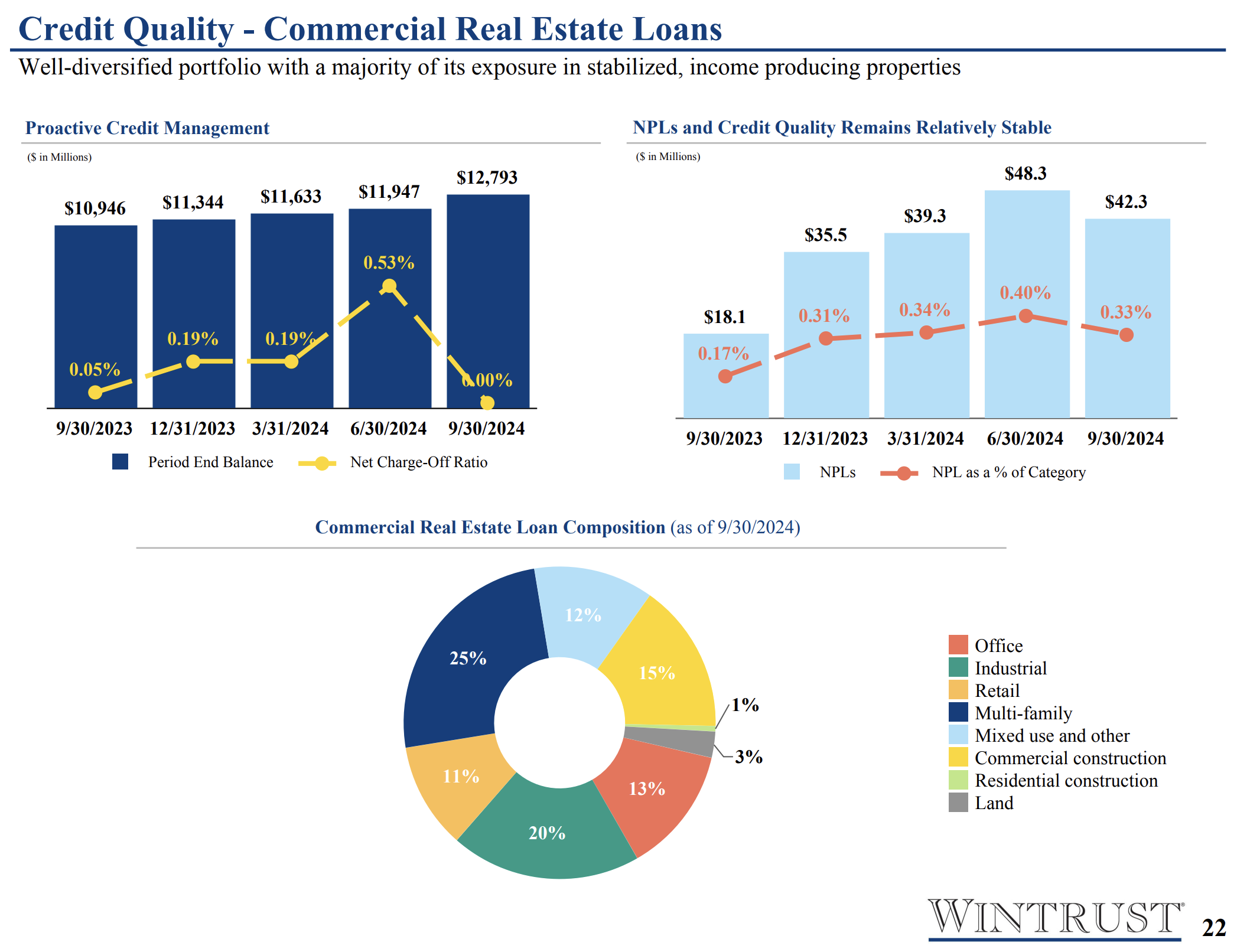
On top of that, prudent underwriting also appears to be a cultural or DNA trait of the bank. NPLs in CRE appear to be behaving (for now at least) and with limited concentrations investors don’t have to worry quite as much.
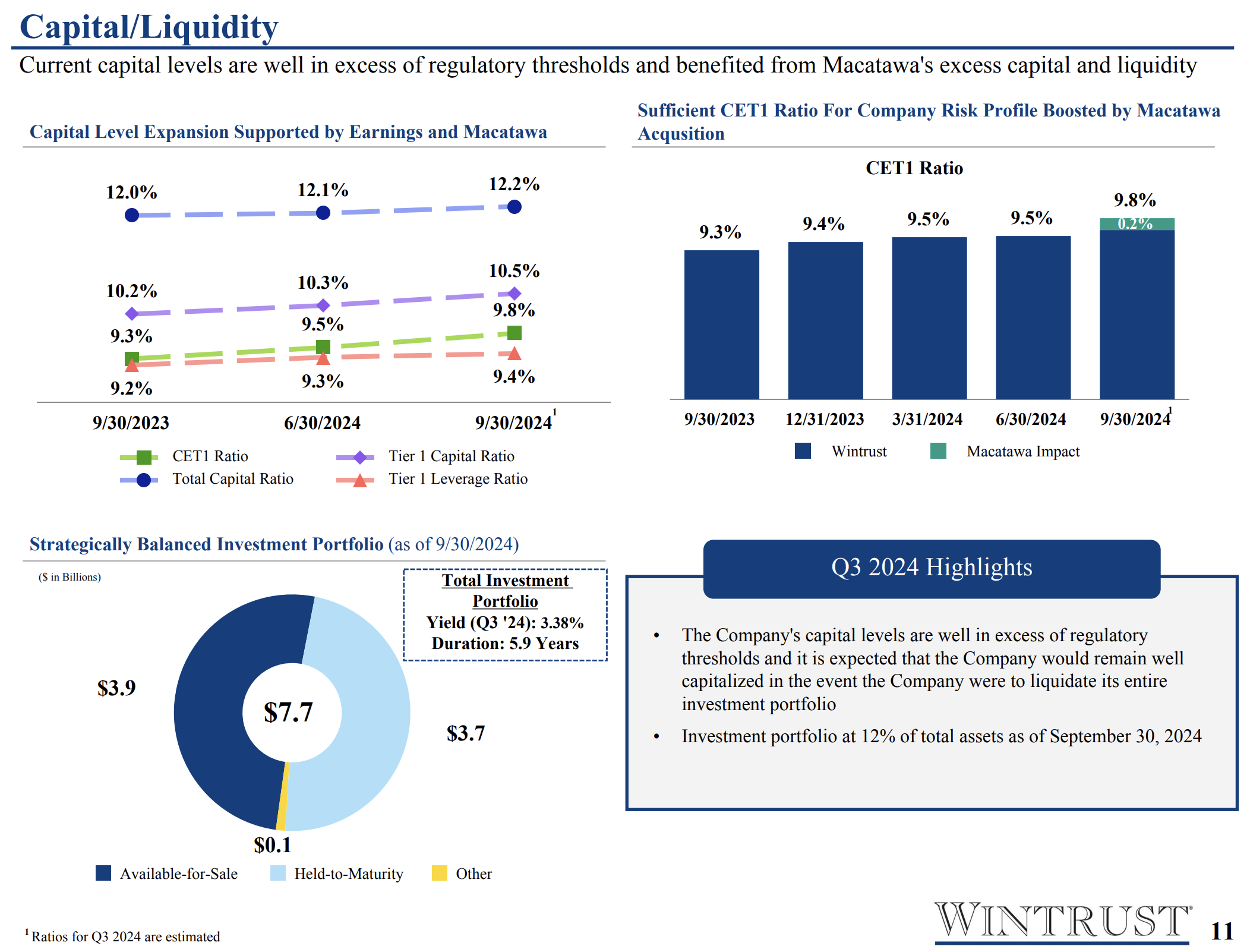
They do not have a big bond book, they have a good deposit base, and no major liquidity concerns. If anything, one could say they are thinner than most on CET1, but are building capital prudently.
How Could It All Go Wrong?
The bear rebuttal to me would be that they won’t be able to continue growing via M&A into the future or that credit could go wrong. The latter is the risk for all banks, that the economy and their loan book go bad.
Price Target?
With 18 months, Trump tailwinds, a strong U.S. economy, and continued operational excellence I’ll say they’re doing EPS just north of $11 a share, TBVPS just north of $98 a share and trading around $154 for 14x on a P/E basis and 157% on a P/TBV basis.
At any rate, I hope I’m wrong to the upside and appreciated learning more about Ed Wehmer, Tim Crane, the WTFC balance sheet, the culture, and most importantly that you can create a dynamite bank name at a bar over some beers and a game of darts.
Until next time,
Victaurs
PS: And I’m sorry but when this scene of a Midwestern bar plays in my head, this is what was there all along.

The research behind essays like this one lives in the Terminal: open Research. 107+ companies and counting.