The Math on Rocket: $5.8B Revenues, $40B Cap, and a $1.2T Rate Unlock
This one won’t be long, but wanted to get it out given the “buzz” about a name I know fairly well, Rocket Companies (RKT).
I’ve written up the name at length. Subscribers have made money on the long side, on the short side, on the long side on Mr. Cooper, and also enjoyed a take-out by Rocket on Mr. Cooper. So yes, if you are looking to learn about the name and to quote David Byrne, this must be the place.
I also dug up a Deutsche Chart that lays out total mortgage volume outstanding at each 50bps coupon level which is crucial for figuring out what Rocket’s go forward mortgage production could look like if the GSE’s cap on MBS holdings is lifted and spreads compress.
Let me get out of the way first the past write-ups on Rocket for new followers.
As opposed to droning on and regurgitating feel free to catch up on these for lot’s of deeper knowledge on the two companies.
Where are we at today?
Rocket has acquired Mr. Cooper for their servicing book, which is a great way to weather rates up and grow refi volumes as they use their industry leading recapture rate driven by AI and great UX. Basically once they’re in your mindshare, they tend to keep you as a client. They also acquired Redfin for a lead funnel and to diversify away from pure refis. My numbers have them at around 10% to 12% of the refi market in the US, but only 4% of purchase. So these two purchases take market from a refi pure play into a more balanced platform.
Current market cap is $40 billion with a $19.15 share price. Projected 2025 revenue is $5.8 billion. Consensus revenue estimates for 2026 are lofty at $7.8 billion with $1.8 billion in Q1, $1.9 billion in Q2, and $2 billion in Q3 and Q4 which to me says there is definitely some “rates down” drift to the base case. This puts the valuation on a market cap to revenue basis at around 6.9x trailing and 5.1x forward. The question of course is whether or not this is cheap or expensive.
Before getting to the meat of it, note that these acquisitions though will create some EPS messiness in Q3, which has been known for some time. Expenses will jump around $335 million in Q3 with $275 million in Redfin-related costs and $120 million tied to non-recurring items. They’re still targeting cost saves, but those aren’t a thing until Q4. So Q3 will look fugly from a EPS standpoint with inflection in Q4 and beyond.
These are very rough numbers but they’ll give you enough to go on.
Rocket does about 1 in 10 U.S. mortgages, which is for math geniuses like me about 10% of volumes. In refinances they’re 11% to 12% with a stretch goal of 20%. They make about 3% on gain on sale of originated loans (currently) and inclusive of servicing value and fees that number can go all the way up to 5%. Back of the napkin math says that given their $5.8 billion of revenue this implies they’re supporting around $120 billion to $180 billion of annual mortgage production. This math ties out with total mortgage market volumes of $1.5 trillion to $2 trillion.
Here now is the real info, this is a chart from Deutsche Bank estimating the amont of mortgage debt given various coupon rates. This is from 2024 FYI.
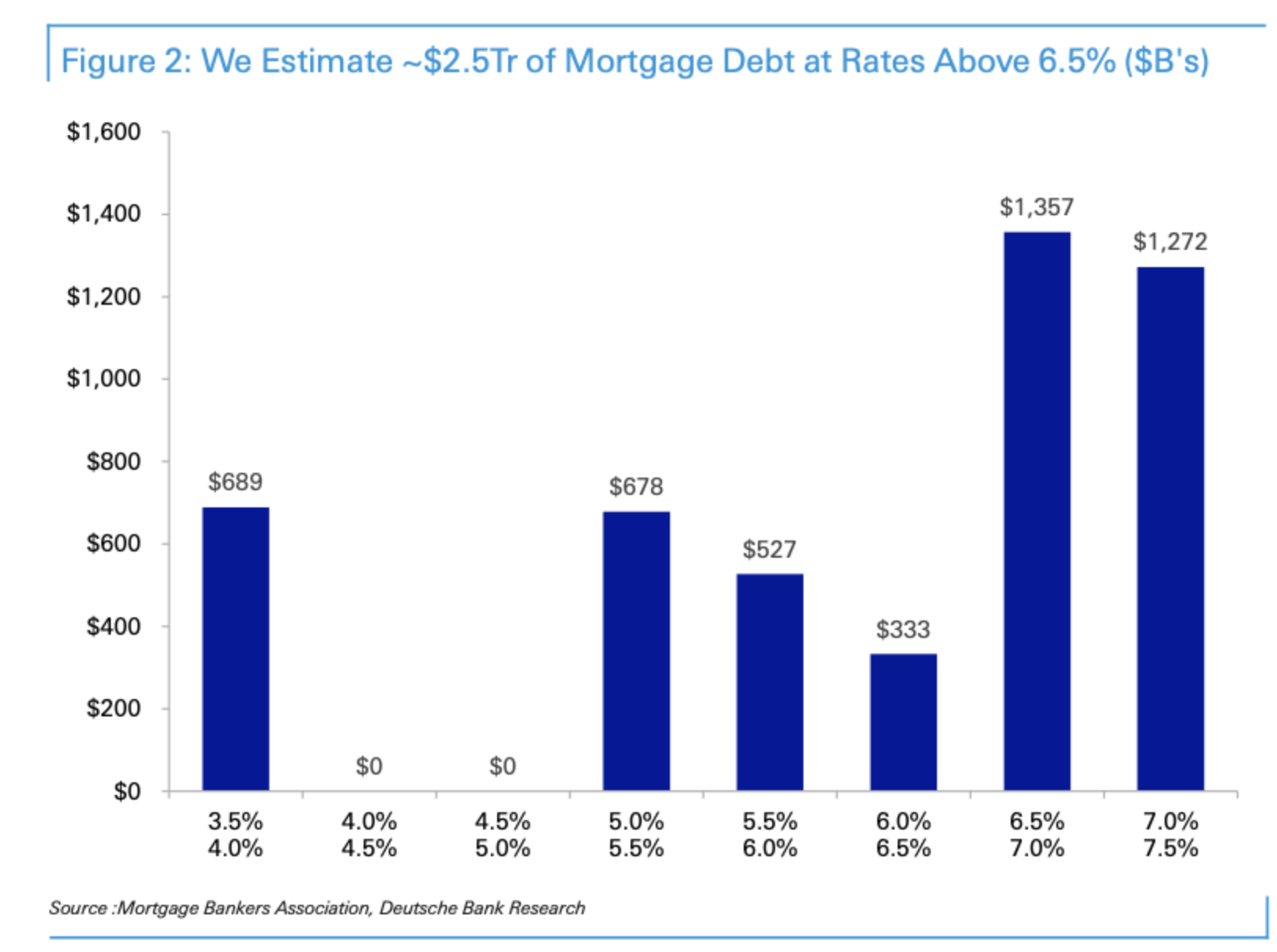
With mortgage rates at at 6.5% I’m assuming most if not all of the 7% to 7.5% bucket is already refi’d. I’m assuming that only 1/3 of the 6.5% to 7% bucket is left which may be wrong, but is a more conservative way to look at it. This means that there is about $425 billion of potential mortgage debt to refi in that coupon bucket, and then $333 billion at the next 6% to 6.5% bucket, $527 billion in the 5.5% to 6% bucket, and $678 billion in the 5% to 5.5% bucket.
Despite the fact that Pulte, Bessent, and Trump have all been pushing the Fed to lower rates, the long end of the curve has stubbornly stayed north of 4%. This has created a situation where the new thing is to talk about IPO’ing FNMA and FMCC and lifting the MBS purchase restriction as astutely noticed by Citrini. I too have written about this at length, noting that the only way to jam spreads tighter is to increase demand for MBS, which with the Fed doing QT and big banks not buying can only happen if the GSE purchase cap goes away.
For Rocket though the only thing that matters is not how it happens, just if it happens.
If somehow mortgage rates come down to 6% this unlocks a pool of $471 billion. At this rate level and with Rocket’s market share being held at 10% and at 3% margins gives us a potential revenue bump of $1.4 billion. Funny how this gets us to 12 month revenue of $7.2 billion and is just shy of 2026 estimates. If Rocket were to grow share to 20% and have 5% margins this booms to almost $4.7 billion and makes the thing look screamingly cheap.
If mortgage rates come down to 5.5% this unlocks a cumulative pool of $787 billion and holding the same low end base case of 10% share and 3% margins this gives us a low end extra revenue bump of $2.4 billion and in the high end more market share fatter margin world of $7.9 billion (both inclusive of the prior coupon group’s volume & revenue). Giving us forward revenue of $8.2 billion to $13.7 billion.
If they get all the way down to 5% this unlocks a cumulative pool of $1.19 trillion. And using the same math a low end extra $3.6 billion in extra revenue and upwards of $11.9 billion, which is pie in the sky but a logical boom case.
So there’s our math on Rocket’s upside potential.
Is it cheap? Is it expensive? That entirely depends on what you think happens to mortgage rates. Regardless of what happens this is a wonderful way to play mortgage rates. It’s always traded a little meme-y, which basically means people rush in when they think rates are going to fall. Smart people like Soros call it “reflexive” but it basically means that people front run future revenues and whip back out when they see rates back up.
We all know that Trump & his posse want mortgage rates down. They know the situation is bleak for the homebuying population. High rates, lack of supply, and all of the bad things. If somehow mortgage rates drift down to 6% and given current margins Rocket like gets $600 million short of 2026 estimates at $7.8 billion and not exactly cheap at 7x. But if you believe in a mortgage world of 5.5% and if you think Rocket can push capture rates and margins higher then revenues could be $10 billion to $15 billion which would make this look like a steal.
I do like it it here as part of a “rates down parallel” sleeve. If the long end stays up and the curve steepens, without spread compression it’s expensive. As I look at what I own I am exposed to this scenario so it makes sense at least with a piece of the portfolio. But make no mistakes, if rates stay high on the long end or the GSE MBS cap isn’t lifted, this thing will trade down. I’ll be looking at other players in the space but for now hope you enjoyed the knowledge.
And if you’re looking for a bank with a lot of mortgage exposure, check out Western Alliance. They purchased Amerihome in 2020 which is low to mid single digits of the mortgage volume world.
Rocket’s story is simple. Slick AI. Great UX. And it is a straight bet on mortgage rates. At 6.5% it looks expensive. At 6% it brushes up against consensus and feels rich to maybe fair depending on the retail masses opinions on future mortgage rates. But in 5.5% world at $19 a share and a $40 billion market cap this thing is a screaming bargain. And it’s also probably cheap if they grow market share to their audacious goals of 20%. And even though it wasn’t noted, in a world where gain on sale margins that will hurt so be mindful of that. Rocket is a fun one. A pure boom & bust play on mortgage rates. But at least now you know, and knowing as they say is half the battle.
Until next time,
Victaurs
The full RKT research, with the durability test and the verdict, lives in the Terminal: RKT research. 107+ companies and counting.